How Lokpobiri engineered stability in Bayelsa APC, paving way for Diri’s leadership
 SKAiF NewsNG SNN
By Nneamaka Okafor
In what has become one of the most closely watched political realignments in Nigeria’s South-South region, Bayelsa State has witnessed a strategic transition of power and party identity — anchored by seasoned political stewardship and a carefully managed reconciliation process within the All Progressives Congress (APC).
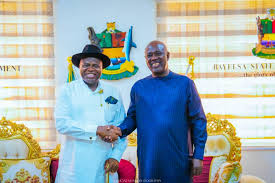
At the centre of this development is Senator Heineken Lokpobiri, Nigeria’s Minister of State for Petroleum Resources (Oil), whose influence and political dexterity have been instrumental in stabilising the APC in Bayelsa, managing internal party tensions, and creating a conducive environment for the defection and leadership consolidation of Governor Douye Diri.
A Political Climate Ripe for Change
Bayelsa has long been a stronghold of the Peoples Democratic Party (PDP), with a deep loyalty rooted in decades of electoral dominance. But the political landscape began shifting in 2025, as crackdowns on PDP loyalty surfaced amid growing disenchantment with the party’s internal strife. Governors, lawmakers, and senior political figures began signalling an openness to alternative platforms.
Governor Diri’s decision to resign from the PDP on October 15, 2025, marked a turning point. Although he did not immediately declare a new party affiliation, it was widely expected that he would join the APC — a move seen as aligning Bayelsa more closely with the ruling federal government and promising greater access to national developmental leverage.
Lokpobiri’s Quiet Leadership and Alignment with APC Strategy
Senator Lokpobiri, a veteran politician with deep roots in Bayelsa’s political theatre, emerged as a pivotal actor in this transition. Rather than stoking factional tensions — which have historically threatened the APC’s coherence in the state — he adopted an inclusive approach, advocating for unity and strategic patience among party stakeholders.
When Diri’s resignation from the PDP was publicly announced, Lokpobiri was among the first APC leaders to commend his decision and urge him to complete the transition by formally joining the ruling party. In a statement through his media office, the minister described the governor’s move as bold, patriotic, and aligned with Bayelsa’s long-term interests.
This endorsement was crucial: it helped reassure several APC factions — including supporters of former governor Timipre Sylva and other key leaders — that Diri’s entry would not displace established party interests but rather strengthen the APC’s local blueprint.
Managing Internal Tensions
Bayelsa APC hasn’t been without its internal challenges. At times, rivalries between key leaders — especially between supporters of Sylva and Lokpobiri — threatened unity, especially as negotiations around Diri’s entrance intensified. Reports noted that these tensions occasionally manifested as public disagreements over how to manage the party’s structural balance ahead of Diri’s defection.
thesouthernexaminer.com
Still, Lokpobiri’s ability to navigate such factional nuances without allowing divisions to widen into open conflict helped preserve APC’s operational effectiveness. While external commentators urged that Diri should work to unite these competing camps before defecting, Lokpobiri’s influence and strategic framing kept the broader party intact through the transition.
Independent Newspaper Nigeria
From Defection to Leadership
On November 3, 2025, Governor Douye Diri formally declared his allegiance to the APC at a high-profile ceremony in Yenagoa — an event that symbolised not just his personal realignment, but a broader political shift in Bayelsa. His decision was officially welcomed by party leadership, and national figures including the Vice President and other APC governors attended the ceremony.
President Bola Tinubu also publicly welcomed Diri into the APC fold, characterising the moment as one of unity and progress for both Bayelsa and the country.
Governor Diri himself stated that his decision was driven by a sincere interest in the development of Bayelsa, emphasising that aligning with the ruling party would unlock fresh opportunities for state projects and federal collaboration.
A New Political Equation
The combined efforts of Lokpobiri and Diri reveal a calculated political shift — one marked by negotiation, consensus-building, and strategic timing. Instead of resulting in upheaval, the defection created space for a more unified APC in Bayelsa, positioning the party to contest future elections with a stronger leadership profile.
As the state gears up for the 2027 general elections, APC in Bayelsa now boasts deeper political reach and growing grassroots acceptance — laying the groundwork not just for electoral victories, but for sustained governance partnerships between state and federal stakeholders.
The post How Lokpobiri engineered stability in Bayelsa APC, paving way for Diri’s leadership appeared first on Vanguard News.