Mayhem as NPA, tank farm owners, police, LASTMA lock down Oshodi-Apapa Expressway
 SKAiF NewsNG SNN
By Victor Ahiuma-Young, Olasunkanmi Akoni, Rosemary Iwunze, Providence Ayanfeoluwa, Efe Onodjae, Precious Enaike & Florencemary Nwabueze
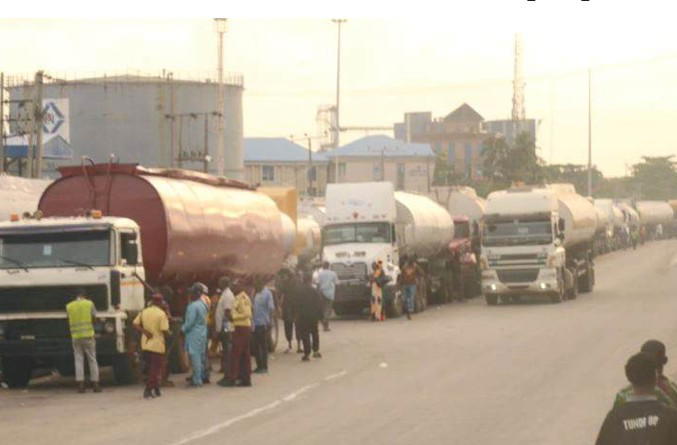
LAGOS — There was mayhem yesterday on the Oshodi-Apapa Expressway as negligence and lack of coordination by the Nigerian Ports Authority, NPA, the Police, the Lagos State Traffic Management Authority, LASTMA, and tank farm owners combined to lock down the Oshodi-Apapa Expressway, the major access road to the nation’s busiest seaports.
Consequently, thousands of commuters and motorists were trapped in one of the worst traffic nightmares witnessed in recent months after container-laden trucks and fuel tankers brought the Oshodi-Apapa Expressway to a standstill, triggering a fresh blame game among the NPA, tank farm owners, truck drivers and traffic management agencies over the persistent gridlock along the nation’s busiest port corridor
The gridlock, which crippled movement along the Mile 2-Berger Yard axis and adjoining routes, was worsened by the indiscriminate parking of trucks on both sides of the road and reckless driving by truck operators along the Mile 2-Tin Can corridor.
Motorists and commuters spent several hours on journeys that ordinarily would have taken less than one hour, while commercial transport operators lamented huge losses caused by the traffic paralysis.
Some motorists caught in the congestion told Vanguard they spent about two hours travelling from Fatgbems Filling Station to Berger Yard.
One of them said: “From Fatgbems Filling Station to Otto Wharf, I spent more than two hours. The slow movement is caused by tankers loading products at the tank farms.”
While some tanker drivers, PTD, blamed poor traffic management by the Lagos State Government, the NPA and the activities of independent tanker drivers, customs agents accused the NPA of failing to effectively manage port access roads.
Truck owners, on their part, blamed petroleum tankers for abandoning the designated single-lane arrangement, while Traffic Transit Point, TTP, managers of the electronic call-up platform, insisted that tankers are yet to be integrated into the system and therefore should not be linked to the current gridlock.
Residents, transport operators and businesses affected by the congestion also identified the commencement of operations at the new Kirikiri terminal, poor road infrastructure, inadequate traffic coordination, indiscriminate parking by tanker drivers and weak enforcement of traffic regulations as major factors responsible for the recurring crisis.
Despite the deployment of police officers, military personnel and LASTMA officials to the corridor, the gridlock persisted for several hours, with motorists, commuters and commercial operators bearing the brunt of the chaos.
Stakeholders maintained that unless truck movements are better coordinated, tank farm operations properly regulated, and all relevant agencies—including the NPA, Lagos State Government, security agencies, terminal operators and transport unions—work in unison, the Oshodi-Apapa Expressway and adjoining port corridors will continue to witness recurring traffic paralysis with severe economic consequences.
How the traffic nightmare began
Findings by Vanguard showed that the heavy gridlock along the Mile 2-Coconut Expressway was triggered by the inability of fuel-laden tankers to exit Shema, Integrated and Sahara tank farms by Westminster, before the Ibru jetty after access routes became blocked by empty tankers waiting to load petroleum products.
The situation worsened as scores of empty tankers parked indiscriminately along the corridor, obstructing entrances and exits to the depots and preventing loaded tankers from leaving.
Investigations further revealed that the recent decline in crude oil prices on the international market encouraged many tank farms that had previously been inactive to replenish their petroleum product stocks.
The increased availability of petroleum products along the Mile 2-Coconut corridor attracted a surge of tanker drivers, many of whom abandoned the Dangote Refinery route and diverted to the Mile 2-Coconut Expressway in search of loading opportunities.
Further findings indicated that the congestion originated from the Coconut axis, where hundreds of tankers besieged several tank farms in a bid to load fuel.
Entrances to tank farms, including Shema, Integrated and Sahara, were completely blocked by stationary tankers.
Many of the drivers had queued to load petroleum products but, after failing to secure clearance, ended up blocking sections of the road.
As the situation deteriorated, members of the Petroleum Tanker Drivers, PTD, arm of the Nigeria Union of Petroleum and Natural Gas Workers, NUPENG, task force moved in to clear the road, forcing several tankers to leave the queue.
However, many of the displaced vehicles simply relocated to the opposite side of the road, worsening the congestion and preventing loaded tankers from leaving the depots.
A member of the NUPENG task force, who spoke on condition of anonymity, told Vanguard:
“The traffic started around noon when empty tankers waiting to load were turned back because it was not yet their turn.
“Most of the tankers removed from the queue relocated to the opposite side of the Coconut-Mile 2 Road, obstructing vehicles and loaded tankers trying to exit the tank farms. As a result, movement became almost impossible, and the traffic stretched all the way to Mile 2.”
A tanker driver who had been on the queue since morning blamed the gridlock on indiscipline among some drivers.
Another driver also blamed the lack of coordination among road users.
“The major cause of the traffic congestion is the lack of coordination among road users. Everyone is trying to gain access to the tank farms at the same time, with little regard for traffic management or orderly movement. This has resulted in severe bottlenecks, prolonged delays and persistent gridlock along the corridor.
“Until there is better coordination, stricter traffic enforcement, and greater patience and cooperation among all stakeholders—including truck drivers, transport operators and traffic management officials—the congestion along the Tin Can corridor is likely to persist. Orderly queueing and strict adherence to traffic regulations are essential to achieving a lasting improvement in traffic flow.”
A PTD official, who also spoke on condition of anonymity, blamed the persistent gridlock on poor traffic management by the Lagos State Government and the Nigerian Ports Authority, NPA, as well as the indiscipline of truck drivers, particularly independent tanker operators.
He explained that many independent tanker drivers, who are not members of recognised unions such as PTD, park indiscriminately while waiting for marketers to engage them to lift petroleum products.
According to him: “At the moment, Lagos supplies about 95 per cent of the petroleum products consumed across the country, and the state is witnessing a massive influx of tankers. The Lagos State Government is aware of this situation and should have put in place a practical traffic management plan for the Oshodi-Apapa Expressway. Unfortunately, that has not happened, and it has led to the chaos we are witnessing around the tank farms, particularly between Westminster and Coconut Bus Stop, especially around Ibru Jetty.”
He also accused some jetty operators of worsening the traffic situation.
“Some of the jetty operators have not helped matters. The inflow and outflow of tankers are poorly managed, and some operators ignore basic traffic discipline and orderliness. There are also tanker drivers who operate independently and are not members of the PTD. They simply park indiscriminately wherever they find space while waiting for marketers to patronise them.”
The PTD official maintained that responsibility for maintaining order along the corridor rests primarily with the Nigerian Ports Authority and the jetty operators, stressing that effective coordination among all stakeholders remains the only lasting solution to the recurring traffic crisis.
NPA under fire
As the gridlock worsened, NPA came under renewed criticism over the persistent traffic congestion along the Apapa-Oshodi Expressway, with customs agents and truck owners accusing the authority of failing to effectively manage truck movements and port access roads.
The National Council of Managing Directors of Licensed Customs Agents, NCMDLCA, blamed the NPA for the recurring gridlock along the Tin Can Port corridor, saying the authority had failed in its responsibility to keep the port access routes free of obstruction.
Speaking with Vanguard, President of the council, Lucky Amiwero, said the roads affected by the congestion are designated port access routes under the management of the NPA and should be properly coordinated.
According to him, the authority is responsible for regulating activities along the port corridor to ensure the free flow of traffic.
The worsening gridlock has also sparked concern among truck owners, who said the traffic crisis is disrupting port operations, crippling businesses and increasing transportation costs.
The Association of Maritime Truck Owners, AMATO, said many businesses operating around the port corridor had either suspended operations or were struggling to survive because of the persistent congestion.
Speaking with Vanguard while trapped in traffic, the association’s General Secretary, Sani Mohammed, blamed petroleum tankers for worsening the situation.
According to him, many tankers have abandoned the designated single-lane arrangement and now occupy several lanes, preventing trucks and other motorists from accessing the Tin Can Port corridor.
“The gridlock has disrupted the supply chain and port operations, while commuters now spend several hours trying to move in and out of Apapa. Transport fares have also increased because commercial buses spend more time navigating the congestion,” he said.
Mohammed appealed to both the Federal Government and the Lagos State Government to urgently intervene and restore sanity to the port access roads.
Electronic call-up system not responsible — TTP
Responding to claims that the electronic call-up system had failed, the General Manager, Corporate and Strategic Communications of Traffic Transit Point (TTP), Nancy Nnamdi, clarified that petroleum tankers are not currently covered by the electronic call-up platform.
She explained that although TTP has consistently advocated the inclusion of tankers in the system, implementation depends on government approval and enforcement.
Nnamdi said discussions had been held on bringing tankers into the electronic call-up platform but stressed that the company lacks the authority to regulate tanker movements without the necessary government backing.
She maintained that the absence of enforcement has limited TTP’s ability to manage tanker traffic and insisted that the current gridlock should not be blamed on the electronic call-up system.
Meanwhile, the Nigerian Ports Authority said it was working with relevant stakeholders to address the traffic situation and restore normal vehicular movement along the Apapa port corridor.
Kirikiri terminal operations worsen crisis
The persistent truck congestion also brought the Kirikiri-Apapa corridor to a standstill, leaving thousands of commuters stranded, disrupting businesses and prompting renewed calls for urgent government intervention.
Residents, motorists and commercial drivers who spoke with Vanguard described the situation as one of the worst in recent years, blaming the worsening gridlock on the recent commencement of operations at a new terminal in Kirikiri, inadequate road infrastructure and poor traffic management.
The traffic nightmare, which has plagued the corridor for years, has intensified in recent weeks, crippling commercial activities and forcing motorists to spend hours on journeys that ordinarily take only a few minutes.
Police officers deployed to the area admitted that the situation had become increasingly difficult to manage.
One of the officers said: “This has been happening for years. We are doing our best to control the traffic from the UBA axis so people can move freely. The opening of a new terminal in Kirikiri has made the situation much worse. Traffic builds up as soon as operations begin in the morning, and we have been here since early today trying to control it.”
A commercial driver, Mr Captain Wes, also blamed the new terminal for worsening the congestion.
“Most of these trucks are heading to the new terminal. If you get there, you will see personnel of the Nigerian Navy and the Police controlling traffic. We don’t know exactly what is happening there, but the biggest victims are motorists who cannot get to their destinations,” he said.
Another motorist, Mr Chigozie, who had spent more than 50 minutes in traffic, lamented his ordeal.
“I joined this traffic from Mile 2 and have been here for almost an hour. Ever since the new terminal began operations, the situation has become unbearable. Had I known, I would have taken another route,” he said.
For commercial sand supplier, Mr Sunday, the gridlock translated into heavy financial losses.
“I was on my way to deliver sand when I got trapped here. Today alone, I have lost about N120,000 because of this traffic. Government must act quickly to address this problem,” he appealed.
Military personnel drafted to the area to assist with traffic control said they had been working without respite since July 1.
“We were deployed here on July 1 to help manage the traffic. Many drivers refuse to obey traffic instructions, making our work difficult. We have been here since morning and are exhausted,” two officers said.
The officers also identified poor road conditions and terminal operations as major contributors to the congestion.
“The roads are in poor condition, while some companies also contribute to the problem. Exodus Terminal has two exits, but AGL operates with only one access point. Trucks use the same route to enter and exit, worsening the congestion,” they explained.
The officers urged the government to regulate the number of trucks entering the terminals daily, saying such a measure would significantly ease the gridlock.
When Vanguard visited Africa Global Logistics (AGL), security personnel denied reporters access to the management and directed them to obtain reflective safety vests. However, when the reporters returned with the vests, they were informed that the management was unavailable.
Responding to the allegations, the Manager of Exodus Terminal, Mr Chidi, denied that his company was solely responsible for the traffic crisis.
“It is not only our terminal contributing to the congestion. Other terminals, including AGL, also operate here. We currently receive most of the empty containers because some other terminals are no longer functioning, which has increased traffic around our facility,” he said.
According to him, Exodus Terminal operates two access points—one for incoming trucks and another for outgoing vehicles—to ease traffic flow.
He also called for sustained traffic enforcement.
“We want the military and the police to continue controlling traffic. Trucks should be restricted to one lane to allow other vehicles to move freely. Although LASMA, the Navy and the Police are on the road, more coordinated traffic management is still needed,” he said.
With businesses counting losses, commuters stranded for hours and security and traffic officials struggling to maintain order, stakeholders insisted that only coordinated government action and stricter regulation of truck movements would restore normalcy to one of Nigeria’s busiest transport corridors.
LASTMA moves in as Lagos blames corruption, tank farms
In a bid to restore normalcy, officials of the Lagos State Traffic Management Authority (LASTMA) later evacuated several trucks obstructing the Oshodi-Apapa Expressway.
The General Manager of LASTMA, Peter Gbemende, said the agency had deployed additional personnel to the affected corridor and engaged the management of tank farms to ensure that the road remained free of obstruction or face sanctions.
According to him: “We have deployed our officers to the area and also engaged the leadership of the tank terminals on the need to keep the corridor clear or face severe consequences and sanctions.
“Preliminary investigations revealed that the indiscriminate parking is linked to activities at the tank farms, which are currently overwhelmed by the high influx of tankers.
“The backlog created by this process has resulted in indiscriminate parking. We are on top of the situation, and necessary actions are being taken to restore order,” he said.
The few LASTMA officials deployed to the area were apparently overwhelmed as truck drivers had a field day.
Joint efforts by LASTMA officials and the Police eventually cleared the gridlock at about 8 p.m
The intervention came after hours of traffic paralysis that left thousands of commuters stranded, disrupted businesses and crippled movement along the Mile 2-Tin Can-Apapa corridor.
As of press time, the Lagos State Commissioner for Transportation, Mr Oluwaseun Osiyemi, had yet to comment on the development.
However, the Special Assistant to the Governor on Transportation and Logistics, Comrade Hassan Adekoya, attributed the persistent gridlock to what he described as deep-rooted corruption along the Apapa port access roads.
According to him, the traffic crisis has become entrenched over the years and will continue unless comprehensive and decisive measures are implemented to address the underlying causes.
The latest traffic nightmare has once again exposed the lingering challenges associated with truck movements around Lagos ports, despite repeated interventions by government agencies and stakeholders.
The post Mayhem as NPA, tank farm owners, police, LASTMA lock down Oshodi-Apapa Expressway appeared first on Vanguard News.