From abundance to scarcity: How climate change is hurting Nigerian farmers
 SKAiF NewsNG SNN
By Juliet Umeh
At Ajah bus stop in Lagos island, the smoke from Mrs. Nkiruka Ekeh’s charcoal grill rises slowly into the heavy afternoon air, curling above rows of half-roasted corn.
She turns each cob carefully, as if willing it not to burn, not to waste. A young man stops, glances, and asks for the price. “N700,” she replies.
He hesitates, shakes his head, and walks away. Ekeh watches him go, then sighs. In a friendly chat with Vanguard, she said: “Before, I would have sold everything before evening. Now, people look, ask, and leave. She lifted one cob, inspecting it. “Now, a proper, healthy corn is from N500 now. If it is less than that, it is either too small or not good,” she added.
For her, the price is not a choice. “It is no longer about profit,” she explains. “It is survival. We buy it high. Before, a bag of corn was less than N20, 000. Now, it has doubled in some places. Farmers say the harvest is poor. The rain did not come on time, or it stopped too early, I really don’t know which one,” Ekeh said.
What was once one of Nigeria’s simplest pleasures, roasted corn eaten casually by the roadside, is quietly slipping out of reach. When the seasons stopped making sense
In Ogun State farms, one of the farms where Nigeria’s food system begins, the problem is already deeply felt. For a farmer, Mrs. Ekaitte Gorden, who plants cassava, maize and Ofada rice on about seven acres of land, the seasons used to be predictable because rain would come and crops would grow and then harvest would follow.
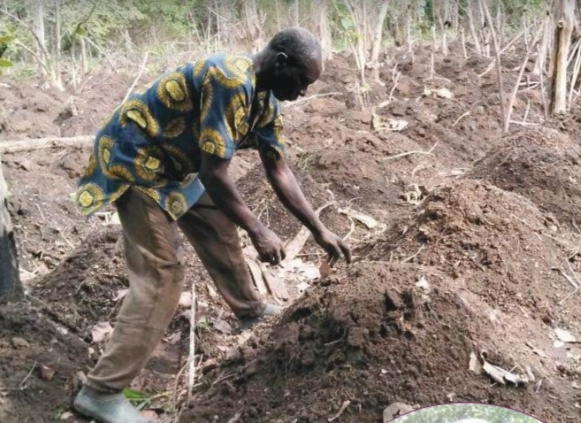
Gorden said: “In recent years, that rhythm has broken and the consequences have been devastating. In fact, 2025 was a disaster. It was the hottest year I have ever experienced. Farm production was a disaster. My losses are measured not in percentages, but in land. “I had an issue with my Ofada rice farm. My five acres of Ofada rice dried up completely. The climate has been hectic. Even my maize in the farm dried. My cassava struggled and my cucumbers could not survive. The problem discouraged me, so I didn’t plant Ofada rice this year,” she said quietly.
The problem, she explains, is not just less rain, but uncertainty. “Before, you could plan. Now, you cannot. The rains come late, or they come at the wrong time.”
With nothing to harvest, she abandoned planting and turned to processing poultry and fish, buying from others just to survive.
In Ewekoro, Ogun State, another farmer, Felicia Okotie, spoke about the same disruption.
Okotie, a member of the Small-scale Women Farmers Organisation in Nigeria, SWOFON, has about three acres of land where she plants yam, maize and cassava. She also deals on livestock.
She narrated: “The rain no longer comes when we expect it. This year, we are already having delayed planting. You cannot plant when you are not sure when the next rain will come. If there is no rain, we create our own water, but fuel, labour, everything is expensive. The heat has been too much and it keeps getting worse every year.
“2023 was better, and now when you compare 2025 and 2026, it is even worse. The weather is becoming too harsh for farming. The uncertainty has turned every decision into a gambling.”
Explaining why food is expensive in the market, she said: “So what we have done on the farm now is to introduce sprinklers. Where there’s no rain, we now use a sprinkler. It is expensive to use it effectively, so our costs are now higher.
Another thing, it’s now increasing the cost of production because I have to pump all the time, I don’t have access to rivers close to my own farm. So we have to pump water all the time. So, the cost of buying petrol alone has also now increased. “In fact, I told my farmers that the likelihood of making profits on those yams and maize this year is really very slim,” she said.
As a way of intervention, she said: “The Federal government needs to assist us in the area of equipment. Some of us do value addition and reprocessing, and we require this modern-day kind of equipment, some of these things are too expensive, even if we have to pay at subsidised rates, that will help” she appealed.
From abundance to scarcity
In Oyo State, where maize once grew reliably, the decline is stark. When Vanguard visited his farm settlement in Pago/Odo Ooto, in Iseyin Local Government Area, Azeez Ismail, a farmer of over 30 years on the job, recalled better years. The average old man who farms with his two wives and four children said his 30 acres of farmland was given to him by his father. He plants maize, cassava, yam, pepper. Ismail said: “Many years ago, rain was very constant and farming was very profitable. We were all very happy. But over the last three years, rainfall has not been constant. “There was a time when I harvested 200 bags. Now, we don’t even get 50. In 2024, I harvested 30 bags and in 2025 my harvest was just 12 bags.
Yet our costs keep rising. The money we spend, we don’t recover. “For one acre of land, the tractor is paid N30,000 to cultivate the land with other expenses such as money for drugs, labourers and all expenses.
“As for Cassava, we sell it in trucks. In 2024, we sold a truck load of cassava between N500,000 to N600,000. So, the person who harvested it would collect N20,000, the people who would carry it to the truck would collect N10,000 each. So, if we sold a truck for N500,000, at the end of the day we would be left with between N200,000 and N400,000 for the farmer.
But in 2025, a truck load of cassava was sold for N100,000, the truck driver collected N50,000, the person who harvested was paid N20,000, the person who carried it had N10,000 and we were left with N20,000 for a labour of two years,” Isamil explained.
Near the Ismail farm settlement was 38-years-old Muhammad Abu. Originally from Kwara State, but Abu has settled in Iseyin with his two wives and seven children for farming,
He said he has delayed planting entirely in 2026 already due to delayed rain. Abu said: “We are still waiting for rain to start planting in my five acres of land. I plant cassava, and maize. Without it, there is nothing we can do.”
As for Abdullahi Lawal, a 28-year-old from Kaduna, who has settled in Oyo for his farming business, with his wife and four children, the drop-in yield is even more severe.
Lawal narrated: “I plant rice on 10 acres, maize on 12 acres. I also plant guinea corn, cassava and yam. Where we used to harvest 10 bags, now we get two or three,” he explained.
“So, for over two years now, there has not been any profit because of lack of rainfall. Where we used to harvest 10 bags now we harvest just two to three bags
I used to listen to weather predictions. Sometimes when they say, “it would rain, it doesn’t rain.”
As for support from the government, “If we can get maize and rice that has a very short yield timeframe, so that we can cultivate and harvest it quickly before it stops raining, that will be good. We also need fertilizer that will help improve the soil for a better yield,” he requested.
Explaining the impact of the hot weather in the north, the Tomatoes Section Secretary at Mile 12 market Lagos, Mr. Suleiman Dandawa, who is a dealer and a farmer too said: “During tomato season, a truck can take up to 350, 369 or 380 baskets but by now that there are no tomatoes the truck will carry 160,179, 200 baskets.
“You know during Harmattan, tomatoes don’t get spoiled, so many farmers plant tomatoes then but now that it is very hot, farmers are afraid to plant tomatoes because of problems with fertilizer, insecticides, insecurity, and the sun is very high now.
The consequences of weather disruptions ripple outward, from farms to markets, and ultimately to consumers like those walking past Ekeh’s stand.
The science behind the scarcity
The changes farmers describe are not isolated. The World Meteorological Organization, in its State of the Global Climate 2024 report released on March 19, 2025, confirmed that the past decade has been the hottest on record, with recent years ranking among the warmest ever observed.
Explaining what this means for Nigeria, Prof. Ilemobayo Oguntimehin, an environmental dynamics expert, said the effects are already visible.
“When greenhouse gases build up, they act like a blanket,” he explains. “Heat comes in, but it cannot escape. That is why temperatures are rising.”
The impact on agriculture is direct. “We now see delayed onset of rainfall and early cessation,” he said. “For maize, just a one-degree rise in temperature can reduce yield by about 10 percent.”
That single shift, barely noticeable in daily life, can wipe out entire harvests. Beyond economics, the crisis is reshaping lives negatively.
“When agricultural conditions worsen, you begin to see migration, pressure on cities, even security challenges,” Oguntimehin warned.
A chain reaction from sky to plate of food
What begins as heat in the atmosphere ends up on the dinner table. For instance, erratic rainfall leads to crop failure. Crop failure reduces supply. Reduced supply drives up prices and higher prices force families to eat less. For many Nigerians, that chain reaction is already playing out.
“I hardly eat corn these days,” says Chinedu Chigbo, a Lagos resident and a corn lover. “Even when I buy one, I just eat it quietly.”
Food, stability, and national risk
Experts warn that the implications go far beyond rising food prices. Speaking at a recent economic discourse, the Food and Agriculture Organization’s representative in Nigeria, Hussein Gadain, framed the issue in broader terms. “Food security is far more than an agricultural outcome,” he said. “It is a pillar of national security, economic stability, and social cohesion.”
According to him, “shocks to agriculture, whether from climate change or conflict, quickly translate into poverty, malnutrition, and rising social tension.
“In Nigeria, where millions depend on farming for survival, the risks are amplified. Agriculture contributes over 20 percent to GDP and employs more than 60 percent of the labour force.”
Also, the Minister of Agriculture and Food Security, Senator Abubakar Kyari at Vanguard Economic Discourse, admitted: “When agriculture struggles, the entire economy feels it.”
A system under pressure
The Minister acknowledges that the sector is under strain. He said: “The sector faces challenges ranging from climate shocks to rising production costs, financing gaps, and infrastructure deficits.”
These pressures are affecting food availability, affordability, and stability. Across the country, farmers are delaying planting, reducing output, or abandoning crops altogether.
The result is visible in markets, and in the rising cost of everyday foods.
Signs of recovery, but uneven
Despite the crisis, the government insists progress is being made. “Food prices of essential commodities have dropped by up to 15 percent,” Kyari said.
“For the first time in a decade, food inflation dropped below 10 percent earlier this year.”
He noted the interventions include: Distribution of over two million bags of fertiliser, support for more than 622,000 farmers, yield increases of up to 30 percent in some areas.
“These are indicators of a system gradually stabilising,” he said. Yet, on the ground, farmers remain cautious. Gorden, Okotie, Abu, Isimal told Vanguard, “Fertiliser is still expensive, mechanisation is limited and most of us rely on manual labour because we can’t afford tractors.”
Without sustained support, they warn, recovery may be fragile. Climate stress is no longer just an environmental issue, it is a social and economic one. For millions of Nigerians, it is also deeply personal.
The post From abundance to scarcity: How climate change is hurting Nigerian farmers appeared first on Vanguard News.