BADAGRY-SOKOTO SUPERHIGHWAY: Outcry as over 300 houses, investments, others destroyed due to setback confusion
 SKAiF NewsNG SNN
…Say they lost ancestors’ graves, inheritance, businesses worth billions
…’Compensation not sure’
…FG denies realignment claim
…Ogun govt washes hands off exercise
By Nnamdi Ojiego
More than 300 houses in Atan-Ota in Ado-Odo/Ota Local Government Area of Ogun State were destroyed after residents allegedly acted on setback markings that were later altered for the Badagry-Sokoto Superhighway project.
Affected residents told Sunday Vanguard they removed roofs, doors, windows and other valuable building materials after officials marked their properties for demolition, only to discover later that some of the buildings they had dismantled were no longer within the construction corridor, while other structures previously untouched became affected.
The Federal Ministry of Works, however, rejected the allegation, insisting that the highway alignment has remained unchanged from the outset.
The ministry also disclosed that compensation for affected property owners could commence before the end of the month, while Ogun State government maintained that compensation is the responsibility of the Federal Government because the road is a federal project.
A visit by Sunday Vanguard to Atan-Ota revealed rows of half-demolished buildings stretching along the proposed highway corridor.
Some houses stand without roofs, while others have broken walls and empty window frames after owners hurriedly stripped them of valuable materials.
In many compounds, stacks of roofing sheets, doors and iron rods remain neatly piled, waiting for compensation that has yet to arriveResidents insist they are not opposed to the Federal Government’s ambitious highway project, one of four Legacy Projects expected to transform transportation and trade across the country.
Their grievance, they say, is with what they describe as conflicting setback measurements that left many families counting losses in billions of Naira they believe could have been avoided.
“We supported the project from the beginning,” a community leader told Sunday Vanguard.
“Nobody here said government should not build the road. What pains us is that many people destroyed their own houses because they believed what government officials told them. Today, some of those buildings are no longer even within the area they say they need.”
How the ordeal began
Residents said officials of the Federal Ministry of Works and contractors handling the highway visited Atan-Atan three times to identify structures that would fall within the project’s right-of-way.
According to them, the final visit came in November 2025, when residents were informed that demolition would commence on January 1, 2026, and they were advised to take their valuables.
The announcement triggered a race against time.
Families hurriedly removed roofing sheets, ceiling boards, aluminium windows, burglaryproofs, plumbing fittings and electrical installations in a desperate effort to salvage materials before bulldozers arrived.
Some even demolished parts of their own buildings so that concrete blocks and reinforcement rods could be recovered for future use.
“We had no choice,” one resident recalled.
“Once government tells you your house will be demolished, you try to save whatever you can.”
Another homeowner said he spent hundreds of thousands of naira employing labourers to dismantle sections of his building.
“I believed demolition was certain,” he said. ”I thought it was better to remove the materials myself than allow heavy machines to destroy everything.”
The setback controversy
Residents said what followed remains the most painful aspect of the entire exercise.
According to several property owners interviewed by Sunday Vanguard, officials later returned to carry out another round of measurements.
They alleged that the setback no longer corresponded with the earlier markings that had informed their decision to dismantle parts of their buildings.
Some houses that had already been stripped of roofs and fittings, they claimed, were no longer within the construction corridor, while other structures that had initially escaped the markings suddenly became affected.
“It was difficult to understand,” one landlord said as he pointed to his roofless building.
”They first marked this place. We obeyed them and removed the roof, doors and everything inside. Later they measured again and the line was no longer where it used to be.”
He paused briefly before adding: ”It felt as if we destroyed our own house for nothing.”
Heavy cost
Another elderly resident, whose family compound has stood in Atan-Ota for decades, said obedience to government directives had come at a heavy cost.
“We did not argue with anybody,” he said. ”When they said demolition was coming, we believed them. We removed the roof because we thought the house would soon come down.”
Looking at the cracked walls that remain, he shook his head in regret. ”If we had known this would happen, would anybody willingly destroy his own property?”
The allegation has become the defining issue in the community.
Although individual experiences differ, many residents insist they acted based on the original markings and only realised much later that some of the buildings they had dismantled no longer appeared to fall within the final construction corridor.
History lost
Beyond the physical destruction, many residents say the exercise has left deep emotional wounds.
Several families told Sunday Vanguard that the affected compounds were inherited from parents and grandparents who had lived in Atan for generations.
“Our fathers built these houses,” one resident said. ”Our grandfathers lived here before us. This is family property.”
Another added: ”You can build another house, but you cannot replace ancestral land.”
Some homeowners have moved into rented accommodation, while others continue to occupy partially dismantled buildings because they have nowhere else to go.
Residents estimate that more than 1,000 structures, estimated at billions of Naira, have been affected by the project in Atan-Ota and neighbouring communities, including homes, schools, hotels, churches, mosques, shopping plazas and petrol filling stations.
Sunday Vanguard observed that several commercial buildings now stand abandoned, while business owners continue to count their losses.
The owner of a shopping complex that once housed more than 20 lock-up shops said the project had wiped out years of investment.
“I have lost everything. This place was my retirement plan. I spent years developing it and now there is nothing”
He added that many of his former tenants had dispersed to neighbouring communities, while others had shut down completely.
“The shops were feeding many families. It was not only the landlord that suffered.”
For residents, the uncertainty surrounding compensation has made the losses even harder to bear.
Many believe that had the alleged setback confusion not occurred, some of the destruction could have been avoided.
As the debate over what truly happened continues, the people of Atan remain caught between the promise of a transformative national project and the painful reality of rebuilding lives that have already been upended.
Beyond family house
For one middle-aged woman, the loss goes beyond bricks and mortar.
Before the demolition exercise, she ran a modest fast-food business that had become a familiar stop for motorists, traders and residents.
The proceeds kept her household afloat, paid her children’s school fees and provided daily meals for the family.
Today, both the restaurant and part of her family house are gone.
Speaking in Yoruba, she recalled how officials marked the property and warned residents that demolition would begin in January 2026.
“We accepted it because we believed it was for development,” she said. ”They told us demolition would start soon, so we removed our roof, doors and windows to save whatever we could.”
Like many others, she believed compensation would follow shortly after the demolition notice.
Instead, months have passed without any payment.
“My restaurant fed my family,” she said.
“Today, there is no restaurant, no compensation and we are paying rent elsewhere while trying to start life all over again.”
Despite her ordeal, she insisted she was not opposed to the highway.
“If the road will help Nigeria, we are happy,” she said. ”We only want government to treat us fairly.”
Relocation of ancestral graves
For some families, the greatest loss cannot be measured in monetary terms.
Residents told Sunday Vanguard that several ancestral graves located within affected family compounds had to be exhumed before demolition commenced.
Many of the compounds had remained in the same families for generations, with deceased parents and grandparents buried within the homesteads in keeping with tradition.
One resident estimated that more than 100 graves were relocated across the community. ”It was one of the hardest things we have ever done,” she said. ”Our parents had rested there for decades. We never imagined we would one day have to move them.”
Her voice faltered as she reflected on the experience.
“You can rebuild a house. You can reopen a shop. But when you disturb the graves of your ancestors, that pain remains forever”, she told Sunday Vanguard.
To many families, the exercise represented more than the loss of buildings.
It disrupted family history and severed a connection with generations past.
Churches, mosques also affected
Religious institutions have not been spared. Residents said churches and mosques that had served the community for decades also fell within the project’s right-of-way.
Some lost entire buildings, while others surrendered substantial portions of their premises.
One church elder likened the experience to the fall of a giant Iroko tree.
“When a giant Iroko tree falls, every bird nesting on it scatters,” he said.
“That is exactly what happened to our church.”
The congregation has since moved to a temporary worship centre while members struggle to raise funds for a new permanent building.
“It was more than a church building,” he said.
“It was where generations worshipped, celebrated marriages, dedicated children and gathered in difficult times.”
Residents said several mosques also suffered similar disruptions, forcing worshippers to improvise while plans for relocation continue.
Businesses count the cost
The economic impact extends far beyond homeowners. Residents estimate that more than 10 filling stations, about 20 shopping plazas and at least 15 churches and mosques have either been partially or completely affected by the project.
Mechanics, welders, vulcanisers, food vendors and petty traders who once depended on roadside traffic have relocated or shut down altogether.
The closure of shopping plazas has also forced residents to travel farther for basic necessities, while landlords have lost rental income and apprentices have been displaced.
“The buildings were not just houses,” one resident said.
“They were our means of livelihood. When the buildings disappeared, many people’s income disappeared with them.”
Waiting for compensation
If there is one issue that unites almost every affected resident, it is the uncertainty surrounding compensation.
Several property owners recalled that officials visited months ago to document their names, telephone numbers and bank account details, creating the impression that payment would soon follow.
Among them is Mr. Kalejaye, manager of one of the affected hotels.
“They collected our names, telephone numbers and bank details,” he told Sunday Vanguard.
“Eight months later, nobody has contacted us. We don’t even know where we stand.”
The prolonged silence, he said, has fuelled fears that compensation may never come. For many families, the delay has deepened financial hardship.
Some borrowed heavily to build their homes and businesses and now struggle to repay loans while living in rented accommodation. Others have exhausted their savings trying to restart businesses destroyed by the project. Yet, despite their frustrations, residents insist they are not asking government to abandon the highway.
“We are not against development,” one resident said.
“We are only asking government to remember the people whose lives have been turned upside down.”
FG rejects setback claims
When contacted, the Engineers’ Representative for the project from the Federal Ministry of Works, Aliu Oyewande, rejected allegations that the setback had been altered after residents dismantled their buildings.
According to him, the project has followed the same alignment from the beginning.
“We didn’t change alignments,” he said.
“The alignment we are using today is the same alignment we started with.”
Oyewande also dismissed suggestions that compensation had stalled indefinitely.
According to him, the ministry has completed the enumeration of affected properties and forwarded the report to its headquarters in Abuja for approval.
“We have done the enumeration and submitted the report,” he said. ”The approval is almost out. Before the end of this month, we should begin calling affected property owners for verification and payment.”
He explained that compensation would not be limited to buildings.
“It is not only houses,” he declared. ”Owners of crops, economic trees and farmlands captured within the approved corridor will also be compensated.”
Asked how many houses and other structures had been captured, Oyewande said he could not give an immediate figure because he did not have the report before him.
He, however, maintained that every property within the approved alignment had been documented and that compensation would commence once the final approval was received. For residents, who have spent months living with uncertainty, that assurance offers a measure of hope.
Whether it will finally bring closure to the controversy remains to be seen.
Ogun: Compensation is FG’s responsibility
Ogun State government has distanced itself from responsibility for compensating affected property owners, insisting that the obligation rests with the Federal Government because the Badagry-Sokoto Superhighway is a federal project.
Speaking with Sunday Vanguard, the Special Adviser on Media and Strategy to Governor Dapo Abiodun, Hon. Kayode Akinmade, said there should be no confusion over who is responsible for paying compensation.
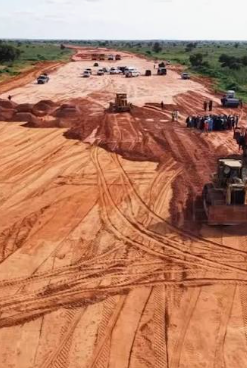
“The Federal Government is the one to pay compensation because the road belongs to the Federal across Nigeria. Stretching more than 1,000 kilometres from Badagry on the Atlantic coast to Sokoto in the North-West, the highway is designed as more than a conventional road.
Plans for the corridor include multiple carriageways, interchanges, service lanes, truck parks and supporting infrastructure such as fibre-optic ducts, power lines and other utilities intended to stimulate commerce and regional integration.
Government officials believe the project will improve the movement of goods, reduce travel time, connect agricultural and industrial hubs and strengthen trade between Nigeria and neighbouring West African countries.
Residents of Atan-Ota do not dispute those ambitions. Most of those interviewed by Sunday Vanguard acknowledged that projects of such scale inevitably require sacrifices from host communities.
Their appeal, however, is that those sacrifices should be matched with fairness, transparency and prompt compensation.
Waiting for a promise to be fulfilled
Months after dismantling their homes and businesses, many residents remain in limbo.
Some continue to live in roofless or partially dismantled buildings because they have nowhere else to go. Others are paying rent while struggling to rebuild businesses that once sustained their families.
For many, the issue is no longer simply about engineering measurements or the exact location of the highway corridor. It is about homes built over decades. It is about family businesses that disappeared overnight. It is about churches and mosques that held communities together.
It is about ancestral compounds where generations lived and were laid to rest. Above all, residents say, it is about trust.
The Federal Ministry of Works insists there was no setback realignment and says compensation is in its final stage of approval, with payments expected to commence before the end of the month. Ogun State government maintains that compensation is the responsibility of the Federal Government because the project is a federal one.
For the people of Atan-Ota, however, the debate over alignments and administrative responsibilities is secondary. Their hope is simple. That the long wait for compensation will soon end. That they can rebuild their homes, restore their livelihoods and begin again after months of uncertainty.
Until then, the piles of salvaged roofing sheets, roofless buildings, abandoned shops and silent compounds that line sections of Atan remain stark reminders that while the Badagry-Sokoto Superhighway promises to connect communities across Nigeria, its construction has left one community waiting for the assurances that officials say are finally within reach.
The post BADAGRY-SOKOTO SUPERHIGHWAY: Outcry as over 300 houses, investments, others destroyed due to setback confusion appeared first on Vanguard News.