Asagba of Asaba: Legal encyclopaedia-cum-activist changing narrative from throne
 SKAiF NewsNG SNN
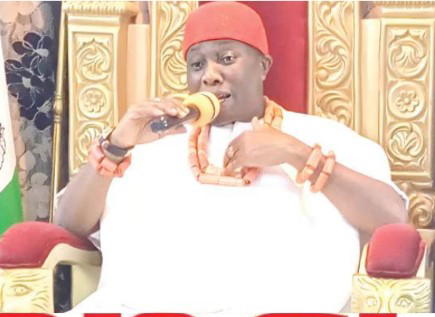
•HRM Obi (Prof) Epiphany Azinge opens up on his vision for the Asaba Kingdom
•Initially, I didn’t want to go for the Asagba stool, but the people mounted pressure
His Royal Majesty, the Asagba of Asaba, Obi (Prof) Epiphany Chigbogu Azinge, who clocked 70 years last Thursday, was hesitant to go into the battle for the Asagba stool in 2024. But an encounter with a Catholic priest changed the papal knight’s orientation.
The Senior Advocate of Nigeria, SAN, made up his mind thereafter. But against what many thought was a fierce royal rumble for the crown, especially with the reverberations that attended the kingship nomination, the monarch told a crew of Saturday Vanguard at his Asaba castle point-blank that there was no fight, as by his pedigree, he is head and shoulders above all other contestants.
In this down-to-earth interview by Emma Amaize, our Regional Editor (South-South), just back from a medical check-up, cut short his vacation, to lead Ochuko Akuopha (Reporter-Asaba) and Humphrey Omorodion (Advert Executive-Asaba) to the king’s bastion in Asaba. The Asagba of Asaba shed light on his connection to the ancestors before and after his emergence.
The regarded monarch x-rayed the metamorphosing mindset of an average Asaba native and his vision for Asaba Kingdom, his homeland and capital of Delta State, which he says is the fastest-growing state capital city, not just in Nigeria, but in the south of the Sahara, Africa.
One thing HRM Azinge has provided in good measure to the Asaba people since he was crowned the 14th Asagba of Asaba on October 5, 2024, is traditional governance, not just traditional rulership.
That is his panache, and he seems to be an activist and advocate rolled into one sitting on the throne.
Did you have any clairvoyance, or did the ancestors ever speak to you before your selection as the Asagba of Asaba?
There was never an inkling whatsoever. Indeed, I tried to avoid getting involved in any form whatsoever. So, the ancestors never spoke to me. If at all, not directly, not through anybody. If you go to my biography, “Born to Serve,” I was so unequivocal about any attempt to drag me into the race for the throne.
I was quite clear that I would never get involved. But things happened. And circumstances prevailed on me, such that I got involved in the exercise. And why did I hesitate? You don’t have to engage a living Asaba in any conversation of this nature.
And truly, it is only the Asagba who is alive that can tell you what it takes to be an Asagba. Nobody else can tell you what it feels like to be an Asagba. Nobody can tell you the consequences or the obvious challenges that could come with some of the places you go to or swear to become an Asagba.
Therefore, given such circumstances and the fact that a lot could be wrapped in secrecy, there was no way you could convince yourself that you could embark on such a journey. For me, I could not decode some of these things, and seemingly, a good number of them seemed to be wrapped in secrecy and also in the shape of a fetish.
Being that I am a Catholic, a papal knight for that matter, the contradictions were obvious, and I could foresee the conflict of interest along the line. And how do I resolve some of those seeming contradictions? I was not prepared to dabble in the inquest.
So based on that, on the face of it, I said, No, it is not for me. But when I started facing enormous pressure, I reached out to the leadership of the Catholic Church in many ways to ask questions and to see if I could be given the nod to proceed.
I asked questions; many of the answers I got were not positive. If they can change XYZ, then I can come on board. But if they cannot, maybe not. And that obviously was counting against my getting involved. But I had to meet with one reverend father here in Asaba. I discussed it with him. He told me Asaba can never change anything because of me.
He advised that my best bet is to go in, face whatever is before me, and then see if I can change the circumstances from within. He stated that people can only change things from within, not from outside. That was all I needed. And I got that note. That was when I made up my mind I would get into the race. That was the last thing that pushed me into the race. I will go in and go through all the processes, but the change begins thereafter.
So, in other words, there was no premonition, there was no intention, there was no indication, and nobody spoke to me. Maybe, by then, I had not started to decode when the ancestors speak and otherwise.
But if you ask me now, I can tell you yes, I know when they speak, so the situation has changed, and it is a different scenario now.
The battle to become the Asagba was not a tea party; many scrambled, but you emerged tops. And until now, there are minor rumblings: How did you outpace others, and how tough was it?
I still don’t consider the battle tough, in all honesty, and the result tells the story. You don’t have to be too immodest to assess yourself and assess a situation. It still counts in everything you do, even in aspiring to become the king of a community. But let’s face it, when I looked at my fellow contestants and my credentials and my commitment to this town—both as the former president general and in many other respects—there was really no contest.
I dare say. Certainly not. Of course, people came out to contest against me or to run the race; it was not that they were contesting against me. Our people spoke in all the parameters you need to climb to get to the top. I was certainly ahead of the pack.
If people are sore losers, as I may call them, so be it. So, they can mumble and grumble, but we are gone, and we are far gone. We are not looking back at all. But we have extended the olive branch to all to come on board so that we, all as critical stakeholders, can build our community.
What I sleep, dream, and think about now is what we can do next to move up Asaba. I’m not in the past anymore. I’m not living in the past. The past has vanished for me. There’s no turning back.
You are a legal icon in Nigeria and internationally. What have you found interesting and different between law and monarchy?
Maybe it was providential. One of the greatest works I did as the Director-General of the Nigerian Institute of Advanced Legal Studies was on the reinstatement of customary law in Nigeria. It was a well-researched work that took us all the length and breadth of this country. We summoned people from across the country and looked into chieftaincy, traditional marriages, land disputes, and inheritance, amongst others.
We realized that customary law is still in flux. In other words, it is ever-changing, dynamic, and not in any solid form. Are we going to codify it as solid as the law or restate it so that those who interpret it can appraise certain variables and reach a conclusion?
With the knowledge from the research, going into a traditional setting was easy for me. A greater percentage of what we do sitting on the stool is traditional administration of justice. They are basically anchored on some of these parameters of customary law. So, that knowledge that inheres in me helps a lot with where, how, and when I look at issues, and how I resolve them with an air of finality, as the case may be.
But back to your question. Moving from a legally regulated environment to a highly dynamic, unregulated monarchical system, yes, the difference is there. But again, the applicable knowledge is basically the same.
I have been able to draw on my life experiences and my sojourn in the law profession to bear with whatever I do. I wouldn’t say that they don’t come in handy; they do, to a large extent. And in the same vein, the administrative acumen—I have tried to modify traditional rulership to a reasonable extent.
And because of my administrative acumen, my engagements as the director-general, and my international outlook, amongst others, I told myself we must migrate from traditional rulership to traditional governance.
What I am doing today is not as a traditional ruler; I am leading as if I am in governance. That is why I don’t want to be restricted in what I do as a traditional ruler. I move out. That is governance. That is no longer rulership.
I don’t sit down in one place, believing that the whole world will empty before me with all the traditions. I don’t believe in that. So, I am in traditional governance, not traditional rulership. That is why I get into marketing, hospitality, tourism, and everything.
My turf is Asaba and whatever can develop Asaba. And I have to move out to achieve all those things. So, when the roads are bad, I go there to speak on behalf of my people. I engage. That is how I know I can do it to get positive results. But if I stay aloof, far away from the crowd, and believe that I can only sit on the throne and people will come and tell, I don’t think that the result will be the same.
So, yes, I have migrated from the legal community to a monarchical system that, in my mind, I must modify to achieve meaningful results. Whether it is against the custom or not. But the important thing is that we achieve the result we set out for. So, in sum, the totality of the experience garnered in the legal community is helping out because no experience is wasted.
In totality, all you pray for is wisdom. Wisdom is greater than knowledge, so the prayer is that God should grant you wisdom when you are on the throne, so that you can judge and judge rightly, so that you make decisions that people will come to terms with and agree with.
So that people will come before you, believing that they can get justice before you. So that you make yourself as transparent as possible, make yourself accountable to your people, and they will see that transparency glaringly and believe in you.
If you can do all those things, God giving you wisdom, believe you me, your people will queue behind you. Whether you are going up or going down, they will support you. That’s exactly what I have achieved in the past year.
What are your new understandings and findings about the Asaba Kingdom, as a subject and now a king?
Well, certainly not in terms of philosophical understanding; maybe in terms of dimensions, infrastructural development, and trajectory, yes. That is all the boundaries of Asaba, how large Asaba is, and how well developed Asaba has become. Yes, there are findings that intrigue, amaze, and impress. But in philosophical apprehension of the Asaba man, I do.
I grew up in Asaba, and I attended St. Patrick’s College, Asaba. I lived in Asaba. For my sojourn, whether to the University of Lagos or London, I still come back here. In my mind, I have understood the thinking of the average Asaba man, the way of life of the average Asaba people, their mannerisms, and their norms.
Proceeding from what I know, an opportunity has presented itself for me to change. One is the mindset, and the second is the narrative. So, we are working on our people’s mindset and changing the narrative in certain respects. Some of them can come through reforms, and some of the reforms we have tried to put in place.
A good number of them can transform by setting up committees to address certain mindsets and philosophical issues. What are those philosophical issues? Our people tend to be individualistic in their actions and their conduct, and for me, it is a nay-nay. We can achieve better if we pull together. If we can move together, if you are down, somebody brings you up. Somebody is up; he wants to bring somebody up. That, for me, is a change of mindset, and our people are reacting positively to it.
Secondly, the average Asaba man doesn’t trust easily. They readily believe that whoever asks them to bring money wants to squander their money, so they don’t trust. And for me, it is a question of how you can engender trust and make them believe that whatever they bring out is safe.
That is a change of mindset, and the only way you can achieve that is to make things transparent and make yourself as accountable as possible. Let them know that their one naira is safe with you, that you will not tamper with it, and that you will use it judiciously.
The scenario is there, and Asaba people are pulling in their money; individuals are bringing in the neighborhood of N400 million, and people are putting in N200 million, so you can see that the mindset is changing. The narrative is changing. We are doing a palace project; nobody has given us N1 million. The NDDC gave us N100 million, but the rest of what is going on there is by the Asaba people.
The mindset of the average Asaba man is changing because I understand what militated against their doing certain things; I worked on it, and the result is what we are getting. I also know that a traditional ruler doesn’t mean you are merely the custodian of their tradition and culture. You have to be more than that.
You can build all the roads in Asaba and do all the skyscrapers, but what of the welfare of the people? You have to show that you care about their welfare, and that is why we are doing all that we are doing.
We are getting into the schools. We offer scholarships and bursaries, we empower women, and we want to start skills acquisition and vocational training. We know that we have a very youthful population of almost 70 percent, and we must take care of them. If not, they will become restive.
We know that we have drug-related issues here; people are getting into addiction because maybe they don’t have jobs to do. We cannot just hold them accountable for being addicted to drugs, but we must also help them get out of addiction.
Hence, we have established on our own, the first of its kind, a drug rehabilitation center set up purposely for our drug-addicted brothers and sisters by the Asaba people and funded by the Asaba people only.
The post Asagba of Asaba: Legal encyclopaedia-cum-activist changing narrative from throne appeared first on Vanguard News.