Why lenders move to block Amukpe-Escravos pipeline sale
 SKAiF NewsNG SNN
By Sufuyan Ojeifo
An independent journalist takes a look at the renewed push by lenders to halt the revival of a previously terminated pipeline transaction and what it signals for valuation discipline and reform credibility in Nigeria’s oil sector._
A group of lenders led by
Sterling Bank is pushing to stop the revival of a scrapped deal to sell a 40% stake in the Amukpe-Escravos Pipeline [AEP], warning that relying on a 2024 valuation could significantly underprice the asset relative to more recent assessments.
The concerns are not new. In March 2026, Africa Oil+Gas Report, an independent industry publication, described the AEP matter as “no longer just a transaction story” but “a wider test of how Nigeria governs, values and safeguards strategic oil infrastructure.” That assessment now appears increasingly relevant.
At the heart of the dispute is a $243 million offer that collapsed in October 2024. A subsequent independent valuation conducted in 2025 places the same stake substantially higher, with estimates approaching $600 million under reasonable assumptions. Lenders argue that a September 2025 approval linked to the earlier process should be revisited rather than implemented.
The termination itself is not in dispute. The same industry report confirmed that the Technical Committee formally closed the Conpurex transaction in October 2024 following “a prolonged inability to meet key commercial obligations.”
The proposed sale between Continental Oil and Gas Limited and Conpurex Limited was terminated after Conpurex missed payments, breached terms, and sought to shift key risks back to the seller. By the time the process ended, lenders said it had lost credibility.
Since then, there have been moves to rely on the earlier September 2025 approval as a basis for progressing the transaction. Lenders describe this as an “administrative carryover” of a compromised process. They are calling for a full reset, including cancellation of the existing approval, appointment of an independent adviser, and a fresh tender anchored on current market value.
“Proceeding on the earlier benchmark risks locking in a transaction materially below market,” one industry source said. “For a strategic national asset, that raises clear concerns about value preservation.”
The valuation gap has been widely noted. The March 2026 report placed the 40% stake at a mid-case of $372 million, a high-case of $544 million, and an upside scenario of $641 million, figures that align with the independent assessment reviewed by this writer.
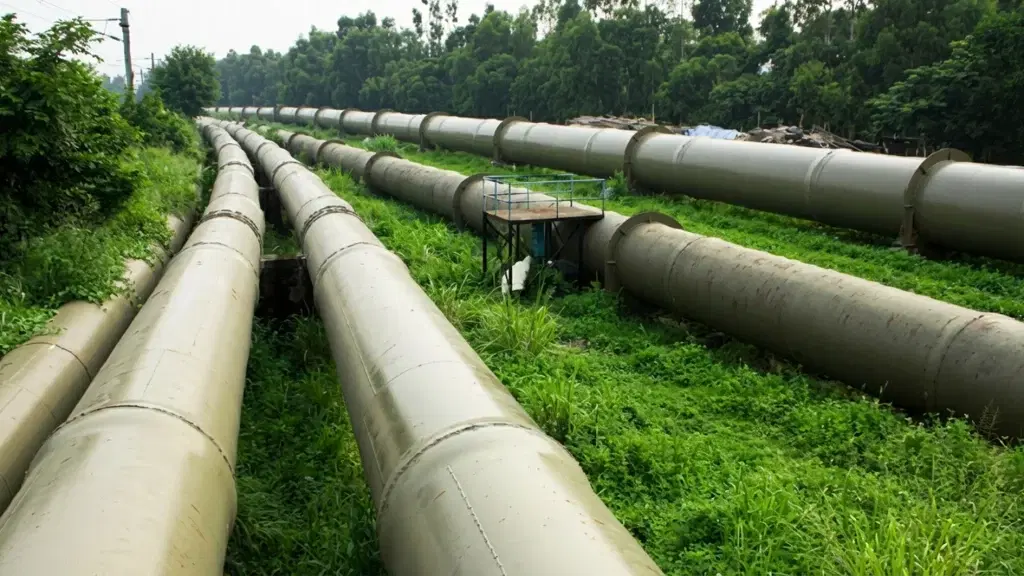
With a capacity of 160,000 barrels per day and uptime above 95%, the Amukpe-Escravos Pipeline has become one of Nigeria’s more reliable crude evacuation routes as theft and outages continue to affect other corridors. Lenders argue that pricing must reflect both its performance and its strategic importance.
The original $243 million bid had already drawn resistance. Lenders questioned the underlying assumptions and argued that the valuation did not reflect the pipeline’s operational reality or prevailing market conditions.
Beyond pricing, lenders say the earlier process suffered from weak coordination. Key financial stakeholders were not fully aligned, and the financing framework was later restructured to establish clearer parameters for any divestment.
After Continental Oil and Gas exited as the initial bidder, Conpurex Limited emerged without a clearly defined transition process. The firm subsequently failed to meet its financial commitments while seeking to reopen settled terms.
Proposed revisions included transferring regulatory approval risks to the seller and introducing interest claims on refundable sums, conditions lenders described as commercially untenable.
What now concerns the syndicate is the attempt to give a renewed effect to a terminated transaction without a formal restart. “If a closed deal can be revisited without starting over, the line between concluded and ongoing processes begins to erode,” a lender said. “That weakens contractual certainty and makes capital allocation more cautious.”
As one industry publication observed in March, the dispute touches directly on “how Nigeria intends to encourage local investments in the national interest, value strategic petroleum infrastructure, and how creditor interests are balanced against long-term public value.”
The lenders’ position is straightforward: revisit the September 2025 approval, appoint an independent adviser, and return the asset to the market through a transparent and competitive process.
The path forward has already been outlined. The same independent report called for “a fresh divestment framework grounded in current valuation benchmarks, transparent process oversight, capable counterparties, and full alignment among lenders, partners and regulators.” Lenders are now pressing for that outcome.
They warn that anything less risks setting a precedent in which approvals can be carried forward without full reconsideration, valuation benchmarks may lag market realities, and discipline in asset transfers could weaken.
“For an industry built on long-term capital and measured risk, that is not a trivial signal,” one source said. “It is a defining one.”
*Ojeifo is a journalist and publisher based in Abuja.
The post Why lenders move to block Amukpe-Escravos pipeline sale appeared first on Vanguard News.