‘Nothing to offer our refineries’ — Outrage grows over NNPC’s partnership with Chinese real estate firm, chemical trader
 SKAiF NewsNG SNN
By Omeiza Ajayi, ABUJA
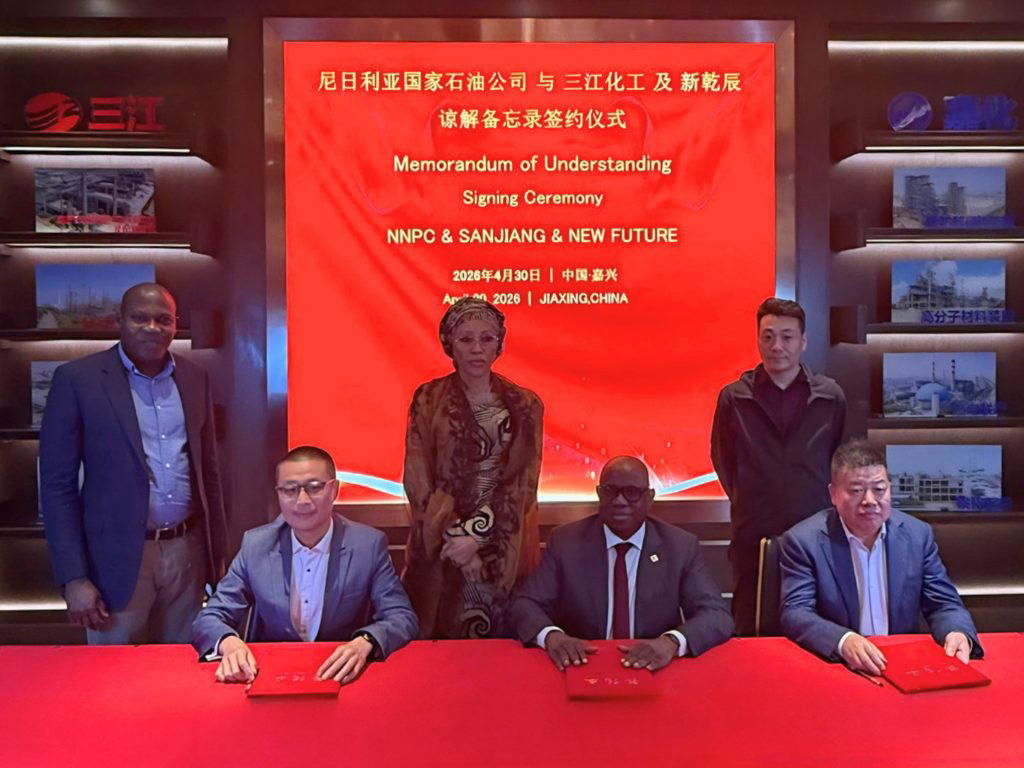
Outrage is growing over the Memorandum of Understanding MoU signed between the Nigerian National Petroleum Company NNPC Limited and two Chinese firms for the rehabilitation of the Port Harcourt and Warri refineries, with former Vice President Atiku Abubakar and a former president of the Organised Private Sector of Nigeria, Dele Oye, independently tearing apart the deal and demanding its immediate cancellation.
Read Also: NNPC signs MoU with Chinese firms to restart, expand Warri, Port Harcourt refineries
The two men, speaking from different platforms on Thursday, arrived at the same verdict — that the two Chinese companies selected by the NNPCL, Sanjiang Chemical Company Limited and Xingcheng (Fuzhou) Industrial Park Operation and Management Co. Ltd, are technically unqualified, financially questionable, and have no business being handed responsibility for two of Africa’s most complex and strategically vital refineries.
Atiku, in a statement issued by his Senior Special Assistant on Public Communication, Phrank Shaibu, described the arrangement as “another dangerous gamble with Nigeria’s economic future,” accusing the President Bola Tinubu administration of attempting to mortgage critical national assets through opaque arrangements lacking technical credibility, transparency and national accountability.
“It is both shocking and insulting that after wasting over $2.5 billion on endless refinery rehabilitation scandals, the NNPC is once again asking Nigerians to trust another experiment built on secrecy and questionable competence,” Atiku said.
Oye, speaking on Arise News monitored in Abuja, after conducting what he described as a due diligence exercise through his organization, the Alliance for Economic Research and Ethics, was equally blunt. He said; “These two companies have nothing to offer Nigeria. They have no professional experience. They have no engineering experience. They have never been in the industry to run a refinery of this magnitude.” The NNPCL had signed the MOU with the two firms in a move it described as a shift away from purely contractor-led rehabilitation towards deeper operational and financial collaboration on its ailing refineries.
The company justified the choice of Sanjiang Chemical in particular, arguing that modern refineries are increasingly designed as integrated energy hubs rather than standalone fuel plants, and that Sanjiang’s experience in converting refinery byproducts into high-value chemicals such as polypropylene and surfactants made it a suitable partner.
Atiku’s statement acknowledged Sanjiang as a legitimate petrochemical company but stressed that it is fundamentally a downstream fine chemicals manufacturer specializing in surfactants, ethylene oxide, methanol-to-olefins, and light hydrocarbon processing — not crude oil refining.
He said; “There is no publicly available evidence anywhere in the world showing that Sanjiang has ever built, operated, or managed a full-scale crude oil refinery of the magnitude and complexity of Port Harcourt or Warri refineries. Processing petrochemical derivatives is not the same as running an aging national refinery burdened with decades of operational decay”.
Oye drove the point home. “Sanjiang Chemical is not an EPC company. It is not an engineering company. They are into the downstream. They are more into chemicals. They have never run any refinery. They have never rehabilitated one,” he said, adding that the Hong Kong-listed company was currently running low on cash and carrying short-term borrowings. “It doesn’t have the technical competence. It has never done any similar business.”
On Xingcheng, the second firm, Atiku’s statement said it “appears to have absolutely no verifiable experience in petroleum engineering, refinery operations, or hydrocarbon processing,” likening the choice to “handing over a hospital’s intensive care unit to a real estate developer simply because they can construct buildings.”
Oye was just as dismissive. “That one is just a real estate company. They are into industrial parks. There is no evidence anywhere in the world where they have been involved in any refinery or they run a refinery,” he said. Both men also raised red flags over the financial condition of Sanjiang Chemical.
Atiku’s statement pointed to declining revenues, shrinking profitability, and significant short-term debt exposure, asking: “If a company is already battling financial compression and liquidity concerns in its own operations, how exactly does it intend to shoulder the burden of reviving two of Africa’s most troubled refineries?” Oye put the company’s margin decline at approximately 5.7 percent year-on-year.
Benchmarking the two Chinese firms against the existing refinery contractors — Technimont SBA and Saipem SBA — across key parameters including EPC capability, crude oil refinery experience, global track record, and downstream operations, Oye said the contrast was damning. While Technimont and Saipem were globally certified and extensively experienced, Sanjiang and Xingcheng scored nothing on the critical indices.
The critics also converged on the question of accountability for previous rehabilitation contracts. Oye argued that the NNPCL had not answered for the failure of past arrangements before rushing into a new one. “Have they determined the current contracts of the two existing contractors? If they have determined it, what is the value Nigeria got for the money collected? Until you resolve the past, we are going to be setting ourselves up,” he warned.
He added that unresolved legacy contracts could be weaponised to frustrate the new MOU in future litigation. Atiku pressed the same point. “It is unacceptable that after years of failed Turnaround Maintenance scams, billions of dollars squandered, and repeated lies about refinery functionality, Nigerians are now being told to celebrate a Memorandum of Understanding signed with companies whose core expertise does not align with the technical realities of refinery rehabilitation,” his statement said.
He questioned why the Federal Government and the NNPCL would bypass globally established refinery engineering and EPC firms with proven records in favour of entities “whose backgrounds raise more questions than confidence,” warning that the Tinubu administration risked turning the refineries into “another expensive black hole of failed promises, reckless experimentation, and opaque transactions.”
Atiku laid out five demands: immediate publication of the full terms of the MoU; a transparent technical due diligence report on both firms; disclosure of financial commitments and liabilities expected of Nigeria; open competitive engagement involving globally reputable refinery operators; and a full legislative investigation into the billions previously spent on refinery rehabilitation without measurable results. “The era where NNPC signs opaque agreements abroad and expects Nigerians to clap blindly is over,” he declared.
Oye recommended a government-to-government arrangement with a credible Chinese state energy company as a more credible alternative. “With a G2G agreement, it would have been better. Maybe with Sinopec or PetroChina,” he said, warning that signing agreements between Nigerian public officials and unvetted private foreign entities had historically cost the country dearly. “Our history — we have lost $76 billion.”
He also renewed calls for accountability over the $1.5 billion approved for the refinery rehabilitation exercise, saying the NNPCL had remained silent on how much was disbursed and what it yielded. He equally questioned transparency over the Warri refinery, where public ceremonies were held to declare it operational even as it reportedly ran for only 30 days before being shut down.
Despite his criticisms, Oye acknowledged that the current NNPCL under its Group Chief Executive, Bayo Ojulari, represented a marked improvement over its predecessors.
“To be fair to Ojulari, since he entered, we see there have been less talking by NNPC. There is a level of confidence. When you appoint people from the industry, he has a reputation for himself to live up to. He was already there before he got there,” he said. But he insisted that confidence in management did not excuse the error of judgment. “In every human endeavour, there are mistakes. The due diligence they did may not have been sufficient.”
Both men ultimately called on President Bola Tinubu to act. “I hope this is not another deal for the boys. The Nigerian president should look into this and cancel that arrangement,” Oye said.
Atiku specifically said; “Nigerians must not allow the same people who destroyed the refineries through incompetence and corruption to now hide behind vague Chinese partnerships to continue the cycle of deception. National assets are not toys for bureaucratic experimentation. The Port Harcourt and Warri refineries are too strategic to be surrendered to uncertainty, obscurity, and corporate guesswork.”
The post ‘Nothing to offer our refineries’ — Outrage grows over NNPC’s partnership with Chinese real estate firm, chemical trader appeared first on Vanguard News.