Why Almajirai are infiltrating Abuja
 SKAiF NewsNG SNN
By John Alechenu
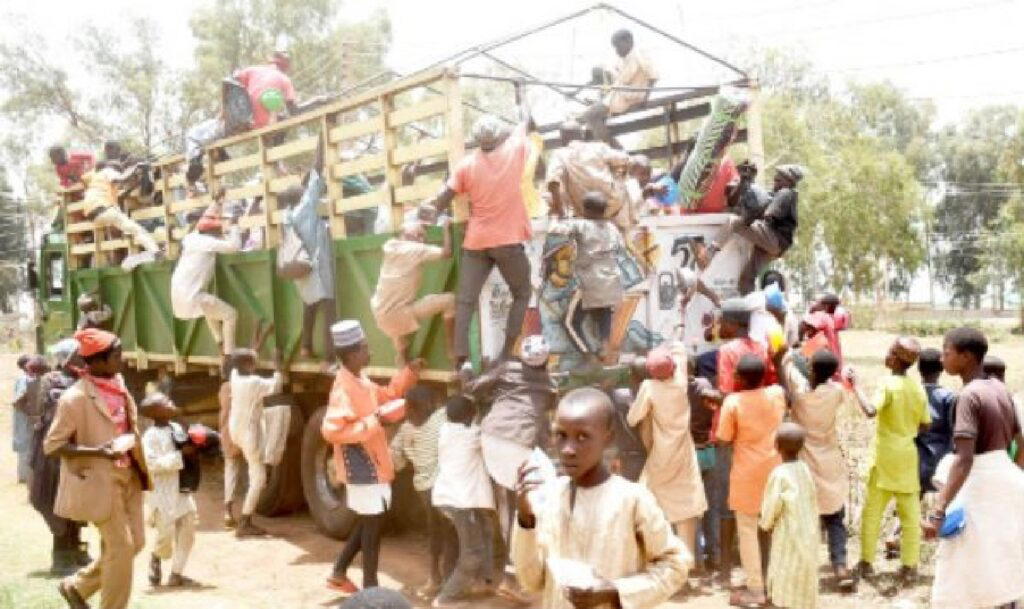
Nine-year-old Aminu hails from Kankiya, in today’s Katsina State. He bears the mark of a child who is being robbed of his childhood, looking unkempt with his skin in dire need of soap and water.
He is dressed in oversized clothes which appear to have survived many seasons, hanging on his tiny frame. He is one of many children his age who currently hang around the popular NNPC bus stop in Kubwa, one of the suburbs of Nigeria’s bustling capital, Abuja.
With a plastic plate held by a string hanging from his neck, he holds out his hands while speaking in a whisper, begging for alms. He is prepared to collect food or cash and doesn’t hesitate to proudly identify himself as an Almajiri. “I’m an Almajiri” – a student of a traditional Islamic school,” Aminu declares with childlike innocence, when asked if he is one.
Aminu, like several of his friends, left the comfort of his parents’ home in rural communities of Katsina, Sokoto, Kano, and Bauchi to study Arabic and memorise the Quran. To survive, he begs for food or money to buy some. Sometimes, he sleeps wherever the night catches up with him, whether it’s during the day or at night, as long as he can reach his Mallam’s study centre, which can be a hut or under a tree, for prayers and Quran memorisation sessions.
Asked if he has been to a formal school, he says, “No.” He looks over his shoulders, perhaps to see the expression on the faces of some of his companions who had gathered to listen to the conversation. “My father strictly forbids it.” It is haram” (forbidden), “ he says with all the courage he can muster.
Asked when he last saw his parents, who now reside in rural Funtua in Katsina State, North-West Nigeria, he responded with a simple answer: “I can’t remember.”
At this point, perhaps sensing the session may not meet his expectations, he sidesteps the reporter to join his friends, who have sighted a man in a flashy Sports Utility Vehicle, distributing packs of cooked food as part of the alms-giving ritual popular among Muslims during Ramadan. He said fear of being recruited by terrorists forced him to flee to Abuja.
Aminu’s story resonates with Ibrahim, a 29-year-old motorcyclist who plies his trade in Bwari, one of the sprawling urban centres in Nigeria’s Federal Capital Territory, Abuja. Ibrahim, who describes himself as a product of the Almajiri system, equally announces that he did not attend western-style school.
Ibrahim explains that he was born in Charanchi, Katsina State, and was handed over to his Mallam (teacher) when he was just five years old. They were many who were taken from his village to other towns in northern Nigeria in search of greener pastures using the Almajiri system as the foundation. The Mallam first took them to Katsina before moving to Kano, where they stayed for some time studying Arabic and memorising the Quran.
Life in the city was different from their village. In the village, they went to the farm with their parents, ate mangoes and dates for fun, and were fed at least twice a day. Even when they moved with the Mallam to his abode, not far from home, Ibrahim saw his father during Friday prayers.
For the first few months, life in the city was harsh for most of them. Most times, they slept in the open because the Mallam’s accommodation was inadequate for them and members of his immediate family.
As he did not have a farm in the city, they depended on the generosity of the Ummah (Muslim community) and a few rich men for their survival.
They wake up very early in the morning, perform ablution, say their Fajr prayers, fold their mats, clean the Mallam’s quarters in Kurnan Asabe, Kano, and begin studying the basics of Arabic. Older pupils continue with memorisation. Sometimes, smart children catch up with learning Arabic fast and join the memorisation class.
During his time, they ran errands for their Mallam’s household as children, while the older ones went to do odd jobs or beg for alms. Whatever they got- foodstuffs or cash- they brought back to share with the Mallam. Sometimes, people in the area brought arms to their Mallam to help with their feeding.
Hardship forced many pupils to abandon learning
Fridays are especially full of activities because many people bring gifts of cooked food, raw grains, and cash to give to their Mallam and share with them. In Islam, believers are encouraged to give to the poor as part of their worship to Allah.
Ibrahim explains that as time passed and the economy took a nose dive, feeding became a challenge. Their teacher grew older and could no longer cater for the number of pupils under his care. The hardship forced many of the pupils to abandon the system and take to menial jobs to survive.
Ibrahim describes himself as lucky when he ran into a childhood friend who had been to Abuja. “My friend came to Kano and taught me how to ride a motorcycle,” he says with a broad smile on his lips, his eyes lighting up, temporarily setting aside the exhaustion and thirst that comes with his line of business during the fasting in the Muslim holy month of Ramadan.
“My friend encouraged me to follow him to Abuja, where he said we could make more money and continue with our Islamic studies.
“That is how I came to Abuja. I re-established contact with my parents. They married a wife for me and we have two children. My wife and our children are in the village while I operate as a commercial motorcyclist in Abuja. From the little I make on my daily struggle, I send them money and visit whenever I get the opportunity but we speak on the phone every day.”
He, however, admitted that learning about Islam is a lifelong tradition, which requires continuous learning in addition to successful memorisation of the Quran.
Mansur Liman, 17, a native of Zurmi in Zamfara State, has a similar but different story. He described his trip to Abuja as a journey of necessity. He likened his journey to that of early Muslims running away from Mecca to take refuge in Medina to escape persecution during the time of the Holy Prophet of Islam, Muhammad (PBUH).
Liman explained that he was among several other young boys who were active in their rural farming community before bandits engaged in illegal mining and hostage-taking forced them out.
Looking tired and frail, with a few clothes in a bag hanging on his right shoulder, Liman politely turned down a request to be photographed. He explained that while his parents had handed him over to a cleric to guide him in his quest for Islamic knowledge, they made him swear he would have nothing to do with western education.
“I’m an Almajiri,” he declared. “I have been an Almajiri since I was a little child. Back home, our teacher was a farmer. He grew millet, guinea corn, and reared sheep. He had a few cows but had to abandon the breeding of cows because he lost most of them to cattle rustlers.
“In my community, being an Almajiri doesn’t exempt you from going to the farm or engaging in any legitimate business activity to support yourself and your family. We study in the morning and in the evening and engage in farming in between. We do this to provide for ourselves and our teacher. We fetch water, firewood, and run errands for him as occasion demands.
Terrorists’ attack forced many to relocate to Abuja
“Going a distance away from home is designed to help the pupil concentrate and build resilience. My plan was to work hard and study and maybe go to Saudi Arabia, Yemen, or Egypt to increase my knowledge about my religion – Islam – then return and teach others.
“I came to Abuja along with my uncle to save my life because bandits attacked my village and wanted to recruit me into their fighting force but I resisted them. That was what prompted me to move to Kano to stay with my maternal uncle”.
Ibrahim, Aminu, and Liman are only three out of millions of out-of-school children roaming the busy streets of Abuja and other states in Nigeria.
The United Nations Children’s Fund (UNICEF) estimates that as of 2024-2025, 18.3-20 million Nigerian children of school age are out of school. This figure includes around 10.2 million primary school-age children and 8.1 million in junior secondary, with UNICEF reporting that one in three Nigerian children in North-Western Nigeria accounts for the highest number, with approximately 8.04 million children. It is followed closely by the North-East.
Most estimates point to the fact that more than 80 per cent of Nigeria’s out-of-school children are found in the Northern region.
This situation has been worsened by age-long cultural practices, growing inequality, poverty, and insecurity. For decades, after Nigeria’s independence from colonial rule, successive northern leaders have made pronouncements, held workshops, seminars, and symposiums in their bid to change the narrative, but these efforts appear to come to light during campaigns and fizzle out at the end of elections.
In his foreword to the report of a study carried out by the Northern Education Research Project, Arewa House, titled: ‘Towards The Improvement Of Education In the Northern States of Nigeria, Agenda For Action”, published in 2000, former Vice President Atiku Abubakar called on Northern leaders, especially governors, to take up the challenge of changing the narrative.
Atiku observed that apart from dedicated and visionary leadership in the first 15 years post-independence, successive administrations had paid lip service to education.
Education suffered monumental setbacks
He wrote: “It was in the third and fourth decades that things fell apart, education suffered monumental setbacks and was brought to its knees with all the attendant social problems.
“Ironically, this was a time when more funds were allocated to education and several institutions such as the National Primary Education Commission (NEPC-now Universal Basic Education Commission- UBEC and the Education Tax Fund-ETF now Tertiary Education Trust Fund-TET Fund) were created.”
The report itself painted a grim picture of the state of education across the region.
It observed that enrollment figures in secondary and tertiary institutions pale into insignificance when compared to the south.
“For example, while there are 4,049 secondary schools with an enrollment of 2.84 million students in Southern states, there are only 2,419 secondary schools with an enrollment of 1,417,945 students in Northern states and the FCT,” the report stated.
Other factors identified as impediments include decay in basic infrastructure, unhelpful cultural practices, insufficient number of teachers, teaching and learning facilities, as well as poor funding.
As part of the proposed action plan, it was recommended that “all Northern states and local governments should, as a matter of policy, allocate not less than 26 per cent of their total annual budgets to the education sector, and this should be increased by 2 per cent each year for at least five years.”
A little over a quarter of a century after this recommendation, (2026), only three of Nigeria’s 19 northern states have taken this recommendation to heart and are acting on it.
Kano State leads the pack, allocating over 30 per cent of its budget to education in both 2025 and 2026, surpassing the UNESCO and national 26% benchmark. Other northern states in this category include: Jigawa with 26.4 percent and Kaduna with 26.14 percent in their 2025 budgets.
Two days before the end of his final four years in office, the late President Muhammadu Buhari on May 27, 2023, assented to the bill establishing the Almajiri Commission.
Two years later, precisely on November 2025, his successor, President Bola Tinubu, approved a national policy on Almajiri education. The bill and the policy drawn from it give official recognition to the Almajiri learning system with modifications to bring it up to speed with modern trends. Its structure is to be harmonized with the inclusion of literacy, numeracy, critical thinking, and skill acquisition.
The federal ministry of education explained that key initiatives aimed at ensuring this happens include building/recovering 157 model schools; implementing a blended curriculum (Qur’anic + Western education), and establishing 119+ learning centers focussing on vocational skills, literacy, and numeracy.
Mallams will also be paid a stipend to eliminate the dependence on their pupils begging for alms to sustain themselves.
These initiatives form part of the broader 2026 Education Sector Roadmap, which saw a major budgetary increase to N3.520 trillion, focussing on reducing the number of out-of-school children.
Mallam Nasir, a Quranic scholar who runs one of several Almajiri schools in Abuja, said: “I was born into this. I was an Almajiri myself, but my case was different because I was a student under my late father.
“We moved from place to place, teaching and impacting Islamic knowledge. We are willing to cooperate with the government, provided it will not introduce practices that contradict our beliefs.”
An educationist, Mr. Ikwulono Oguche, while commenting on the issue, said: “We are never short on brilliant ideas and policies in this country. What has always been our greatest challenge is implementing them.
“The Federal Government established a whole commission for Nomadic Education; how has this commission contributed to the educational advancement of herders and pastoralists?
“Today, these same people have become a threat to national security because some persons failed to deliver, but each year, billions are voted for the operations of these commissions. I don’t want to sound pessimistic; I can only wish them luck.
“But let me say this; unless the government involves traditional rulers and Islamic religious leaders to buy into this, I’m afraid the Almajiri system, as we know it today, is not changing any time soon.”
The post Why Almajirai are infiltrating Abuja appeared first on Vanguard News.