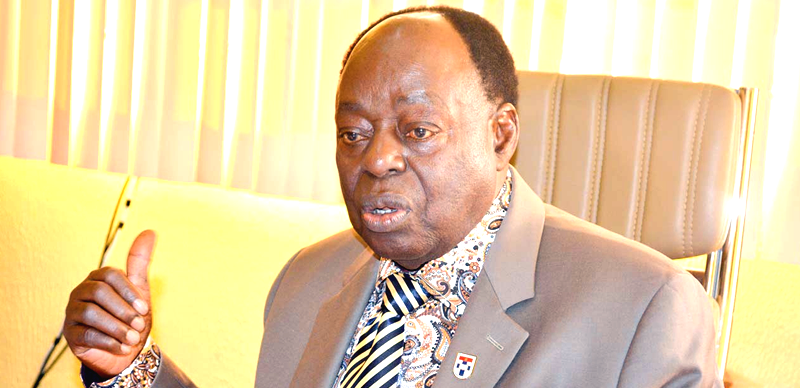
The Need for National Political Reform Conference (11), by Afe Babalola
 SKAiF NewsNG SNN
Continued from last week
Economic Reforms
As part of the ongoing exercise, there is urgent need for economic reforms. Regrettably, Nigeria is one of the poorest countries in the world.
Having regard to the natural resources, including minerals, grassland, savannah, tropical and rain forest region, we should be one of the richest countries in the world. There is urgent need to develop agriculture, minerals of all types, including oil, bitumen, gas, iron, coal, gold, columbite, etc.
Government should hands off completely participation in business and encourage citizens to take over all the sectors of development and industries.
ELECTRICITY
Electricity deserves special mention. It is a historical fact that the discovery of electricity in the 17th century was the beginning of industrial revolution. Today, Nigeria is the biggest importer of generators. A person who has five offices in different towns must buy at least five generators, excluding those in his residence.
Any industry in Nigeria must be supported by huge generator, thereby making the cost of production of manufactured goods costlier than those produced outside Nigeria.
Electricity should not be on the exclusive list for Federal Government. It should be on the residuary list and each state should be encouraged in conjunction with private investors to generate electricity. This was the position before the military came into power and it worked well. In fact, each town tried to generate power by itself. In Ado- Ekiti, for instance, there used to be electricity for 24 hours. Now there is hardly electricity at any time of the day and when there is, it is so weak that we have to supplement with lantern. It is also not very wise to concentrate all power generating in one spot. In case of war (God forbid), it is an easy target, thereby bringing the whole country into darkness.
We should look into the possibility of generating power from solar energy. Many advanced countries are currently availing themselves of this source of power supply.
Thing have gone so bad that something urgently has to be done.
TRANSPORTATION
As far back as 1900 when there was no electricity or even tarred road, the British succeeded in building a network of railways from Lagos and Port Harcourt to the far North. It is a shame that after 100 years, we have not improved on what we inherited.
On the contrary, the rail system has gone into disuse.
We all know the useful role which the rail system plays in other countries. They are fast, cheap and convenient. A good modern railway system from Lagos to Abuja will take less than two hours.
Instead, what we have is road system which are overused by heavy vehicles and within few years of building them, because of the weight and pressure, the roads become impassable. Instead of using train, Nigerians buy heavy vehicles with which they convey heavy load, affecting our roads and the roads get spoilt very quickly.
Successive governments have neglected the rail system, whereas by now, especially with the oil money, we should be able to develop the inter-state rail network as well as the intra-state rail network.
In fact, it is imperative that we must have the intra-state railway network. Take, for instance, in Lagos there is no reason why we cannot decongest the hectic traffic by having intra-state rail which are cheaper, easier and move more people at the same time. This is the practice all over the world. I do not know why our country is different. It will yield a lot of income too. The country should also establish mass transportation system as is done in Europe. We should encourage local governments to operate public bus transportation system, particularly in capital cities and other major cities and towns. The purpose of this should not be to make profit. In fact, the system should be subsidised. This is not to say the local government should not break even or realise its investment but this should be gradual.
IMMUNITY CLAUSE
The purpose of the immunity clause which protects certain serving officers from criminal prosecution is to prevent unnecessary distractions while in office.
Unfortunately, this immunity has been greatly abused. It is, therefore, my suggestion that the immunity clause be amended in the following manner:-
(a) Allow conduct of investigation into activities of such serving offices even if they will not be prosecuted;
(b) allow for the management of indicted officers a month or two months before leaving office;
(c) prevent them from contesting for any elective office or holding any political office until such officer has been discharged and acquitted by a court of law.
FOREIGN DEBT
For the past 10 years or more, I have been advocating a drastic measures to address this issue of our foreign debt.
These white men invaded Nigeria and bought our fellow country men for slavery in the early 19th century.
The missionaries came to our rescue when they stopped this slave trade.
In 1986, Nigerians unanimously agreed that the country should not take an International Monetary Fund, IMF, loan which has done more damage to the under-developed countries. In 1985, Brigadier Tunde Idiagbon vowed to pay the debts incurred by Nigeria. An inquiry was set up because of the belief that we did not owe as much as they alleged that we owe them. Payments were announced periodically by the government of Nigeria at the time. The government denied that it was in the best interest of the country to liquidate the debt.
However, the regime that succeeded the Buhari/Idiagbon government stopped the enquiry and continued to borrow more.
The amount allegedly owed these institutions has increased from $14 billion in 1985 to $35 billion as at 2005, yet we have paid $37 billion by way of debt servicing.
I had suggested that we institute a court action against the Paris Club for fraudulently alleging that we are indebted to them. These foreign institutions came under the guise of granting soft loans or incentives to our industries. One can imagine the amount of money that has been expended on the Ajaokuta Steel Rolling Mills, yet this project is not functional.
Another ground for the legal action is to challenge the interest element on the alleged loan. The interest charged by the foreign institutions is fixed and higher than what they charge their own people. In fact, we pay about 10 per cent interest on these loans as against 2 – 5 per cent interest awarded their people.
The third ground for the proposed legal action is that it is unconscionable to continue to charge interest after the principal amount has been paid. In Roman law, it was usury and many countries will adopt that policy that once the principal amount is paid, the debt is extinguished.
The actions of these international institutions such as the Paris Club amount to slavery. Nigeria now spends 40 per cent of all her earnings on debt servicing. The first slavery was when our brothers and sisters were taken to West Indies to work on sugar plantation. After the abolition of slavery, the White men introduced economic crops. Again, they dictated the prices. The servicing of the so-called debt with over 30 per cent of our earnings is the third slavery. What is most insulting is that they even refuse to allow the capital to be paid. Unfortunately, successive governments in Nigeria have continued to re-schedule the so-called debt. In other words, we are being enslaved in perpetuity.
Whereas countries like Iraq, Ivory Coast, Pakistan, Egypt have been given debt relief either by total write-off of their debts or considerable reduction in the amount, Nigeria has not been considered despite enormous pressure from the present government. My dream seems to have been realised when on Tuesday, March 8, 2004, the National Assembly passed a resolution not to pay the debt allegedly owed by Nigeria to these foreign institutions. This option by the National Assembly cannot be adopted because these foreign countries have a way of punishing Nigeria. The best way out is to proceed to the International Court of Justice, ICJ, and file an action against them seeking injunctive reliefs, amongst others. Other Third World countries should be joined as plaintiffs to sue these foreign institutions.
•Please send your comments to president@abuad.edu.ng
The post The Need for National Political Reform Conference (11), by Afe Babalola appeared first on Vanguard News.