
Nigeria’s federalism facing existential threats, body of SANs warn
 SKAiF NewsNG SNN
…says judiciary must assert itself amid single-party dominance
By Ikechukwu Nnochiri
ABUJA– The Body of Senior Advocates of Nigeria, BOSAN, on Monday, warned that the country’s federalism is facing existential threat from single-party dominance.
The organization, comprising legal eggheads that constitute the Inner Bar of Nigeria’s judiciary, decried that “the dominance of one political party, as is currently the case, has tended to weaken Nigerian federalism and virtually eliminated the opposition.”
It maintained that the situation has made the role of the judiciary more urgent and important, insisting that “a strong judiciary is crucial when opposition is weak.”
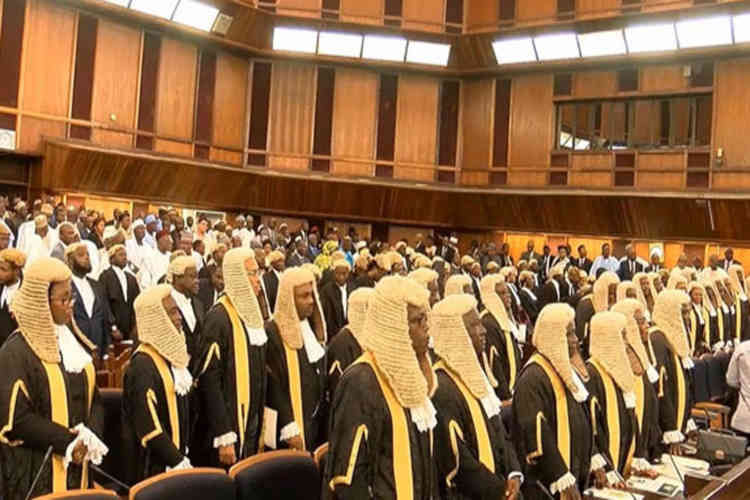
BOSAN took the position in a speech it presented at a Special Court session that was held to mark the ceremonial commencement of the 2025/2026 Legal Year of the Federal High Court.
The speech was read on behalf of the body by a former Attorney General of the Federation and Minister of Justice, Chief Kanu Agabi, SAN.
According to BOSAN: “When there is no strong opposition, the judiciary must be strong.
“It must be adept. It must be innovative. It must defend the law and the constitution, and employ every inherent sanction of a court of law.
“The framers of the constitution would never have entrusted the judiciary with the custody and control of the constitution, without at the same time, giving it the necessary jurisdictional power to protect it at the time of mindless corruption.
“As I said before, it is midnight. It is you judges who will lead in this darkness.
“At such a time like this, you must be bold and courageous. You must be honest, you must be innovative.”
Continuing, the body warned against what it described as the criminalization of politics, saying it was time for the judiciary to rise to the occasion by ensuring the protection of constitutionally guaranteed rights.
It said: “Criminalization of politics means that you are the hope of the nation. If the electoral process continues to be dominated by money, if violence and ethnicity continued to prevail, if the checks and balances instituted by law have been eliminated or have ceased to be effective, if all the structures for accountability provided in the constitution are surprisingly ignored, in that case, we need a judiciary that can assert itself.
“Do so now! Do not fear and do not be afraid. If this generation does not appreciate you, generations to come will do so.
“Generations to come shall look back and wonder how you were able to save a nation so totally lacking in moderation.
“It has been said that as long as the nation is rife with corruption, we should not consider ourselves a democracy.
“The hope of the nation is in the judiciary to remove this cankerworm of corruption so that we can have a genuine democracy
“This means that judges must be enlightened. You must spiritualize yourselves. You must be holy.
“The nation remains godless. It depends not so much on our priests and pastors and Imams. The men of God have taught the lessons they ought to teach. It remains for you judges to punish disobedience. The appropriate use of punishment.
“You have the means to compel criminals to give up crime.That is why it is said that a nation is as good as its judiciary.
“It is for this reason that some people blame not the politicians, but our judges and magistrates,” it added.
Among dignitaries in attendance at the event when the speech was read, included the Chief Justice of Nigeria, CJN, Justice Kudirat Kekere-Ekun, as well as the Minister of the Federal Capital Territory, Nyesom Wike.
In her speech, the CJN acknowledged that public expectations of the Judiciary grew significantly in recent years, noting that “scrutiny has intensified.”
She stressed that the Judiciary remained the last line of defence for the Constitution and the rights it guarantees.
“In an age where misinformation travels swiftly and institutional trust is increasingly
fragile, we must continually demonstrate, through both conduct and decisions, that justice in Nigeria is anchored firmly on impartiality, transparency, and integrity.
“The Judiciary does not speak through press
statements or public commentary; our judgments constitute our voice, and the manner in which we discharge our duties defines the authority and credibility of that voice.
“Beyond the substance of our judgments, the public increasingly measures justice by the discipline of our daily processes. Punctuality in sitting, consistency in court schedules, and the courtesy of giving advance notice
when a court will not sit are no longer minor administrative matters.
“They are essential expressions of respect for litigants, counsel, and citizens whose time, resources, and confidence are invested in the justice system.
“It would be unrealistic to ignore the fact that public confidence in judicial institutions is fragile, and that perceptions, whether fair or otherwise, carry real consequences.
“Where court processes appear unpredictable, opaque, or inefficient, the credibility of even sound decisions may suffer.
“Restoring confidence is not achieved by rhetoric, but by reliability, professionalism,
and visible order in the administration of justice.
“Judicial independence must therefore be upheld, not as an abstract ideal, but as a lived and daily discipline grounded in courage, restraint, and fidelity to the law.
“Independence is not an adornment of democracy; it is its lifeblood. Yet independence, standing alone, is insufficient unless exercised with responsibility and moral clarity,” the CJN stated.
She said the Bench and the Bar must remain partners in the administration of justice.
“A weak link on either side diminishes the system as a whole. I therefore urge members of the Bar to uphold the highest standards of advocacy, to eschew tactics that frustrate proceedings, and to work constructively with the courts in advancing efficiency, professionalism, and the Rule of Law,” Justice Kekere-Ekun added.
The post Nigeria’s federalism facing existential threats, body of SANs warn appeared first on Vanguard News.