Nigeria must return to fiscal federalism, governors should stop regional jamboree — Igali
 SKAiF NewsNG SNN
— PANDEF chair seeks restructuring, 15-region federation proposed
By Henry Umoru
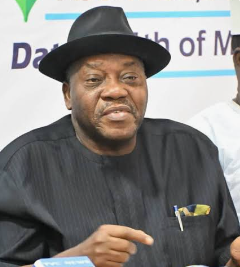
ABUJA — The National Chairman of the Pan Niger Delta Forum, PANDEF, Ambassador Godknows Igali, has called for the restoration of fiscal federalism and greater devolution of powers to Nigeria’s regions, warning that excessive concentration of political and economic powers in Abuja is weakening the country’s productive capacity.
Igali also criticised governors for what he described as turning regional cooperation into “jamboree”, urging them to move beyond meetings and ceremonies and establish economic partnerships capable of generating wealth and employment.
He spoke on Monday in Abuja at a national dialogue organised by the Citizens Rebirth & Awareness Initiative, C-RAIN, ahead of the Citizens Assembly on Restructuring of Nigeria’s Federated Regions.
According to Igali, Nigeria’s over-centralised system has weakened productivity, accountability and security, while the monthly Federation Account allocation system has created a culture of dependence among states.
“FAAC has made governors CEOs of ‘allocation sharing’. Decree 43 made us lazy and dependent on oil. Fiscal federalism will make them CEOs of production,” he said.
He urged governors to deepen economic cooperation across their respective regions by investing in productive ventures rather than limiting their activities to meetings.
“Why can’t they operate as a region to invest in the centre? Not just going off eating, wearing the same clothes and all the other things,” he said.
Igali said Nigeria’s founding fathers deliberately adopted federalism because they understood that the country’s diversity could thrive when its constituent parts had sufficient autonomy, resources and incentives to develop.
He argued that successive military interventions, particularly from 1966, progressively weakened the federal structure by concentrating powers and resources at the centre and making states increasingly dependent on federal allocations.
“From the outset, let me state clearly, we from PANDEF are gathered here today not to divide Nigeria, but to save her. We are gathered not to weaken the centre, but to strengthen the federation,” he said.
According to him, Nigeria does not necessarily need to disintegrate but must stop operating a system in which virtually everything passes through Abuja.
“We must correct the damage of 1966. Nigeria does not necessarily need to break apart; it needs to stop being run as though everything must pass through Abuja.
“We destroyed what was working,” he said.
Igali recalled the era of regional governments when the Western, Northern and Eastern regions competed in agriculture, education, industrialisation and infrastructure, arguing that the system created incentives for governments to generate revenue and develop their economies.
“Where are the pyramids?” he asked, referring to the agricultural production that once characterised parts of Northern Nigeria.
He said the disappearance of such productive activities reflected a structural shift from a system that rewarded production to one that increasingly rewarded access to federal revenue.
“Nobody should wait for Abuja every month,” Igali warned, arguing that the allocation culture had weakened accountability and discouraged states from developing sustainable economic bases.
He urged states to identify their comparative advantages and build productive economies around them, stressing that federalism should not mean 36 states competing for a share of revenue generated largely from the centre.
Igali recalled that the old Western Region developed free primary education and Cocoa House, while the Eastern Region built industries and the Northern Region developed agriculture and educational institutions.
“And it worked,” he said, stressing that the regions achieved those feats without depending on monthly allocations from the centre.
“That was the dream: a federation of strong, productive units paying dues to a limited but effective centre,” he said.
The PANDEF chairman also advocated greater regional collaboration in infrastructure, power, security and other areas of economic development, citing the potential for stronger partnerships among states in the South-West, South-South and South-East.
He called for state police, arguing that Nigeria’s security challenges required local intelligence and responses.
“Banditry in the Northwest, kidnapping in the Southeast, farmer-herder clashes in the Northcentral all require local intelligence and local response. You cannot do that from Abuja,” he said.
Citing countries including the United States, Canada, Germany, Switzerland and India, Igali said Nigeria could remain united while devolving substantial powers to its constituent parts.
He called for constitutional amendments to devolve powers, strengthen fiscal federalism, restore greater resource control, guarantee local government autonomy and promote regional cooperation.
Igali stressed that restructuring should not be equated with disintegration, urging Nigerians to maintain unity while allowing ethnic, religious and regional identities to serve as platforms for constructive engagement.
“Let us not separate ourselves under ethnicity, let us not separate ourselves under religion, let us not separate ourselves under those lines. Those lines should be basis for discussion,” he said.
He also insisted that Nigerians must be central to discussions on the future structure of the country.
“The people must talk. National Assembly can be that way, but the people must talk,” he said.
Igali said Nigeria remained worth preserving for future generations, adding: “Some of us, by choice, don’t have our own country, and this is the country we have. It’s the country of our parents, it’s the country of our children, and we will continue to work hard for the future of this country.”
Restructuring now national survival strategy
Meanwhile, the Concerned Citizens Assembly declared that restructuring had become a “national survival strategy”, citing insecurity, economic hardship, mutual distrust and declining confidence in public institutions as evidence of the need for a new national consensus on the structure of the federation.
The Assembly, which brought together representatives of ethnic nationalities and other stakeholders from across the country, proposed a federation comprising 15 autonomous regions.
The proposed regions are Akwa Ibom Region, Igbo Region, Ane-Igala Region, Bendel Region, Benue Region, Cross River Region, Dala Region, Ijaw Region, Kanem Region, Niger Region, Plateau-Gurara Region, Romania Region, Rivers Region, Savanna Region and Yoruba Region.
The Convener of the Assembly, Deacon Owolabi Oladejo, said the platform was established to provide Nigerians with an opportunity to determine how they wished to be governed.
He said the initiative was not sponsored by any government, political party or sectional interest.
“Today, we gather not as spectators of history, but as its makers,” Oladejo said.
He argued that restructuring based on the consent of Nigerians would provide a peaceful and constitutional pathway to addressing the country’s challenges.
“That is why restructuring has become a national survival strategy,” he said.
Oladejo advocated a federation of autonomous and economically viable regions operating within one sovereign Nigeria, with responsibilities devolved to the level of government best equipped to perform them.
He also called for fiscal federalism that would reward productivity rather than dependence on federal allocations, arguing that Nigeria’s unity would be stronger when anchored on justice, equity, mutual respect and genuine federalism.
15 federating regions proposed
The General Secretary of The Rebirth Group, TRG, and Citizens for Restructured Nigeria, CRN, Ambassador Ali Ocheni, said extensive consultations conducted across the six geopolitical zones showed widespread concerns over the concentration of power at the federal level.
Ocheni said the groups consulted citizens in Ibadan, Kaduna, Enugu, Gombe, Port Harcourt and Jos between May 2024 and March 2026.
According to him, the consultations identified over-centralisation and excessive concentration of executive authority at the federal level as major factors contributing to Nigeria’s fractured unity and poor economic performance.
“Power must be devolved to the sub-regional federating units of government with separate but mutually administered federal and regional constitutions,” he said.
Ocheni said delegates were favourably disposed to returning to a regional federal structure similar to that established under the 1963 Constitution, arguing that autonomous regions would promote productivity through healthy competition and cooperation.
He rejected what he described as mere tinkering with the 1999 Constitution, insisting that Nigeria required a new constitutional framework produced by the people.
He added that resolutions reached at the Assembly would be forwarded to the Presidency, National Assembly, state governors, state Houses of Assembly and the international community for consideration.
The organisers said the Assembly would deliberate on proposed Articles of Federation, the powers and responsibilities of federating regions, fiscal federalism, natural resource management, regional constitutions, security architecture, citizenship, human rights and intergovernmental relations.
The post Nigeria must return to fiscal federalism, governors should stop regional jamboree — Igali appeared first on Vanguard News.