Nigeria as Federal Republic of Asiwaju? Why not! By Ikechukwu Amaechi
 SKAiF NewsNG SNN

At the rate some public officials are going, no one should be surprised if a bill surfaces in the National Assembly tomorrow seeking to rename the Federal Republic of Nigeria as the Federal Republic of Asiwaju. When that happens, we will seize being Nigerians and become Asiwajuans! What a great name. Anyone saying God forbid as Nigerians are wont to do is not reading the signs correctly. In a country where public officials – elected and appointed – are falling over themselves and elbowing each other to please one man, God is not in the business of forbidden anything. Come to think of it, how long did it take the National Assembly to pass the bill that changed the national anthem in May 2024? Six days! On May 23, 2024, the bill passed its first and second readings in both the Senate and House of Representatives. On May 28, 2024, the Senate passed the bill to restore the old anthem, “Nigeria, We Hail Thee,” an action which the House of Representatives took on May 23. And on May 29, 2024, President Bola Tinubu signed it into law.
A national anthem serves as an important symbol of a country’s sovereignty and the foundation of national identity. Yet, the House of Representatives passed this important bill in one day, without any recourse to the people they claim to represent and on whose behalf they make laws. There was no public hearing. Even in the Red Chamber where the Senate Committee on Judiciary, Human Rights and Legal Matters perfunctorily held a public hearing on May 27, 2024, it was to fulfil all righteousness. Which explains why the admonition of the Attorney General of the Federation and Minister of Justice, Lateef Fagbemi, that the lawmakers should conduct wider, nationwide consultations before passing the bill was ignored. Instead, the committee pushed forward with accelerated legislation. What mattered was that President Tinubu wanted the bill passed. And in the Federal Republic of Asiwaju, whatever Tinubu wants, he gets.
Don’t take my word for it. It is explicitly implied in Senate President Godswill Akpabio’s incessant declaration of absolute loyalty and support for Tinubu, almost to the point of subservience. In all constitutional democracies, the principle of checks and balances ensures accountability, prevents tyranny, and forces the three arms of government – Executive, Legislature and Judiciary – to cooperate in making and enforcing laws. In other words, while the principle encourages cooperation, it nevertheless empowers each arm of government with specific powers to limit the others. The overarching idea is to extirpate any maximalist power inclination by empowering each arm with specific powers to limit the others. Under Tinubu’s watch, that critical line is terribly blurred. The National Assembly that ought to serve as a check on the executive by ensuring that the rule of law is not whimsically violated and the people are shielded against arbitrary government actions, is vigorously dancing on Tinubu’s mandate, so much so that Akpabio, who chairs the Assembly sees himself more as an appointee of the president than the leader of an arm of government that derives its powers derived from the constitution just like the executive.
Akpabio will see it as a privilege to lead the charge for the change of name from Federal Republic of Nigeria to Federal Republic of Asiwaju. Those who still deceive themselves that such a thing cannot happen fail to realise that Nigeria under Tinubu’s watch has become an absurdist state where sycophancy has been elevated to a statecraft and shame is now a scarce commodity in the public space. They are not observing the trend.
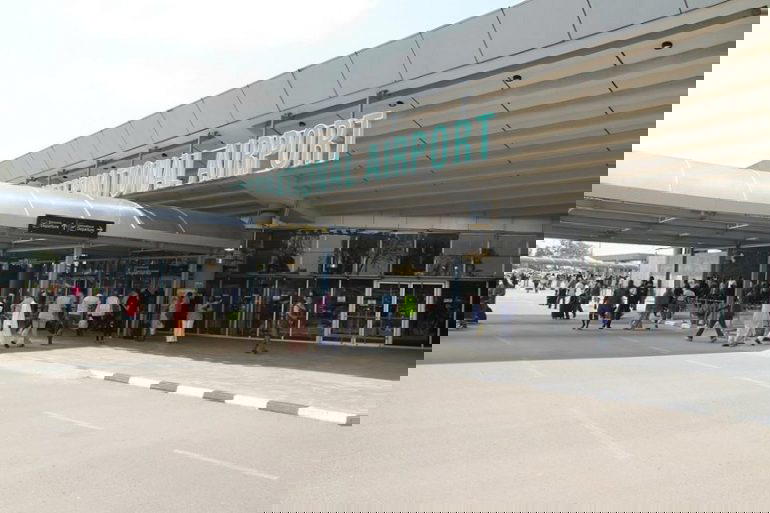
When Minister of Works Dave Umahi announced on Thursday, July 16, that the Federal Government has renamed the 750-kilometre Lagos-Calabar Coastal Highway, which is still under construction, after President Tinubu, he was just mimicking other public officials in a rat race to name public infrastructure after the president – a case of sycophancy on an obsequious boulevard taken too far. Others have travelled that route before him since Tinubu assumed office on May 29, 2023. On March 11, 2024, barely ten months in office, Niger State Governor Umar Bago renamed the Abubakar Imam International Airport, Minna, built in the 1980s, after Tinubu. It is now Bola Ahmed Tinubu International Airport.
Tinubu, a former federal lawmaker, who knows that airports are on the Exclusive Legislative List, as stipulated in the Second Schedule of the 1999 Constitution, was physically present at the renaming ceremony. He is aware that while state governments can fund and construct airports, like the Sam Mbakwe International Cargo Airport, Owerri, which was built by the good people of Imo State in the Second Republic, they do so under strict federal oversight and must hand over operational control to federal agencies like the Federal Airports Authority of Nigeria (FAAN) because only the federal government has the constitutional mandate to regulate aviation matters and airports in the country. The self-acclaimed farmer-governor of Niger State may not know, but Tinubu sure knows that no state governor has the right to rename an institution that is not in the Concurrent Legislative List and, therefore, outside its purview. But what does it matter as long as he is the primary beneficiary of the apple-polishing gesture?
The Minister of Aviation and Aerospace Development, Festus Keyamo, must be cursing Bago for stealing his thunder. But not to worry. No honour is too high for Nigeria’s “Dear Leader.” So, he can rename the Nnamdi Azikiwe International Airport, Abuja or the Murtala Muhammed International Airport, Lagos after Nigeria’s great hope renewer. Then in May 2024, Tinubu’s alter-ego, the Federal Capital territory Minister, Nyesom Wike, renamed the Abuja Southern Parkway as Bola Ahmed Tinubu Way. One year later, in June 2025, he upped the ante by renaming the renovated Abuja International Conference Centre, which was built by General Ibrahim Babangida in 1991 as the Bola Ahmed Tinubu International Conference Centre. The complex, which was funded through an urgent oil-swap arrangement to prepare Nigeria for the hosting of a meeting of the defunct Organisation of African Unity (OAU) at the cost of N240 million (approximately $29.6 million based on the exchange rate at the time), was renovated with a whopping N39 billion.
But a year before Wike’s second coming on the renaming thoroughfare, the National Assembly had in May 2024, renamed its library after Tinubu. The facility, begun under the Ninth Assembly, was completed by the Tenth Assembly and inaugurated by the president. In December 2024, the Nigeria Immigration Service named its command and control centre the Bola Ahmed Tinubu Technology Innovation Complex (BATTIC), and a month later – January 2025 – the Ministry of Education joined the fray when the federal government led by the self-same Tinubu approved the establishment of Bola Ahmed Tinubu Polytechnic in Gwarinpa, Abuja. To prove that their loyalty to the Commander-in-Chief is not in doubt, the Nigerian Army, later that month and in the tradition of North Koreans honouring their “Dear Leader” named a newly built military barracks in Asokoro after Tinubu to “give honour to whom honour is due.” Of course, many more will come. It has become a rat race and nobody wants to be left out. In fact, the new yardstick for measuring loyalty to Nigeria’s emergent Supreme Leader, the Father of the Nation, is how many institutions a government official or agency names after him while he is still in office. It is sycophancy pro max and it will not be a surprise if the Central Bank of Nigeria rolls out a N5,000 note with Tinubu’s image emblazoned on it.
After all, if the faces of “lesser mortals” adorn the country’s currency notes, why should that of the great leader who is refashioning the country in his own image be left out? And if not now, then when? But I quarrel with the piecemeal approach. Rather than renaming Nigeria after Tinubu a little bit at a time, the National Assembly should fast-track the process by passing a “Rename Nigeria Bill.” Such a bill should be given accelerated hearing just like the National Anthem Bill and passed within one week. By so doing, Akpabio will consolidate his reputation as a presidential lickspittle and Tinubu will get his deserved flowers as the master political strategist, the man who conquered a country of over 200 million people by subterfuge and political hanky-panky.
The post Nigeria as Federal Republic of Asiwaju? Why not! By Ikechukwu Amaechi appeared first on Vanguard News.