
May Day 2026: From stadiums to the streets
 SKAiF NewsNG SNN
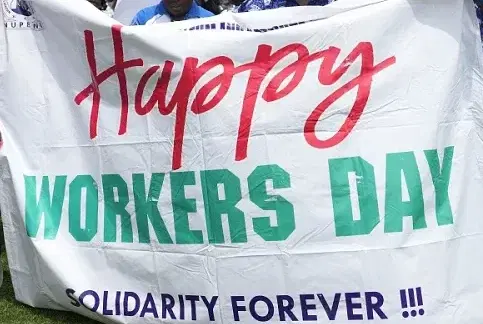
May 1, 2026, will not be remembered for the typical colour and pageantry of march-pasts in front of state governors. Instead, it marks a return to the roots of the Labor Movement—the street. By directing workers in defaulting states to abandon ceremonial venues, Organised Labour – the Nigeria Labour Congress, NLC, and Trade Union Congress, TUC – has sent a definitive signal: there can be no “celebration” of work where the worker is neither safe nor solvent.
The theme of this year’s commemoration, “Insecurity and Poverty: Bane of Decent Work,” is a brutally honest diagnosis of the Nigerian condition. For the first time in our recent history, the “Decent Work Agenda” is being suffocated not just by poor wages, but also by a pervasive climate of fear and an inflationary spiral that has turned the N70,000 minimum wage into a nostalgic relic of 2024.
In 2026, we are witnessing the birth of the “working destitute”—men and women who hold full-time jobs yet cannot afford the transport or the security to return home from work. The “bane” mentioned in this year’s theme is twofold. First, insecurity has fundamentally altered the geography of productivity.
When farmers in the food baskets of the Middle Belt are taxed by non-state actors just to till the soil, and when urban workers face the “ransom tax” of unsafe travel, the cost of labour rises while its output falls. Second, poverty has been “formalised.” With headline inflation making a mockery of the 2024 National Minimum Wage Act, the Labour Movement’s demand for a N154,000 adjustment is not a grab for luxury; it is a desperate attempt to keep the engine of the national economy from knocking.
The decision by the NLC and TUC to shun government-hosted receptions is an act of institutional integrity. It acknowledges a painful reality: you cannot toast to the “dignity of labour” with an administration that violates the sanctity of a signed Wage Act. In states where “consequential adjustments” remain a theoretical exercise, the street becomes the only legitimate venue for the working class to find its voice.
As we look toward the remainder of 2026, government must realise that the “working poor” are the most dangerous demographic in any republic. When the gap between policy rhetoric and the worker’s pantry becomes an abyss, the social contract dissaolves.
This May Day, the message from the barricades is clear: Work cannot be “decent” if the worker is hunted, and labour cannot be “productive” if the labourer is hungry. Nigeria stands at a crossroads where it must choose to either fund the welfare of its people or face the inevitable friction of their discontent.
The era of ritual symbolism is giving way to a new era of radical accountability.
The post May Day 2026: From stadiums to the streets appeared first on Vanguard News.