Inside Lagos’ waste, flood crisis (2): LAWMA, refuse collectors shift blame
 SKAiF NewsNG SNN
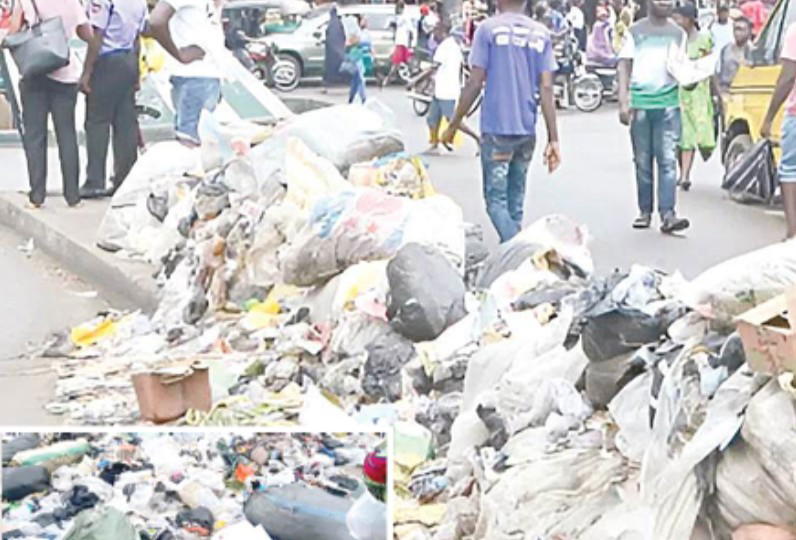
By Olasunkanmi Akoni, Esther Onyegbula, Juliet Umeh & Cynthia Alo
In the first part of this report published last Sunday, Lagos residents and council chairmen traded claims on refuse heaps ‘decorating’ roads in the state. Today, the regulator of waste, Lagos Waste Management Authority (LAWMA), and refuse collectors under the aegis of PSP Operators share their perspectives. Read on.
Addressing the issue of waste on roads’ median in Lagos, Managing Director of Lagos Waste Management Authority, LAWMA, Dr. Muyiwa Gbadegesin, stressed that keeping the state clean remains a collective responsibility.
According to him, the problem of refuse in Lagos has persisted because some residents have decided that they will put their waste on the road instead of giving it to PSP operators.
He said: “Lagos will be free from dirt when Lagosians decide that Lagos will be free from dirt. It is collective. If everyone in Lagos decides today that there is not going to be waste on the road again, then we won’t have a problem.
“But now, some people have decided that they will put their waste on the road instead of giving it to the PSP operator.
“If you have any delay in your collection, reach out to LAWMA. Don’t bring your waste to the roadside. That’s when we will stop having waste on the roadside”.
Gbadegesin, however, assured that the heaps of refuse across the state will soon be a thing of the past following strategic intervention aimed at strengthening waste evacuation operations and improving waste management infrastructure.
The LAWMA MD spoke during the commissioning of the rehabilitated Road E and newly constructed disposal platforms at the Olusosun Disposal Facility, Ojota.
He described the project as another significant milestone in the Lagos State Government’s efforts to eliminate operational bottlenecks, improve access within the disposal facility and enhance the efficiency of waste evacuation across the state.
Municipal
According to him, the rehabilitation of Road E became necessary after recent heavy rainfall affected access to parts of the facility, slowing the movement of compactor trucks responsible for evacuating municipal waste from different parts of the state.
The upgraded access road, he said, would improve access for waste evacuation vehicles, enable more trucks to discharge simultaneously and reduce turnaround time at one of the state’s busiest waste disposal facilities.
Gbadegesin said: “We announced that the site, we’re winding down activities, and that we have a timeline.
“If you recall, we said 18 months from the time that we did groundbreaking on construction of the transfer loading station.
“You have been seeing trucks coming and going and you have also been seeing the queues.
“What we’ve done here is to reclaim a portion so that we can have somewhere to dispose as we wind down the activity.
“That’s what we’ve achieved, and some of the waste backlog on the roads will be cleared away because it is not a good thing for us to have waste on our roads.
“By opening this place, we have created more space. Over the next few days there won’t be refuse on our roads.
”This project represents another important milestone in our commitment to building a more efficient and resilient waste management system for Lagos. By improving access to the disposal facility and expanding operational capacity, we are addressing immediate challenges while laying the foundation for long term improvements in waste evacuation across the state.”
Olusosun
Gbadegesin noted that the intervention reflected Governor Babajide Sanwo-Olu’s commitment to strengthening critical waste management infrastructure through strategic collaboration with the private sector.
He commended Zoomlion Nigeria Limited for rehabilitating the road, saying the company’s support had evolved beyond Corporate Social Responsibility into a broader technical collaboration in waste infrastructure development.
“Waste management is highly resource intensive, and addressing the challenges requires strategic partnerships, technical expertise and sustained investment. We are pleased that our collaboration with Zoomlion is contributing to the transformation of critical waste management infrastructure in Lagos,” he stated.
The LAWMA boss disclosed that Zoomlion is currently constructing modern Transfer Loading Stations at Olusosun and Solous III, each designed to process 2,500 metric tonnes of waste daily.
He added that the state government is also implementing other long term infrastructure projects, including Material Recovery Facilities, waste to energy plants, biogas facilities and the planned acquisition of additional compactor trucks over the next three years.
Gbadegesin said Olusosun currently handles about half of the municipal solid waste generated daily in Lagos, making continuous investment in waste infrastructure indispensable as the state gradually transitions to a more integrated and environmentally sustainable waste management system.
While reaffirming LAWMA’s commitment to improving waste management services, he urged residents to patronise assigned PSP operators, pay promptly for waste collection services and refrain from indiscriminate dumping of refuse.
Managing Director of Zoomlion Nigeria Limited, Mrs. Habiba Abubakar, disclosed that the project was completed within 26 days, ahead of schedule, describing the rehabilitated road and disposal platforms as the first phase of a broader partnership with LAWMA.
PSP Operators react
Speaking on the waste management challenge in the state, the National President of the Association of Waste Managers of Nigeria, AWAMN, Mr. Oluwagbenga Adebola, said Lagos is facing infrastructure deficit in the area that will support effective and efficient waste collection, transportation, and disposal.
According to him, this inhibits quick turnaround time for compactor trucks.
He also spoke of people doing indiscriminate dumping, people who don’t want to patronize PSP operators, and people not wanting to pay for services rendered
Adebola said: “For the drivers and all the crew operating on the trucks, some of them spend several days here, and it impacts negatively on their wellbeing and their health.
“You can imagine a driver and evacuator staying here for several days. This is a mosquito infested area.
“Mosquitoes bite them, they suffer malaria and other illnesses. When you stay too long here, you are exposed to all manners of health challenges. Generally, I think it is going to improve their wellbeing.”
He added that operators also incur heavy financial losses whenever trucks remain stranded at the dumpsite.
“As operators and business owners, we are more or less at the receiving end. Every truck that sleeps here comes with consequences.
“People tamper with the trucks, damage them and even steal diesel. “Before now, bulldozers had to push trucks in and out because of the bad roads and that also affected the vehicles.
“All these are likely going to stop.”
He described the rehabilitation of the Olusosun access road as unprecedented.
“I will say it is unprecedented. It is a big kudos to Zoomlion, LAWMA and the Lagos State Government,” he said.
Adebola expressed optimism that ongoing investments in Transfer Loading Stations and other waste management infrastructure would further strengthen the state’s environmental management system and support LAWMA’s long term reform agenda.
“It will bring about quick turnaround time of the trucks. Once the trucks are able to dump within a very short period, it will definitely improve the overall service delivery of waste collection, transportation and disposal in Lagos State.
“We will have a cleaner, healthier and more aesthetic Lagos.”
He added that the intervention would serve as a stopgap while the transfer loading stations are being completed.
“Almost over 50 per cent of the waste collection in Lagos patronises Olusosun. So, if Olusosun sneezes, every Lagosian will catch cold. It is a good development for us and I hope it will be sustained.”
Adebola also said the rehabilitation would ease the persistent traffic congestion around the Olusosun axis.
“Even the traffic around this axis will be impacted positively. Before now, accessing this place was a terrible experience because of the long queues. Once we achieve a turnaround time of one hour or less, that traffic will disappear.”
20 trucks
Adebola said reduced waiting time would enable operators to increase the number of daily evacuation trips and improve service delivery across Lagos.
“Before now, trucks could only make two or three trips daily. Now we should be able to have nothing less than eight trucks dumping simultaneously.
“With additional facilities, that could increase to between 16 and 20 trucks. That is going to impact positively on almost everything.”
He added: “Road E has been completed so that waste collection trucks coming from households can drive in smoothly, dump their waste quickly and return to collect more refuse from house to house and neighbourhood to neighbourhood. “When waste is collected efficiently and dumped without delays, the environment stays clean.”
Dumpsites
Adebola urged residents to support government and PSP operators by disposing waste responsibly.
His words: “The key takeaway is that this project will help prevent indiscriminate waste dumping across Lagos State.
“We appeal to citizens not to dump waste everywhere but to wait for the collectors.
“Right now, this site has given us some relief and we hope other dumpsites will also be developed because we have about five major disposal sites.
“If people put their waste out properly for collection, it will reduce diseases like malaria. Waste is not really waste unless you make it so.
“Waste is actually a valuable resource. If processed properly, there is money in it.
“Our advice is that everyone should cooperate because a single hand cannot lift a heavy load onto the head.”
PSPs’ challenges
On the challenges faced by PSP operators, Adebola said: “I think we cannot overemphasize this issue. We are currently facing a challenge that is very, very unfortunate.
“Lagos is facing what we call an infrastructure deficit in the area of infrastructure that will support effective and efficient waste collection, transportation, and disposal.
“PSPs will collect waste, and that’s the only thing that the residents know. After the PSP collect the waste, people don’t care wherever they go to dump it, wherever they take it to.
“However, if where they are going to take it has a challenge, inaccessible roads, dump sites are almost at the point of filled up, you know, of course, occasioned by even the constant, continuous rain in June, July, and all that affected the overall turnaround of the trucks.
“The turn-around time of the trucks is affected.
“So if the trucks collect waste and they are unable to dump, then there’s no way they can go back and collect the waste, which is the number one challenge that we have.
“Of course, there are so many other challenges: Of people doing indiscriminate dumping, people who don’t want to patronize PSP operators, and, you know, people not wanting to pay for services rendered.
“Of course, some people might say, the PSPs are having truck challenges. Yes, we have some aging trucks, but it is not that bad. “At the last count, we were having over 100 or close to 1,000 trucks parading the streets of Lagos. Even if you have 2,000 trucks or 3,000 trucks and they are unable to get somewhere to dump their waste, it will all be stranded somewhere.
“And what are the measures? We have made it abundantly clear that we have been working with the government. And one of it is the commissioning of the Road E, one of the roads at Olusosun. That has actually brought about the creation of two platforms where PSPs and LAWMA too can dump.
“And so, since the commissioning, some few vehicles that have been stranded there for several weeks are now dumping. And then, with time, and hopefully when that place is maintained and sustained, and then there are requisite equipment to really do the day-to-day job, things can improve.
“However, it is not only that place that we have a challenge. All the dump sites, disposal sites in Lagos State are challenged: From Olusosun at Ojota to Solous, Igando, Ewu Elepe at Ikorodu, to Gbagada dump site at Badagry, and then to Epe dump site at Epe, all of them do have a major challenge regarding access roads.
“Having commissioned Road E, we are hoping—and I know that there is a whole lot of arrangement on ground working with LAWMA and then the state government, in fact, the Ministry of Environment.
“We had a meeting yesterday, Thursday, today, Friday, we had a meeting, all for all hands to be on deck to ensure that we have an improvement.
“I mean, once the infrastructure that are in deficit are provided, then waste management will go back to the normal effective and efficient service delivery.
“There are over 420 PSPs operating in Lagos. And then you’re asking how many of them are operating. I can assure you a large number of these people are operating.
“However, there are some challenges where people have actually serviced tenements for several years and then there’s no payment, and then the issue of non-implementation of cost-reflective tariff.
“I mean, both the Commissioner for the Environment and Water Resources, and LAWMA have talked about this severally.
“The current tariff that is being charged in the industry was set in 2022. That was before the full deregulation of the petroleum sector.
“Diesel was just N600 per liter, and diesel went up to N1,500, even up to N2,000 and over N2,000.
“The tariff has not changed. That cannot bring sustainability because in waste management, there is what we call the cost element.
“If you are not meeting your cost, the cost that you put into the industry, with time, people will just fizzle out. “There are some people that couldn’t even meet up with whatever, and they willingly left the industry because it’s no longer profitable. It’s not a business that they want to stay in. So there are a few of them like that.
“However, what we have been appealing and discussing with government, and I believe we are on the same page, is for government to provide an enabling environment: access to the dump sites, implementation of cost-reflective tariffs, and so on and so forth, including enforcement anyway, so that when you invest, you can recoup your money.”
The post Inside Lagos’ waste, flood crisis (2): LAWMA, refuse collectors shift blame appeared first on Vanguard News.