I told Abacha to disband clique of ‘bad influence’ officers around him — Abubakar
 SKAiF NewsNG SNN
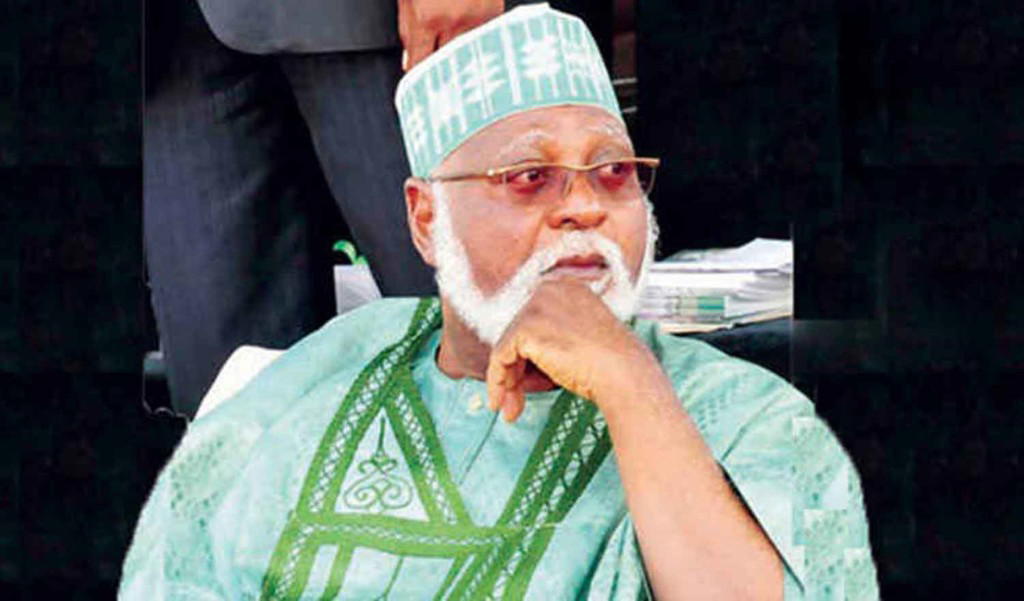
—His cabal marked me 3 other senior officers dow
—He was devoted to friends
—Only in 1999 I was shown money transferred to Abacha’s family, associates
By Johnbosco Agbakwuru
ABUJA — Former Head of State, General Abdulsalami Abubakar, has revealed how a clique of officers who acted as a kitchen cabinet for the then Head of State, General Sani Abacha, had marked him and a few other senior military officers down for elimination from the regime.
General Abubakar said he told General Abacha to disband the clique of officers around him because they were a bad influence on his government.
These and other accounts are contained in the autobiography of General Abubakar titled Call of Duty, which, alongside two other books — Nigeria’s Grand Patriot and Mediating for Peace in Africa — were presented on Saturday at the event marking his 84th birthday at the Old Banquet Hall, Presidential Villa, Abuja.
The event was attended by President Bola Tinubu, represented by his deputy, Vice President Kashim Shettima; the former Head of State, General Yakubu Gowon, who chaired the event; and former presidents Olusegun Obasanjo and Goodluck Jonathan, among other high-profile personalities.
In his autobiography, General Abubakar gave insight into the group he described as “caucus members” in General Abacha’s military administration, who wielded significant influence in the running of government.
He said some officers initially penciled for retirement escaped because the late General Sani Abacha was devoted to his friends.
“To be fair, General Abacha was loyal to his friends. A caucus that sprang up when he became Head of State didn’t want to see some faces around, and they often insisted that some officers be retired.
“All the time, four of us who were slated for retirement survived because Abacha was devoted to friendship. They wanted him to retire Lt-Gen Jeremiah Useni, Lt-Gen Garba Duba, Maj-Gen Mohammed Balarabe Haladu and myself. Ironically, all those hawks were retired before us. They became a pain in Abacha’s neck and he had to get rid of them.”
Abubakar, who was Chief of Defence Staff (CDS) to Abacha, said: “I didn’t bother to find out why I was made Chief of Defence Staff. I believed it was Abacha who insisted. As I noted already, he was very loyal to his friends.
“This same group of people urged him to arrest General Babangida. He asked them what his offence was and they said charges could always be found after his arrest. People who knew Abacha through Babangida would come and ask Abacha if it was okay for them to go and visit Babangida. Abacha had some qualities that I respected. We were friends. In our discussions, I would call him ‘Sani’ and he would call me ‘Mallam.’
“In one of our conversations, I told him that he needed to disband the group of officers that formed the clique around him. He initially wanted me to talk to them and ask them to be careful, but I refused and insisted that he should be the one to speak to them. Finally, one by one, he retired them from the military. However, two or three were lucky to escape retirement because they were not as exuberant.”
Abubakar, a member of the then Provisional Ruling Council (PRC), the highest ruling body, said contrary to reports that the regime did not hold meetings, they actually did.
“However, I found out that some matters were discussed by ‘the kitchen cabinet’ and in some cases decisions were already taken prior to the meetings. Abacha sometimes asked our opinion on the political crisis rocking the country. Although the buck stopped at his desk, some of us still managed to pass our suggestions to him.”
Abacha ignored our appeal for MKO’s release
“Abacha was not bound to listen to us or take our advice. We asked him to release Bashorun MKO Abiola from detention and to discuss with him one-on-one the way forward after he was arrested for proclaiming himself President based on the June 12 election. However, Abacha did not give our advice any positive consideration.
“It was a difficult period for Nigeria. Powerful foreign nations imposed sanctions on us. Some were targeted at the military and members of Abacha’s government. In the end, we were all part of the administration. No matter what I say, I cannot deny that I was his Chief of Defence Staff and a member of the PRC. But the final decision was for the Head of State to make.”
Abacha loot
General Abubakar said the reports that looted funds were traced to Abacha were very strange to him, stressing that the Abacha he knew was very strict with accountability.
“In fact, whenever Abacha commanded any unit in the Army, he hardly spent allocated funds. Whenever he was replaced or posted out, the new commander always found the money in the account.
“When I was Chief of Defence Staff, Abacha would sometimes call me to his office for us to sit down and do proper costing before releasing money for the military. He hated waste. Sometimes, he would bring out his calculator before releasing money for the purchase of equipment for the military. That was the Abacha I knew.
“It was in the closing days of our administration in 1999 that I was shown papers of money transfers to accounts traced to members of his family and associates. After I left office, I was told that Abacha took those monies out of the country in the event of sanctions on Nigeria by Western countries.
Why Abacha shifted funds abroad
“He was said to have been so advised by Colonel Muammar Gaddafi, the Libyan leader who faced heavy sanctions from the West. He reportedly advised Abacha that if the Western powers froze Nigeria’s assets, his government would be stranded if he did not have funds abroad. I honestly cannot confirm or deny these explanations. But I would be lying to say I thought of Abacha as a thief.
“Unfortunately, he didn’t put some of us in confidence about what he was doing. Perhaps it would have been a different story. I know that he bought vehicles for all the security agencies. All the security agencies received the famous Tata trucks. Again, he sustained the Economic Community of West African States Monitoring Group (ECOMOG) operations. Nigeria bore the brunt of those operations in terms of logistics, armament and others.”
He said that Abacha’s government was never short of events and that the June 12 crisis was the biggest, but there were also issues of alleged coup plots and incidents of bomb blasts here and there.
Obasanjo, Yar’Adua arrest
“In March 1995, some military officers were arrested for plotting to overthrow Abacha. General Olusegun Obasanjo, former Head of State, and Maj-Gen Shehu Musa Yar’Adua, his former No. 2, were both arrested over what was called the Colonel Law and Gwadabe Coup.
“I have been asked many times if I believed there was indeed a coup plot. This may disappoint readers but I was not in a good position to know. I was a Major-General and Chief of Defence Staff, quite right, but things were happening that I was not in the picture. I was often in the dark, apparently by design.
“All I can say is that there was a group of young officers who were hungry for power and wanted to do certain things, but Abacha put his foot down and refused to implement their suggestions. Maybe in their analysis, they felt Abacha was a stumbling block to their ambition and thought it would be wise if they removed him from office. This was my guess.
“Obasanjo was sentenced to 25 years’ imprisonment while Yar’Adua got two death sentences. There was nothing I could do and it was quite painful to me. The good thing was that a number of officers, including myself, pleaded on their behalf when their cases were tabled before the PRC.
“The sentences were reduced or commuted. Obasanjo’s imprisonment was reduced to 15 years while Yar’Adua’s death sentences were commuted to life in prison. Although there were threats of sanctions by the U.S., I would think God also helped them. It wasn’t yet their time to die.
“When you look at the whole saga again, there was no way you would not read politics into the implication of Obasanjo and Yar’Adua. Both men were critical of Abacha. Yar’Adua in particular was floating political organisations and movements and asking what Abacha’s transition plans were.
“When he was arrested, Obasanjo was abroad. I went to see Abacha and reminded him that Yar’Adua was our commander during the Civil War and whatever his offence was, he needed to call him to find out for old time’s sake.
“He was a wonderful commander to both of us and it was only fair if Abacha could repay his good deed to us. He said he had heard me. When I raised the issue the third time, he said that should be my last time of bringing it up. I retreated.
“Obasanjo was arrested when he returned to Nigeria. We tried to intervene but they insisted there was a coup plot and his name was mentioned and that they were going to give us evidence. Colonel Bello Fadile was said to have mentioned his name to the interrogators.
“He claimed to have met with Obasanjo and discussed the plan with him. Obasanjo denied having ever met him. The public impression was that Abacha didn’t want anyone to criticise him and decided to keep Obasanjo out of circulation, but I think it was because his name was mentioned in the coup plot.
“There was another coup controversy. In December 1997, Nigerians were jolted to hear that top Generals had been arrested over a plot to overthrow Abacha. His No. 2, Lt-Gen Diya, was accused of leading the plot. Maj-Gen Abdulkareem Adisa, Minister of Works, and Maj-Gen Tajudeen Olanrewaju, Minister of Communications, were also named in the Christmas Eve shocker. I was not in the know of the allegations and investigations until the very last stage when they were to be arrested and charged.
Plot to implicate me by Abacha’s boys
“I later listened to the tapes of the interrogations. One of the interrogators was asking one of the alleged plotters if they got in touch with me and if I was in the know of the plot.
“He said they never contacted me. It appeared those who wanted me retired earlier were still on my case and were looking for anything to hang on my neck. Thankfully, they did not succeed.
“As I never took part in any coup in my entire military career, why would I be plotting close to my retirement and against a man who was not only my friend but one who had backed me when his caucus wanted me retired.
Even as CDS.*
I was sidelined
“Despite being the CDS, I wasn’t involved in the investigations. The entire affair was handled at Army Headquarters. The home truth was that a large chunk of Abacha’s kitchen cabinet did not see me as part of the administration. I was okay with that.
“I did validation. I had the trust of my Commander-in-Chief and that was all that mattered. If he did not trust me, he would not have saddled me with the responsibility of being the CDS. The inner-caucus officers tried all they could to get rid of me, partly because they knew there were certain things I would not be part of and would even stop by using my powers as CDS.
“A good example was when I travelled to Abuja from my Lagos base to see the Head of State. Luckily, some members of the caucus were in Abacha’s office. When I entered the room, his spokesperson, the late Chief David Attah, was leaving with a piece of paper and Abacha said: ‘Very good! Please give the paper to the CDS so he can see.’ I glanced through the list.
“It was a statement meant for 4pm news announcing the retirement of some officers. I collected the paper and asked Attah to excuse us. I then said to Abacha that it was unfair. I suggested that he should call the affected officers and ask them to resign rather than for them to hear over the radio that they had been retired.
“I told Abacha that I was the CDS and he should allow me to handle it. My action irritated the so-called kitchen cabinet because those retirements didn’t see the light of day for almost a year. Strangely, there were civilians on the list. In my conversation with Abacha, I was particular about one of the civilians.
“‘Sir,’ I said, ‘I was present when you summoned the civil servant in question, and he informed you that he was already going on retirement because he was tired and he asked you to promise to find a replacement for him after a year. How do you think he would feel if he suddenly heard his name on radio that he had been retired? It is not fair.’
“He saw my point and that civil servant wasn’t retired until two or three years later. My intervention did not please the caucus. It became obvious that I was a stumbling block to some of their activities. That was why I was always marked down by them, along with others whom they were never comfortable with. All the same, Abacha stood by us. Maj-Gen Haladu eventually retired on medical grounds. Lt-Gen Duba retired of his own accord. Lt-Gen Useni retired when I became Head of State.”
The post I told Abacha to disband clique of ‘bad influence’ officers around him — Abubakar appeared first on Vanguard News.