Global trade without labour, a time bomb for job insecurity
 SKAiF NewsNG SNN
… as WTO demands urgent action to shield workers from AI disruption
By Victor Ahiuma-Young
Since the creation of the World Trade Organisation, WTO, in 1995, global trade has grown tremendously—transforming economies, boosting exports, and creating billion-dollar corporations. But beneath the mind-boggling figures lies a disturbing reality: workers — the very engine of production and services — have been consistently sidelined in trade negotiations.
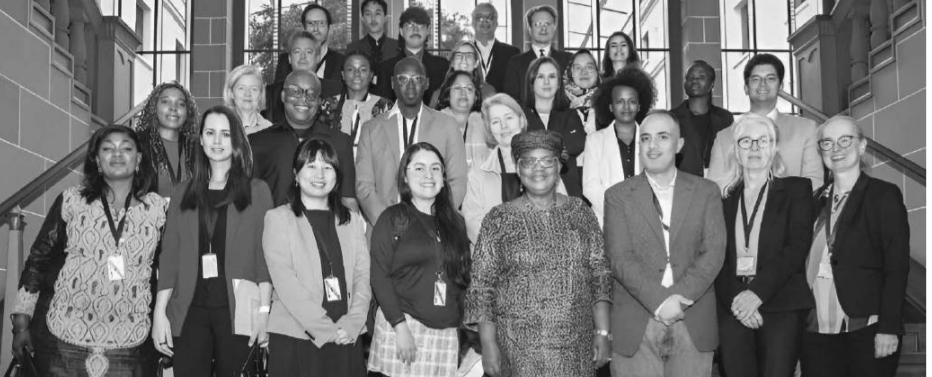
Ngozi Okonjo-Iweala (4th right), at the recent Journalist Programme on Global Trade Policies in the Context of the WTO
Public Forum 2025 for English-speaking journalists in Geneva, Switzerland.
Sadly, the world economic leaders have failed to appreciate the fact that Labour Creates Wealth as Nigeria Labour Congress, NLC’s motto reads.
The continued exclusion of trade unions across the world is not only unacceptable but also unjust and dangerous. The neglect of this critical stakeholder has led to the death of many industries in developing countries, including Nigeria, resulting in massive job losses, rising inequality, erosion of labour rights, and mounting insecurity linked to trade agreements that ignore job creation and employment security.
One of the earliest casualties of labour’s exclusion has been employment itself. Since inception, WTO’s emphasis on liberalisation and open markets has favoured foreign investors and multinational corporations over local industries and workers.
For instance, the removal of trade barriers led to the collapse of many small and medium-scale industries in developing countries, pushing millions into unemployment. Before Nigeria became a founding member of the WTO on January 1, 1995, the textile sector had over 250 textile and garment mills, including cotton processing companies, employing over 500,000 people. The sector was then the second-largest employer of labour after government.
Today, the sector can barely boast of a dozen operational factories nationwide, providing fewer than 15,000 jobs following steady closures and layoffs.
Meanwhile, cheaper foreign goods—often smuggled into the country—have flooded the market. Similar fate befell the leather and tyre industries, with once-vibrant firms such as Bata, Lennard Shoes, Michelin, and Dunlop shutting down and throwing their workers into the job market.
Trade liberalisation promised prosperity, but for workers, it has meant job insecurity, outsourcing, casualisation, and wage suppression. Without unions at the negotiating table, the fate of workers and their livelihoods is often traded away in the fine print of agreements designed for profit maximization and capital growth.
The International Labour Organisation, ILO, has repeatedly highlighted that the gains of global trade are unevenly distributed — with capital reaping the most benefits while labour struggles for survival. By excluding unions, trade deals rarely include labour clauses to protect workers’ rights, leading to exploitative conditions as seen in Nigeria and many other developing countries. This has aggravated issues such as unsafe workplaces, child labour, and poverty wages.
Evidence abounds linking joblessness and growing insecurity in Nigeria and other developing economies. As the saying goes, an idle mind is the devil’s workshop.
Experts warn that rising unemployment, especially among youths, contributes directly to social unrest, migration crises, and recruitment into extremist movements.
Observers have consistently cautioned that a global trade system that ignores workers is a recipe for insecurity.
When people lose hope in employment, decent work, and fair wages, they resort to restiveness and desperate alternatives—fuelling instability everywhere.
On September 15, 2025, WTO members signed the Agreement on Fisheries Subsidies, which Director-General Ngozi Okonjo-Iweala described at a special General Council meeting in Geneva as “a landmark for global trade governance,” emphasizing that cooperation through multilateralism remains essential for addressing global challenges.
Okonjo-Iweala urged all remaining WTO members to complete their ratifications ahead of the organisation’s 14th Ministerial Conference in March 2026.
“One of my key aspirations is to see the agreement ratified by all members,” she said. “Universal participation would cement its promise of healthier oceans and more secure livelihoods.”
However, critical questions remain: What are the implications of this agreement for labour? How will it benefit Nigerian small, medium, and large-scale fishing companies and their employees? As usual, trade unions were not part of the negotiations leading to the deal.
AI, new global challenge
Currently, the WTO is debating and negotiating e-commerce policies as the world grapples with the consequences of Artificial Intelligence (AI) on the global economy. The organisation has already sounded the alarm over the far-reaching impact AI could have on jobs, urging governments to invest massively in education, skills, retraining, and social safety nets to prevent workers from being left behind.
At the launch of the 2025 World Trade Report, titled: Making Trade and AI Work Together to the Benefit of All, WTO officials warned that while AI has the potential to supercharge trade and economic growth, it could also deepen inequalities and displace millions of workers if countries fail to act.
“AI is already reshaping our economies and our societies,” the report stated. “Though not without risks of its own, AI has the capacity to transform the ways we produce, consume, and trade. But one important question is whether AI will lift opportunities for all, or deepen existing inequalities and exclusion.”
Director-General Okonjo-Iweala stressed that the labour implications of the technology cannot be ignored.
She said: “Within societies, AI could upend labour markets, transforming some jobs while displacing others. Managing these shifts demands investment in domestic policies to enhance education, skills, retraining, and social safety nets. The ongoing political backlash against trade has much to do with underinvestment in these areas during past decades of globalization. We cannot afford to repeat this mistake with AI.”
According to new simulations presented in the report, AI could increase global exports of goods and services by nearly 40 per cent by 2040 — “40 by 40,” as Okonjo-Iweala described it.
But the benefits will not be automatic. Without urgent measures to close the digital divide, low-income economies will see only modest gains.
“Our simulations show that without substantial improvements in digital infrastructure and AI adoption, low-income economies would see a modest 8% real income growth from AI, while high-income countries would register double-digit increases,” the report revealed. “Narrowing digital and AI divides could nearly double the GDP gains for low-income economies, to 15%, without significantly changing growth prospects in richer nations.”
The WTO also highlighted encouraging signs from the private sector.
“One key finding from our survey is that 90 per cent of firms using AI report improved efficiency in managing trade risks or compliance with border procedures,” said Emmanuelle Ganne, a senior WTO analyst.
To make AI a driver of shared prosperity, the WTO urged policymakers to align trade rules with investments in people and infrastructure.
“Trade could be a powerful enabler of an inclusive AI transformation,” the report stated. “Trade encourages knowledge to spread, opens new pathways for development, and provides access to key inputs, including cheaper green energy.”
Okonjo-Iweala noted that WTO agreements — from the Information Technology Agreement to the TRIPS Accord — already underpin the global AI value chain, but greater policy coherence is needed across competition, education, energy, and digital infrastructure.
She said: “Two years ago, we started thinking about what AI could mean for trade and for this organisation. There was no one demanding work on AI, but we asked ourselves: ‘Do we need to be prepared, because this thing is going to be big? We built a small unit on AI and frontier technologies, produced Trading with Intelligence, and now we have this report. That’s what being strategic is all about.
”The WTO also pledged to scale up technical assistance, including collaboration with the World Bank to upgrade digital trade infrastructure in Africa, and initiatives such as the Women Exporters in the Digital Economy Fund to help women-led firms seize AI-driven opportunities.
“Whether AI becomes a force for broadly shared prosperity or widening inequality will depend on the choices we make today,” Okonjo-Iweala concluded. “The WTO stands ready to support members to ensure that AI and trade work together for the benefit of all.”
Yet, in all these discussions, there was no mention of trade unions. While the WTO acknowledges potential job losses and disruptions, there appear to be no concrete plans to involve labour movements in shaping policies or agreements that will determine the future of work.
The lesson for trade unions in Nigeria and other developing countries is clear: they must insist on being part of future discussions and global agreements. WTO’s decisions are reached by consensus — and workers’ voices must not be excluded from that consensus.Global trade without labour is unsustainable. If the WTO and other trade blocs continue to ignore the voices of workers, the world risks deepening economic divides and fuelling social instability.
The post Global trade without labour, a time bomb for job insecurity appeared first on Vanguard News.