From Iyana Oworo to Oworo: More homes are gone, what remains is rubble
 SKAiF NewsNG SNN
By Nnamdi Ojiego
As the dust from the Iyana Oworo demolition is yet to settle, another Lagos community has been pushed into ruin. This time, bulldozers rolled into Oworosonki, turning a densely populated area into a sprawl of broken concrete and open wounds. What happened months ago in Iyana Oworo, condemned by many and barely addressed by authorities, has repeated itself with chilling familiarity.
Trapped in fear
From the Ogudu axis through Idi Araba, Musafejo, Coker and adjoining streets, homes disappeared in quick succession. The destruction stretched to the lagoon beneath the Third Mainland Bridge, leaving thousands without shelter and many more trapped in fear, uncertain if their streets would be next.
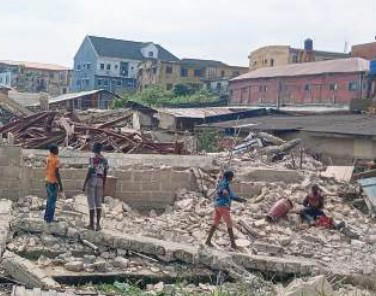
By the time this reporter arrived, stern looking security operatives had sealed off large sections of the area. Excavators moved steadily, reducing houses, churches, schools, hotels and small businesses to rubble. Some buildings were barely completed. Others had sheltered families for decades. What stood before the eyes was not urban renewal. It was human displacement on a massive scale.
Scavengers
Men and women stood in stunned silence, watching as concrete walls collapsed under steel claws. Children running around, seemed unaffected by the unfolding reality. Elderly residents sat on broken slabs, too weak to move, too shocked to cry. Those who could still act scrambled to salvage doors, roofing sheets or mattresses. Scavengers followed closely, hunting for iron rods, aluminium, electric cables and anything of value.
What was unfolding in Oworosoki bore the same marks as Iyana Oworo. Sudden action. Little warning. No clear plan for those left behind. And just like Iyana Oworo, the silence of those meant to speak for the people was deafening. Many had nowhere to go. Across the open grounds and nearby streets, families slept in the open or under makeshift tents made from torn tarpaulins and zinc sheets.
A resident who requested anonymity for fear of arrest said more than 2,000 houses had been pulled down since the exercise began.
Conspiracy of silence
”There is nobody speaking for us,” he said quietly. “Our traditional ruler is silent. The chairman of Kosofe Local Government has said nothing. We are on our own.”
He alleged that the land had been sold to a Chinese firm and that the latest demolition went beyond earlier boundaries because the company demanded more space.
“They said the first land was too small for the amount of money they paid,” he claimed. “That is why they came back again.”
Untouched
One thing stood out sharply amid the devastation. A one storey building remained intact, untouched by the excavators. Residents whispered that it belonged to a military officer. Around it, everything else had been erased.
For Pastor Michael, who superintends one of the biggest churches in the community, the loss was deeply personal. His church building, newly roofed, did not survive the bulldozers.
“We finished roofing the church just two days before they came,” he said, standing on the rubble. “I begged them to give me till the next day to remove the aluminium sheets, musical instruments and chairs because it was already late. They agreed. But in the middle of the night, they came back and demolished everything. We could not salvage even a pin.”
He paused, fighting back tears. “How do you explain this to your members?”
Boundaries
A community leader who identified himself simply as Otunba said the demolitions began as far back as 2023, with assurances that only shanties along the waterfront would be removed.
“They created waterways as boundaries,” he explained. “We believed that was the limit. This month, without any notice or letter, they came into our residential areas and started pulling down houses.”
Otunba said he lost three houses and received no compensation. “They did not pay anybody. I believe in God. No amount they give me can rebuild my houses. But the government should consider the people. Those in authority know the right thing to do”, he said.
Women bore the harshest weight of the crisis. Under a tree not far from the rubble, 38 year old trader, Funke Adebayo, sat with her three children.
Life savings
“We slept outside yesterday,” she said. “My youngest child has been coughing all night. All our clothes are inside that house.” She pointed to a flattened structure. “Where do you want us to go?”
Nearby, another woman, Mrs. Zainab, said she gave birth barely four months ago. “I was cooking when they came,” she recalled. “Before I could carry my baby, they had started breaking the walls. Everything is gone. I am begging anyone who can hear us to help.”
A carpenter, Sola Ogunleye, said he invested his life savings in building his home. “I bought the land properly. Now I am sleeping on the floor of a friend’s shop. They did not tell us anything. They just came.”
Original owners
Another victim, Kola Anu, said many of those affected bought their land genuinely from families believed to be the original owners.
“Some families sold the land to us,” he said. “Now the government wants the land and the same families have collected money again from those chasing us away. The ordinary people are the ones suffering.”
He shook his head slowly. “Nigerians are poor already. You are making them poorer. This is not acceptable. If the land was government acquisition, it should not have been sold to us in the first place. The families involved should be held responsible and the people be compensated.”
In Oworonsoki, homes are gone. What remains is rubble, fear and thousands of citizens left to sleep under the open sky, waiting for answers that may never come.
Meanwhile, Lagos State Government has defended the demolitions as part of its urban renewal plan, citing the need to reclaim public land for development, remove illegal structures, and address environmental hazards, stressing that affected residents received warnings and some compensation.
Mr. Gbolahan Oki, Permanent Secretary, Ministry of Physical Planning and Urban Development, insisted that due process was followed, with amnesty periods offered, while acknowledging that the exercise was for development and security.
Oki said that most of the demolished buildings were distressed, blocking drainage channels and posing security threats.
“Government cannot allow people to live in houses that are not fit for habitation. We are now insisting that every property in Lagos must have a certificate of fitness for habitation,” he said.
Commissioner of Police in the state, Olohundare Jimoh, also defended the demolitions, describing the affected buildings as “illegal structures” and “criminal hideouts.”
“Covernment is justified in clearing them. Genuine residents have been compensated,” he said.
The post From Iyana Oworo to Oworo: More homes are gone, what remains is rubble appeared first on Vanguard News.