Dotun Popoola’s Reclaimed Beauty: A Dialogue Between Continents
 SKAiF NewsNG SNN
By Osa Mbonu-Amadi
When Dotun Popoola’s eighth solo exhibition, “Reclaimed Beauty: A Dialogue Between Continents,” opened on June 12, 2026, at The Village by Tikera in Abuja, it arrived not merely as an art show but as a manifesto of transformation.
The exhibition presents 25 original sculptures and installations within 40 groups of organic-shaped, building-block-like artworks arranged together, all forged from discarded metal and repurposed industrial waste. This is not recycling as we know it; it is resurrection, because it gives dead scraps better values, elevating departed materials into meaning and cultural significance.
The Venue
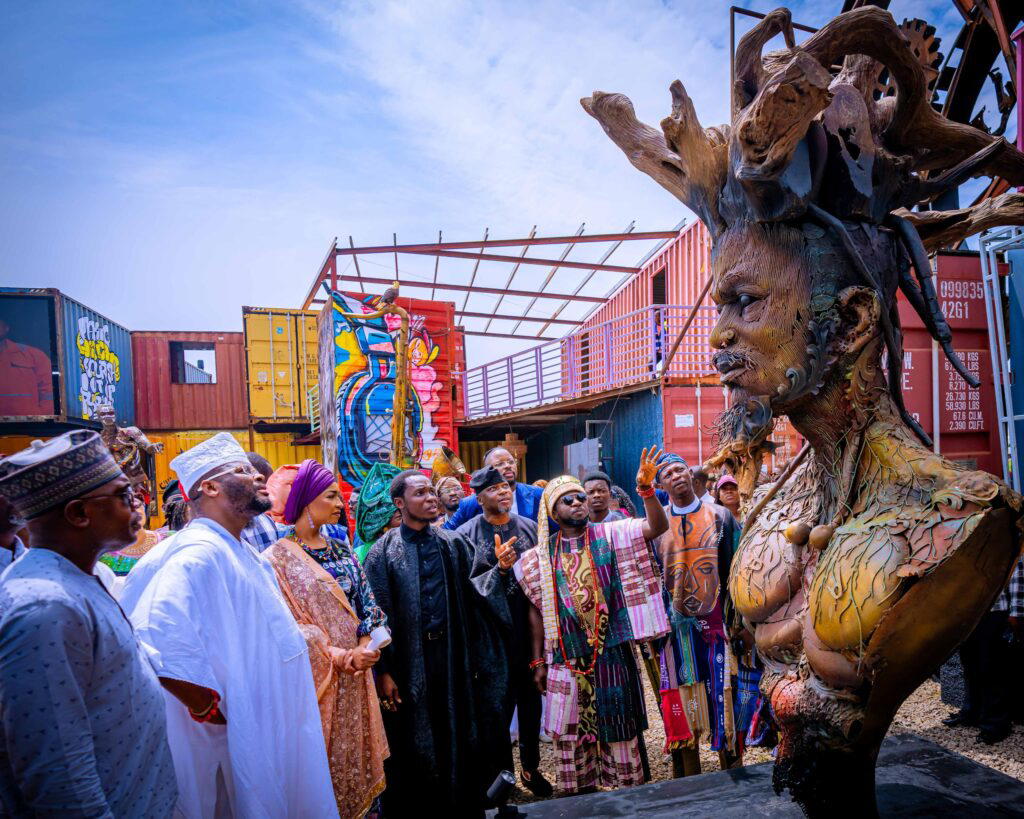
The venue itself mirrors Popoola’s artistic philosophy. The 32-hectare creative campus of The Village was constructed largely from reclaimed airplanes, shipping containers, train components, and salvaged materials.
As Bayo Omoboriowo, founder of Tikera Africa and developer of The Village, declared: “Everything you see here is scrap metal.” It is a perfect canvas for Popoola, inviting the world to witness what happens when imagination refuses to accept limits.
The exhibition, produced by Tikera Africa in partnership with the Scrap Art Museum, will remain open until end of September 2026, offering the public time to experience this transformation of reclaimed materials into works reflecting culture, history, and creativity.
Who is Dotun Popoola?
But, who is this Dotun Popoola?
Dotun David Popoola was born 1981 in Lagos. He is Nigeria’s most distinctive contemporary synergetic metal sculptor, specialising in hyper-realistic monumental metal sculptures. His artistic practice rests on a personal philosophy that “art should be explored as an agent of change, and as a tool of sociocultural review, reengineering and protest against environmental decadence.”
Popoola describes himself as “always on the move searching for new ideas, blending training in different forms of art from different schools and studios; different techniques and cultures, in order to create a unique form of art.”
The journey
His journey began at the age of 9 when his parents discovered his creative ability. He trained at art schools in Auchi, Ile-Ife, and America, eventually carving a niche for himself with works that transform trash to treasures, rubbish to rubies, and waste to wealth.
Exhibitions on the move
His exhibitions have travelled from Lagos to Bahrain, London, Turkey, the United States, Canada, Morocco, Senegal, Dubai, Qatar, India, Ghana, and Azerbaijan, before returning to Nigeria. In December 2024, his seventh solo exhibition “Reclaimed Beauty” opened at the Heydar Aliyev Centre in Baku, Azerbaijan, where it ran until October 2025. Now, in 2026, the eighth edition of this exhibition comes home to Abuja.
In 2024, Popoola earned the AMIAF Award for Hybrid Sculptor, cementing his status as a new generation sculptor. His work has appeared in over 100 publications locally and internationally. More than creating art, he facilitates workshops for students, professionals, NGOs, healthcare institutions, hospices, orphanage homes, and rehabilitation centers locally and internationally. He has emerged as a “role model” who has “lighted the paths of many budding artists” in neo-metal art, with artists now modeling their works after him and seeing him as their mentor.
His materials
Popoola doesn’t simply assemble discarded parts aesthetically. He is “mindful of recreating anatomically correct pieces,” fusing metal junk, cast bronze, and aluminium into masterpieces. His materials include kick-starters, shock absorbers, car parts, galvanised pipes, stainless steel, wrought iron, kitchen utensils, shovels, trowels, and head pans. In his monumental sculpture “Irinkemi Asake,” he employed over 5,000 metal butterflies!
Irinkemi Asake, the centerpiece
The exhibition’s centerpiece is Irinkemi Asake, a 12-foot-tall, 882-pound sculpture of an adorned African woman inspired by Popoola’s spouse. The name means “metals have enriched my life” in Yoruba. The sculpture is a towering tribute to African beauty, heritage, and resilience, fusing metal junk, cast bronze, and aluminium into a hyper-realistic form that celebrates the beauty of Blackness while protesting environmental decadence. As has been highlighted, over 5,000 metal butterflies surround the figure, creating a visual metaphor for transformation and renewal.
Not all Irinkemi
Beyond Irinkemi Asake, the exhibition presents a diverse range of works:
Akugo Gagara (The Rooster): A sizeable sculpture capturing the aggression and vitality of the bird;
Esin Oba (The Royal Horse): A majestic representation of nobility and power;
Boer Bell: An industrial yet harmonious form; Owiwi (Owl): A smaller sculpture, enigmatic and watchful; Okada (Bike): Capturing Nigeria’s ubiquitous motorcycle culture; Double Bass: A hybrid sculpture merging musical instrument with metal art and Fruit of our Labour: A sculpture embodying the rewards of persistence.
A review
Dr. Kehinde Adepegba of Lagos State University notes that Popoola’s use of colour is “much more innovative with the introduction of the impressionist palette of ocular mixture” compared to others before him. His expressive neo-metal art since 2018 with “Irin-Ajo” underscored “artistic imaginations, constructions and reconstruction, location and relocation, assemblages, and installations marrying culture with technology.”
The exhibition’s title, “Reclaimed Beauty: A Dialogue Between Continents,” is not merely poetic. It is architectural. The works create a visual conversation between societies separated by oceans, between industrial decay and cultural renewal, between what others see as waste and what Popoola sees as compelling beauty.
Hannatu Musawa, Minister of Arts, Culture and Creative Economy, underscored cultural diplomacy’s role in promoting Nigeria’s global image at the launch. She commended Popoola for transforming “what others see as waste” into “compelling works of beauty and cultural significance,” describing him as a “global cultural ambassador” whose work promotes environmental awareness and showcases Nigerian creativity internationally.
“You have elevated departed materials that have been put to waste into meaning and into something that is culturally significant,” Musawa stated.
She noted that people in Spain were talking about his art just 24 hours before the Abuja exhibition opened, confirming Popoola’s international reach.
The minister linked the exhibition to the federal government’s efforts to strengthen Nigeria’s cultural economy and soft power. She pledged government support for infrastructure development at The Village, which aligns with the government’s vision of positioning Nigeria as Africa’s cultural hub.
Popoola speaks
Speaking about his artistic journey, Popoola recounted how years of working with scrap materials such as kick-starters, shock absorbers, and car parts culminated in the monumental sculptures on display.
He reflected on how travel and cross-cultural interactions have shaped his work, citing an artwork inspired by native American imagery that was later adapted to celebrate northern Nigerian identity.
When asked what advice he would offer aspiring artists, Popoola said that courage, perseverance, and diligence are essential. “Everyone that can add that audacity and tenacity and the ability to work hard, definitely the world would listen,” he said.
The artist acknowledged the support of the Federal Ministry of Arts, Culture and Creative Economy, the National Gallery of Art, the National Council for Arts and Culture, Tikera Africa, GT Agency, the Scrap Art Museum, and the Scrap Art Foundation in making the exhibition possible.
He joined other participants in calling for stronger institutions, structured funding, and improved export mechanisms to help artists build sustainable careers and access international markets.
Reclaimed Beauty is not merely an exhibition; it is a philosophy of transformation made visible. Popoola’s work addresses three urgent contemporary concerns: Environmental Sustainability, Cultural Identity, and Artistic Innovation.
By transforming waste into beauty, Popoola protests environmental decadence while advocating for cleaner environments and creative reuse of materials. Second, the sculptures celebrate African beauty, heritage, and resilience, positioning Nigerian creativity on the global stage as a form of cultural diplomacy. Third, Popoola’s neo-metal art technique (fusing metal junk, cast bronze, and aluminium into anatomically correct forms) represents a genuine innovation in contemporary African sculpture.
Bayo Omoboriowo described the exhibition as “a natural fit” for The Village, calling it a reflection of Tikera’s vision of sustainability-driven creative ecosystems. He urged creatives to view constraints as opportunities for innovation, describing Popoola as an example of how creativity can evolve from an idea into an enterprise and an industry. “Dotun exemplifies the energy of turning craft into enterprise,” Omoboriowo said. “This place is a perfect canvas for people like him, inviting the world to see what we are doing here.”
After touring the exhibition, Minister Musawa said she was “overwhelmed” by the displays and urged Nigerians, especially young people, to visit and experience the transformation.
“My hope is for as many Nigerians to come and experience the amazing expression of culture, history and creativity that Dotun has shown,” she said.
Dotun Popoola’s “Reclaimed Beauty: A Dialogue Between Continents” represents a powerful intersection of environmental activism, cultural diplomacy, and artistic innovation. The exhibition continues Popoola’s global journey of transforming industrial waste into “symbols of creativity and renewal” while bringing his work home to Nigeria.
Omoboriowo challenged artists and cultural entrepreneurs: “Embrace local materials and innovation in building sustainable creative businesses. When imagination refuses to accept limits.”
And as Popoola advised aspiring artists, the message remains clear: “Everyone that can add that audacity and tenacity and the ability to work hard, definitely the world would listen.”
The exhibition remains open until September 2026 at The Village by Tikera, Abuja. It is a call to see waste differently, to recognise beauty in the discarded, and to understand that creativity can evolve from constraint into enterprise. For anyone interested in contemporary African art, environmental sustainability, or the power of cultural transformation, Reclaimed Beauty is not optional; it is essential.
The exhibition is produced by Tikera Africa in partnership with the Scrap Art Museum at The Village by Tikera, Abuja.
The post Dotun Popoola’s Reclaimed Beauty: A Dialogue Between Continents appeared first on Vanguard News.