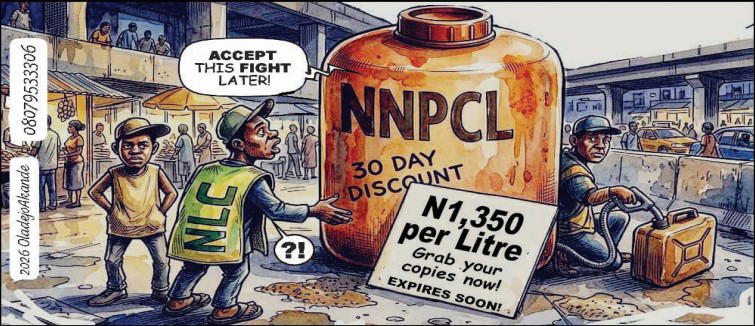
Can Agriculture Replace Crude? Experts reveal path to Nigeria’s export revival
 SKAiF NewsNG SNN
By Cynthia Alo
For more than five decades, crude oil has remained the dominant pillar of Nigeria’s economy, displacing agriculture from the position it once occupied as the country’s major source of revenue and foreign exchange.
However, with the global shift towards cleaner energy and growing concerns over the sustainability of oil dependence, experts are urging Nigeria to return to agriculture — not merely as a subsistence activity, but as a competitive export-driven industry capable of generating foreign exchange, creating jobs and strengthening the economy.
They argue that Nigeria’s agricultural potential remains largely untapped because the country continues to export mostly raw commodities instead of processing them into finished products that attract higher global value.
Oil Still Dominates Export Earnings Despite Growing Non-Oil Opportunities
Data from the National Bureau of Statistics (NBS) highlights the scale of Nigeria’s dependence on crude oil.
In the fourth quarter of 2025, crude oil exports stood at N9.70 trillion, representing 51.17 per cent of Nigeria’s total exports valued at N18.96 trillion.
During the same period, non-crude oil exports accounted for N9.26 trillion, while non-oil products — including agricultural commodities, manufactured goods, solid minerals and others — contributed N3.14 trillion.
Agricultural exports alone were valued at N1.323 trillion, accounting for about 42 per cent of Nigeria’s non-oil product exports during the quarter.
The trend continued into the first quarter of 2026, when crude oil exports rose to N11.20 trillion, representing 52.92 per cent of total exports valued at N21.17 trillion.
Non-crude oil exports stood at N9.97 trillion, while non-oil products contributed N3.19 trillion, with agricultural exports accounting for N1.172 trillion.
Although agriculture remains a significant contributor to non-oil exports, experts insist the sector’s performance is still far below its potential.
Raw Commodity Exports Limiting Nigeria’s Earnings
The NBS data shows that Nigeria’s agricultural export earnings are still driven mainly by unprocessed commodities.
Superior Quality Cocoa Beans topped the export list at N596.90 billion, followed by Sesamum Seeds valued at N153.78 billion, Soya Beans excluding seeds at N129.27 billion, Cashew Nuts in Shell worth N119.76 billion, and Soya Bean Flour and Meals valued at N53.20 billion.
Asia emerged as the largest destination for Nigeria’s agricultural exports, receiving products worth N529.45 billion, followed closely by Europe with N500.34 billion.
The Netherlands, Belgium, India and Canada were among the leading export destinations.
Experts, however, argue that Nigeria loses significant revenue by exporting raw materials instead of processing them locally into finished goods such as chocolate, cocoa butter, packaged foods and industrial products.
FG Moves to Improve Livestock Export Potential
The Federal Government has begun implementing reforms aimed at positioning agricultural commodities, particularly livestock products, for international markets.
The Minister of Livestock Development, Idi Maiha, recently disclosed that the ministry was developing a national animal identification and traceability system to improve Nigeria’s readiness for red meat and animal protein exports.
According to him, the system will strengthen product traceability, improve compliance with international sanitary standards and enable Nigerian livestock products to access premium markets.
The ministry is also working on policies to improve access to quality breeding stock, animal feed, certification and quality assurance systems across the livestock value chain.
The Director of Press and Public Relations in the ministry, Mrs Henrietta Okokon, told Vanguard that Nigeria was already one of Africa’s major exporters of animal-origin products such as bones, hooves and cow horns to China.
She said exporters could also explore opportunities in products such as bile acids and other industrial livestock derivatives used in pharmaceuticals and manufacturing.
“The Ministry maintains strict inspection, certification and quality assurance processes to ensure compliance with required sanitary and technical standards. Only facilities that have been inspected and certified are registered and issued export permits,” she said.
Okokon added that the ministry was encouraging processors to convert raw livestock by-products into higher-value commercial products to increase export earnings and create employment opportunities.
Agriculture Must Connect With Energy, Finance, Technology — Olusanya
The Lagos State Commissioner for Agriculture and Food Systems, Ms Abisola Olusanya, said agriculture cannot become a major export earner unless it is integrated with other critical sectors including energy, finance, logistics, infrastructure and technology.
Speaking exclusively with Vanguard at a summit, Olusanya said agriculture should no longer be treated as an isolated sector.
“The only way agriculture can become a major export earner is when we stop seeing it as a sector for a select group of people. Agriculture is connected to energy, finance, data, infrastructure and logistics,” she said.
She explained that producing food alone was insufficient without investments in cold chain systems, reliable electricity, transportation networks and data management.
Using the Netherlands as an example, she said coordinated planning across sectors had transformed the country into one of the world’s largest agricultural exporters despite its relatively small land size.
“The Netherlands is almost the size of Lagos State, yet it is one of the world’s largest agricultural exporters because every part of its system works together,” she said.
Olusanya stressed that Nigeria requires a national strategy rather than isolated interventions to unlock agriculture’s export potential.
Education Key to Building Skilled Agricultural Workforce — Chef Lizzy
The Head Chef Trainer at Lagoon Institute of Hospitality Studies, Chef Lizzy, said Nigeria’s agricultural transformation must begin with education.
She stressed the need to integrate agriculture and food innovation into the education system to prepare young Nigerians with the skills required for value addition and modern agricultural entrepreneurship.
According to her, many students entering agricultural innovation programmes lack basic agricultural knowledge, forcing institutions to spend time teaching fundamentals instead of focusing on innovation.
“The growth will be much faster if the educational sector comes on board. When students already understand the basics of agriculture before they get to innovation, it becomes easier to build on that foundation,” she said.
She added that stronger alignment between educational institutions and agricultural industries would accelerate growth in the sector.
Cocoa Processing: Nigeria Losing Value to Foreign Manufacturers
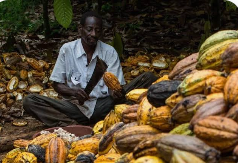
Cocoa farmers say Nigeria’s continued export of raw cocoa beans is denying the country huge economic benefits.
The Global President of the Cocoa and Coffee Farmers Alliance Association of Africa (COCEFAAA), Comrade Adeola Adegoke, said the challenge was not production but weak processing capacity.
He identified inadequate financing for processors, unreliable electricity, weak certification systems and inconsistent export policies as major obstacles preventing Nigeria from moving into higher-value cocoa production.
“Processing cocoa into butter, liquor or chocolate requires long-term investment, reliable industrial power and stable policies. Without these, exporters will continue selling raw beans while foreign manufacturers earn several times more from finished products,” he said.
Adegoke called for the establishment of processing hubs in cocoa-producing states, concessionary financing for agro-processors, expansion of quality testing laboratories and incentives for local value addition.
“Nigeria has never lacked cocoa. What we lack is the infrastructure and policy consistency needed to process it competitively,” he added.
Farmers Demand More Support to Replace Oil With Agriculture
The Acting National President of the Small-Scale Women Farmers Organisation in Nigeria (SWOFON), Chief Florence Ojo, said agriculture could replace oil as Nigeria’s leading economic driver if farmers receive sustained support.
She called for improved seedlings, affordable credit facilities, irrigation systems, rural roads, storage infrastructure and modern farm equipment.
“Agriculture creates jobs, reduces poverty and earns foreign exchange. Before oil became dominant, agricultural exports built landmark infrastructure like Cocoa House. We can achieve that again if government invests seriously in farmers,” she said.
Ojo also urged government to strengthen quality standards and encourage more young Nigerians to embrace agriculture.
Technology Can Drive Agricultural Export Growth
Technology experts believe digital transformation can accelerate Nigeria’s transition towards an export-focused agricultural economy.
The Co-builder of CONSai Agro & Energy OS, Mr Ahmad Ibrahim, said the global shift away from fossil fuels presents an opportunity for Nigeria to rebuild around agriculture.
He said digital tools could improve traceability, reduce post-harvest losses, attract investment and connect Nigerian farmers directly with international markets.
“Nigeria has spent decades sitting on black gold while standing on fertile ground. Agriculture — not oil — has always been the more sustainable foundation,” Ibrahim said.
He stressed the need for improved logistics, certification systems and stronger collaboration between government and private investors.
Private Sector Investment Critical to Unlocking Potential
The Founder and Chief Executive Officer of Golden Harvest Acres Ventures, Uzua Brainz, said Nigeria must begin treating agriculture as a commercial enterprise capable of generating sustainable foreign exchange.
He identified consistent policies, rural infrastructure, affordable financing, mechanisation, research, land reforms and stronger extension services as critical requirements.
According to him, government must prioritise high-value commodities, promote value addition and strengthen traceability and certification systems.
“A private sector-led approach, backed by stable policies and efficient logistics, will boost foreign exchange earnings and position agriculture as the cornerstone of Nigeria’s economic diversification,” he said.
Conclusion: Beyond Oil, Agriculture Remains Nigeria’s Untapped Opportunity
Experts agree that Nigeria’s agricultural future depends not only on increasing production but on building a complete ecosystem that supports processing, technology, financing, logistics and global competitiveness.
As the world gradually moves away from fossil fuels, they warn that Nigeria must decide whether agriculture will remain an overlooked sector or become the foundation of a new export economy beyond crude oil.
The post Can Agriculture Replace Crude? Experts reveal path to Nigeria’s export revival appeared first on Vanguard News.