Asaba massacre comes alive again through documentary film
 SKAiF NewsNG SNN
By Prisca-Sam Duru
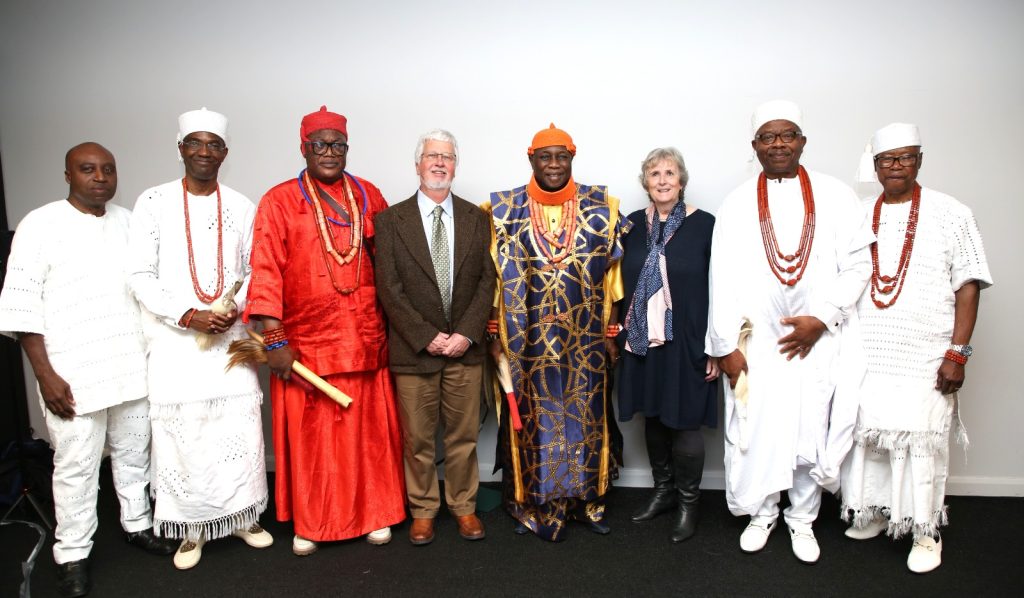
The premiere of the documentary “Earth Conceal Not the Blood Shed on Thee” on October 26, 2025, at The Africa Centre in London powerfully memorialised the Asaba Massacre of October 7, 1967, during the Nigerian Civil War, where federal troops under the 2nd Infantry Division killed hundreds of unarmed male civilians in the town. Executive producer Chief Chuck Nduka-Eze, the Isama Ajie of Asaba, drives the narrative through personal discovery, blending eyewitness accounts with expert commentary to advocate for global lessons in resilience and “Never Again.”
The massacre unfolded as Asaba residents, many in white (akwa ocha) attire, gathered to welcome Nigerian forces with “One Nigeria” songs, only for troops to separate and execute men and boys at Ogbeosowa square, with killings continuing sporadically.
Over 1,000 victims were slain, many buried in mass graves, amid widespread destruction, rape, and displacement that scarred the Igbo-majority town. The event, suppressed by the Nigerian government with British complicity, marked a grim pivot in the war’s ethnic violence.
The film features compelling voices, including HRH Prof. Epiphany C. Azinge (Asagba of Asaba), Nobel Laureate Prof. Wole Soyinka, the late Onyeka Onwenu, artists like Victor Ehikhamenor and Rom Isichei, and historians such as Prof. Elizabeth Bird.
At the premiere, dignitaries like Prof. Oba Nsugbe (Africa Centre chair) and Dr. Charles Adams joined, reinforcing calls for a federal apology and university in Asaba. Nduka-Eze’s script emphasises Asaba’s recovery as a thriving Delta metropolis, offering hope amid unacknowledged perpetrators honored in public spaces.
The London event, attended by Asaba diaspora leaders, institutionalised annual remembrances with a one-minute silence and 21-gun salute every October 7, positioning the film as a tool for healing and international peace advocacy. By drawing parallels to global traumas like Rwanda’s genocide, it highlights Asaba’s “sangfroid resilience” without bitterness. This premiere enriches Civil War documentation, urging reflection over vengeance for future leaders.
The documentary was also shown to a fairly large upscale audience at the Jet Ski Club, Ademola Street, Ikoyi, Lagos, on November 26, 2025.
Considering that Nigeria derived its name from the River Niger, and that River Niger was heavily polluted with the blood of innocent people of Asaba in October 1967, a school of thought believes that that incident was the root cause of Nigeria’s problem.
The same school of thought also believes that God is merciful; that if Nigeria genuinely repents and forsakes her evil ways and submits herself for a ‘thorough blood transfusion’, she might obtain forgiveness and survive. Otherwise, she must pay the supreme price – death, both of body and soul.
Chief Chuck Nduka-Eze, the Isama Ajie of Asaba and Executive Producer of the film documentary, was asked this question: As the Executive Producer of the documentary on Asaba Massacre titled “Earth Conceal Not the Blood Shed on Thee”, how tenable do you think the above thought is?
Here is his response:
“The question you raised is as urgent as it is poignant. It has always been my position that the secret to our country’s harmonious resorgimento lies buried in the blood-stained Square at Ogbesowe where the dream of One Nigeria was sadly desecrated by the Second Division of the Nigerian Army on 7th Oct 1967 – who were led on that tragic occasion by Lt Col Muritala Muhammed and his deputy, Lt Col Ibrahim Taiwo.
“On that occasion innocent unarmed civilians (mostly Asaba men) numbering in their hundreds and thousands were lured to Ogbesowe Square by the Nigerian troops, ostensibly to demonstrate their loyalty to the Federal Government of Nigeria. They matched on singing “One Nigeria” as they made their way to the Square. Unbeknown to them, all the evil apparatus needed for a mass execution had been set up at the Square awaiting their arrival. Over 1, 000 Asaba men lost their lives.
“Asaba was within Federal Territory. So by necessary implication, Nigerian troops executed fellow Nigerians singing One Nigeria within Nigerian territory – they desecrated and violated the “Sacred Essence” of our National Identity. It is stating the obvious that our country has since then not known peace despite the empty promise of reconciliation touted as a conclusive war aim.
“We need to return to the sacred grounds of Ogbesowe where those innocent bloods were spilt to begin the true journey of nation building and to atone for the shame upon our flag ruinously inflicted on that occasion. This is what true leadership now requires.”
Among those that lost dear relations to the massacre were Prof Oba Nsugbe (his mother’s father was killed in the massacre), and Chief Chuck Nduka-Eze (his mum was the only woman killed on October 7, 1967 – shot for counseling the soldiers to desist from their murderous conduct. Sadly, Chief Nwanze Oduah, the Odogwu of Asaba, died just two weeks upon return from London. May his soul rest in peace.
The University of South Florida gave the grant for the research on the massacre that produced the book published by the Cambridge University Press, UK.
The post Asaba massacre comes alive again through documentary film appeared first on Vanguard News.