Abia 2023: ‘They came with money; I refused, they came with intimidation; I resisted, I fear only God’
 SKAiF NewsNG SNN
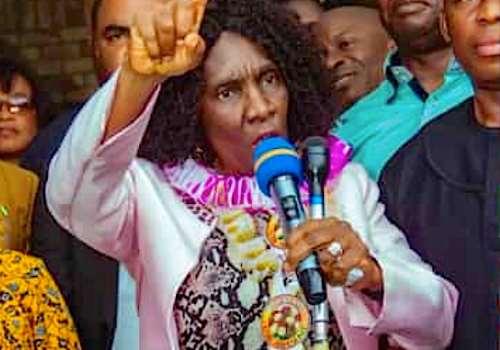
…Prof Oti, woman who oversaw tension soaked election that returned Otti, relieves her story
By Steve Oko
March 22, 2023, will remain indelible in the political history of Abia State, a day when tension gave way to triumph, and the will of the people ultimately prevailed.
The governorship election, held on Saturday, March 18 across Nigeria, had all the trappings of a routine democratic exercise. Yet, in Abia, it evolved into a gripping political drama that stretched over four suspense-filled days, culminating in a defining moment for the state’s democratic journey.
At the heart of the unfolding spectacle was the collation of results at the headquarters of the Independent National Electoral Commission (INEC) in Umuahia. What should have been a straightforward administrative process soon became a theatre of intrigue, suspicion, and high-stakes maneuvering.
Journalists, party agents, security officials, election observers, and other stakeholders converged at the collation centre as results trickled in from across the 17 local government areas. By Sunday afternoon, collation had begun in earnest, and by Monday morning, results from 16 LGAs had been announced.
At that stage, Alex Otti of the Labour Party had established a commanding lead, winning 10 of the 16 LGAs declared. He polled 172,246 votes, far ahead of his closest rival, Chief Okey Ahiwe of the Peoples Democratic Party (PDP), who garnered 78,628 votes—a wide margin of 93,618 votes.
However, the process hit a dramatic snag with the delayed result from Obingwa LGA, historically regarded as a decisive battleground in Abia elections due to its large voting population.
What followed was a swirl of rumours, allegations, and mounting tension.
Whispers of inflated figures began to dominate the atmosphere.
Initially, it was speculated that the PDP candidate had secured 40,000 votes in Obingwa. The figure mysteriously climbed to 60,000, then 90,000, and eventually an astonishing 120,000 votes—all in favour of one candidate, with no corresponding increase for others.
The writer was among the array of journalists who curiously waited for the arrival of the much -anticipated Obingwa tsunami. Occasionally the slogan:”Obingwa landslide is coming”, permeated the air at the Collation Centre, heightening the already tensed atmosphere.
The absence of the Obingwa Collation Officer at the Umuahia centre further deepened suspicion. Reports later emerged that he had allegedly been held under duress by forces seeking to alter the results. Despite threats to his life, he reportedly refused to compromise, choosing integrity over intimidation.
The figures being bandied around raised serious questions. With only 26,845 accredited voters in Obingwa—far below the inflated numbers being circulated—the credibility of the process was at stake. The situation was further compounded by the use of the Bimodal Voter Accreditation System (BVAS), which was expected to eliminate such discrepancies.
As tension escalated, INEC announced the suspension of collation for Obingwa, citing attacks on its office by suspected political thugs. The controversy effectively shifted the battleground from Umuahia to Abuja, where the electoral body undertook a forensic review of the disputed results.
Meanwhile, protests erupted across Abia. Citizens, civil society groups, and political supporters besieged the collation centre, demanding transparency and insisting that their votes must count. The state stood on edge, with palpable fears that any subversion of the popular mandate could trigger unrest.
After days of scrutiny, INEC resumed collation in Umuahia on March 22. In a moment that would define the integrity of the process, the State Returning Officer, Nnenna Otti, stood firm.
Calm yet resolute, she announced the final, verified results, including the much-anticipated Obingwa figures.
Contrary to the earlier rumours, the PDP secured 9,962 votes, while the Labour Party polled 3,776 in the LGA.
With those figures added, Alex Otti was officially declared winner of the governorship election.
The announcement triggered a wave of jubilation across the state. Streets erupted in celebration, not merely because a winner had emerged, but because the outcome was widely seen as a true reflection of the people’s will.
In many quarters, there was a shared belief that any contrary declaration could have plunged the state into chaos. Yes, the state would have gone up in flames had the wrong person been announced winner of the contest.
Central to this historic outcome was the courage of the State Returning Officer, Prof. Nnenna Otti, whose unwavering commitment to truth under pressure earned her national admiration. Before declaring the result, she made her position unequivocally clear—she would only announce what was right.
Her later recount of the ordeal painted a vivid picture of the pressures she faced: offers of inducement, veiled threats, and intense intimidation. Yet, she stood her ground. Prof. Oti who is also the Vice Chancellor, Federal University of Technology Owerri, FUTO, has by her heroic role at the 2023 poll in Abia, carved a niche for herself- an enduring legacy of uncompromising umpire.
“They came with money; I refused. They came with intimidation; I resisted. I fear only God,” she declared while being received back at FUTO by a mammoth crowd of admirers.
Her narration drew thunderous applause from supporters who filed out to give her a heroic welcome.
While her role has been widely celebrated, the Obingwa Collation Officer and the Electoral Officer in the LGA remain largely unsung. Their insistence on due process, even in the face of grave danger, was instrumental in preserving the integrity of the election.
As Nigeria looks ahead to the 2027 general elections, the Abia experience offers critical lessons. It underscores the importance of credible electoral officials and the need for institutions to identify and empower individuals of proven integrity.
Such figures, many argue, deserve not only commendation but national honours for their role in safeguarding democracy at a time when public confidence in the system is often tested.
Nearly three years on, the performance of Governor Alex Otti appears, in the eyes of many residents, to justify the overwhelming mandate he received. While acknowledging areas for improvement, a significant number of Abians believe that the promise of change that defined the 2023 election is steadily being realised.
In retrospect, Otti’s victory was more than an electoral win—it was a watershed moment. A triumph of resilience over manipulation, of truth over falsehood, and ultimately, of the people’s voice over the forces that sought to silence it.
INEC needs more of Prof Nnena Oti to regain its fast – eroding public confidence. For Nigeria democracy to survive the current landmines being laid by the ruling party which appears bent on crippling the opposition, INEC officials and ad-hoc staff who value integrity and transparency above other considerations like Prof Nnena Oti, become sacrosanct.
The post Abia 2023: ‘They came with money; I refused, they came with intimidation; I resisted, I fear only God’ appeared first on Vanguard News.