59 years after Asaba massacre: Obasanjo seeks forgiveness, Asagba demands apology from sitting president
 SKAiF NewsNG SNN
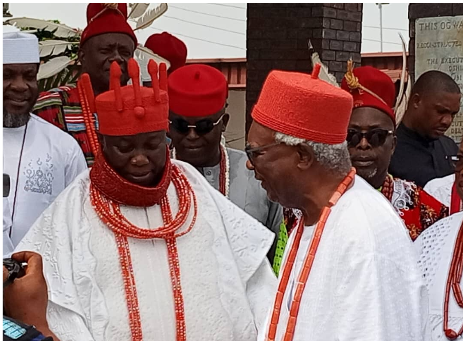
— Asagba Azinge proclaims forgiveness for Col. Taiwo’s family
— Nduka-Eze sensitises stakeholders for big 60th memorial, actualisation of centre
By Egufe Yafugborhi & Ochuko Akuopha
ASABA — Fifty-nine years after the Asaba Massacre, former President Olusegun Obasanjo has appealed for forgiveness and reconciliation, but the Asagba of Asaba, HRM Obi Epiphany Azinge, SAN, has insisted that there can be no closure for his people until a sitting President publicly apologises for the 1967 killings.
The contrasting positions emerged on Wednesday at the 59th anniversary memorial of the Asaba Massacre in Asaba, Delta State, where the Convener of the Asaba Massacre Memorial, Chief Chuck Nduka-Eze, sensitised stakeholders on preparations for next year’s 60th memorial and intensified efforts to actualise a permanent Asaba Massacre Memorial Centre.
Obasanjo, who participated virtually as Chairman of the occasion, described the massacre as “one of the most painful, one of the most terrible aspects” of the Nigerian Civil War.
He said: “This marks the remembrance of one very sad aspect of the Nigerian Civil War. Of course, the war in its entirety was an unfortunate event which should never happen.
“But the Asaba Massacre, as it is called, was one of the most painful, one of the most terrible aspects of that war.”
The former President said he wept after receiving documents on the massacre from Nduka-Eze, adding that he was saddened that such an event occurred “in my own country, in my lifetime.”
He also urged the people to embrace forgiveness.
“To all of you assembled: let us keep one thing in mind — forgiveness, forgiveness, and forgiveness again,” Obasanjo said.
However, the Asagba took exception to the suggestion that the matter could be closed simply through forgiveness, stressing that the community’s demand for accountability remained.
He said: “We may not forget, but certainly, we have to forgive.”
The monarch, however, declared that “there will be no closure, there will be no healing until a sitting President — not an ex-President, but a sitting President — publicly apologises to us.”
According to him, although former military Head of State, General Yakubu Gowon, had apologised while out of office, the people needed an acknowledgement from a serving Nigerian President.
“We need a sitting President to apologise to the Asaba people, and that will bring closure,” he said.
The Asagba also challenged Obasanjo’s “never again” appeal, recalling that the Odi killings occurred during his administration.
“Coming from him, I was a bit taken aback. How long do we say ‘never again’? But it happened at Odi. Odi came years after Asaba, and he was sitting there as President when that happened,” he said.
Despite the unresolved demand, the Asagba made a significant gesture of reconciliation by proclaiming forgiveness for the Taiwo family.
“On behalf of the Asaba community, and as the prescribed authority — the Asagba of Asaba — I hereby publicly proclaim that we have forgiven the Taiwo family.
“Yes, there is every need for us to forgive. We may not forget, but certainly, we have to forgive,” he declared.
He acknowledged the apology offered by Major General Ahmed Ibrahim Taiwo (retd.), son of Col. Ibrahim Taiwo, who was associated with the military operation during the massacre.
Taiwo said he had come “to render our deepest regrets and apologise on behalf of our father and family for any act of omission or commission on his part that led to this heinous massacre.”
“I know it will not right the wrong, but I believe and pray it is a start towards reconciliation,” he added.
The Asagba responded by stressing that forgiveness was part of the community’s character, saying Asaba people had the strength “to accept that apology.”
Meanwhile, Governor Sheriff Oborevwori, represented by the Secretary to the State Government, Dr Kingsley Emu, said researchers and community historians had estimated that more than 1,000 people died in the massacre.
He said: “Let us speak clearly: the killing of unarmed civilians can never be justified.”
The governor pledged continued support for national recognition of the massacre and the establishment of a fitting national memorial.
Nduka-Eze said the 60th anniversary would be used to further tell the story to Nigeria and the world, stressing that “Nigerian lives matter.”
He said: “The message we’ve been sending about the Asaba Massacre is that Nigerian lives matter.”
Nduka-Eze disclosed that preparations were already underway for next year’s 60th memorial, including efforts to actualise the Memorial Centre as a permanent place for remembrance, documentation and education.
The event also featured remarks by Enotie Ogbebor, son of Col. Paul Ogbebor, who is credited with intervening to save lives during the tragedy.
He said the Asaba Massacre “should be remembered all over the world, not just in Nigeria,” comparing its significance with other notorious mass atrocities.
He said the proposed memorial site would become “a reminder for humanity that no innocent lives should be lost unfairly for any reason.”
The Asagba urged Nigerians to continue remembering the victims, saying: “From the going down of the sun till the morning, we will always remember them.”
He added: “We have moved on,” but stressed that remembrance, justice and reconciliation remained necessary as Asaba prepares for the 60th anniversary of the tragedy next year.
The Obi of Onitsha, His Majesty, Igwe Nnaemeka Alfred Ugochukwu Achebe (Agbogidi), also offered remarks on restitution, reconciliation and forgiveness on the occasion.
The post 59 years after Asaba massacre: Obasanjo seeks forgiveness, Asagba demands apology from sitting president appeared first on Vanguard News.