Wrong to assume all women sleep upward — Lafiaji-Okuneye, LASUED VC
 SKAiF NewsNG SNN
By Elizabeth Osayande
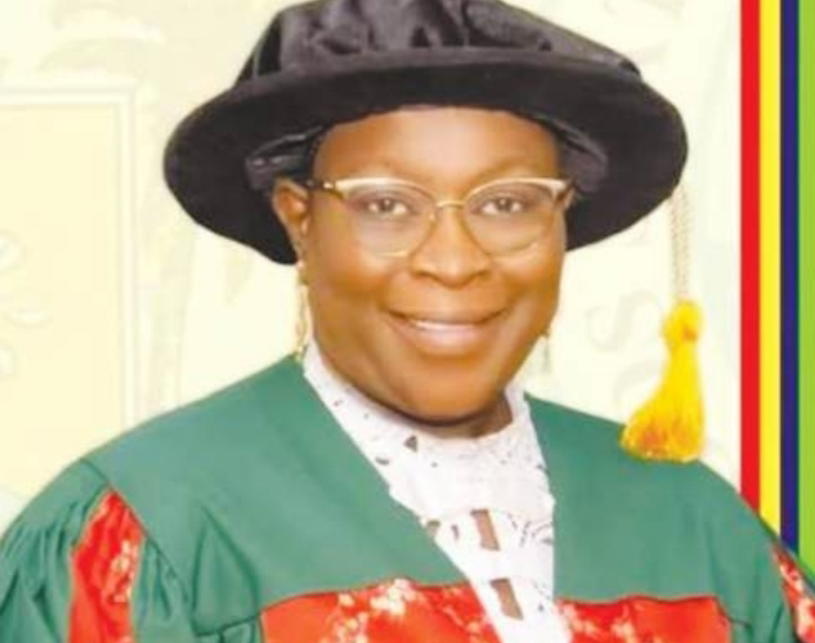
In this interview, Prof. Bidemi Bilikis Lafiaji-Okuneye shares her experience and the dynamics of being the pioneer Vice-Chancellor of Lagos State University of Education, LASUED, Ijanikin, Lagos. She speaks on what it means to break the ceiling of patriarchy in administration and leadership. Exceprts.
How can you describe being the pioneer Vice-Chancellor of Lagos State University of Education, LASUED?
There is no tutelage; you can’t say this is how it is.” And there is no understudying. You know this is a new university. One is not able to learn beforehand. For example, if you are a DVC (Deputy Vice-Chancellor) in a university, you are already learning what it takes to step into the shoes of a VC. I learned from myself and, of course, I used other experiences that I have gained from the university setting to be able to navigate this task.
I’m very particular about females taking leadership positions, because most of the work I do is about spotlighting females. In achieving this role, were there any sentiments or pushback as to whether it is appropriate for a woman to be the VC?
No, not in the area of appointing a woman. But in the area of having a woman issue directives, some men would not want to take directives from an ordinary woman. “How can an ordinary woman…?” And yes, you see it in their countenance. But I think we have come to the age where anyone who merits anything should be given it. It should not be determined by gender. And without being immodest, I could authoritatively say that women are doing better in the areas of administration and leadership. Because as a woman, you can’t seduce me. But men are more culpable; they can be compromised. I don’t blame them, but a woman will still be the one who will come and seduce them. Do you understand? When men are in leadership, they are at more risk than women. And so, it takes a highly disciplined man to be above board. So for appointments, no. But having to direct, it takes a woman extra effort.
How have you been able to navigate that?
For me, people even say that my actions are like a man’s because I don’t compromise. There is this Yoruba adage that says,” You don’t issue directives sweating. No, you have to be firm but fair. You must be fair. You have to be focused without being scared. Sometimes there could be fear, but you have to wear the toga of toughness because you are there and you must issue directives. There are situations where issuing directives may even be risky, but you want to bury that in your heart and still go headlong as if nothing has spoiled—whereas within you, you know what is buried there. And sometimes, because you are a woman, they come to instil that fear intentionally.
And have you had such experiences?
They will say, “Ah, Ma, don’t do this, oh. Somebody tried it one time, and this is what it cost.” As a leader, you need to sit back and analyse it yourself. Is that decision going to pay the system more than the individual who came to give the information? If the system will benefit more than the individual, then you make sure your decision aligns with the system.
Encouragement to females out there who are navigating the ladder of leadership.
They should go all out to get whatever they merit. Every woman should go all out for what they merit. If they are selected, fine. If they are not, they should re-strategise. But to think that any woman who occupies a position must have slept with somebody is a big lie. It’s a fallacy; it’s something that does not exist, but a way to bring women down. They will say: “Oh, you see? To be a VC, do you know how many people that one had to sleep with?” But you don’t have to be discouraged by those words. They will say it, but as a woman, you should be a shock absorber. Your actions will then determine their belief in you. But if you get intimidated by those words, you are in trouble. They will now form a circle around you, and you won’t be able to see anything yourself. It will be whatever report they bring to you that you take.
LASUED recently got 100 per cent accreditation of its programmes from NUC, what was the motivation?
The greatest motivation was the support from the state government. Accreditation involves a lot of funds. If you don’t have the funding, you can’t achieve it. So, that was the greatest motivator. Another factor was the readiness and commitment of the staff. They were really committed to the cause. You know, a single tree cannot make a forest. They were the driving force and the motivating factor that pushed us forward to achieve this. So, I would credit the government, the zeal and commitment of both staff and students, and the cooperative stance of the Governing Council and management. There is no way you can leave out the Governing Council in all of this. These are the major reasons behind the success. We currently have about 66 of our courses accredited by the National Universities Commission, NUC.
How long did the accreditation process take from the moment you transitioned into a university to when they came here?
We had our resource verification in 2022 when we became a university. The accreditation took two years. If we didn’t secure accreditation before the graduation of our first set of students, we wouldn’t be able to mobilise them for NYSC. That is why they had to come in 2024 for their accreditation. It is between two to four years between resource verification and full accreditation.
What is the margin in enrollment numbers between when it was a college of education and now that it is a university?
When we were a college, we had to do an active admission drive to ensure we got students. We had to go after them via newspapers and radio jingles. Staff members even travelled as far as Ogun and Ondo states to canvass for students. But becoming a university changed things naturally. Students now come to us rather than us going to them. For the College of Education, there was dwindling enrollment. But as soon as we became a university, enrollment skyrocketed. The margin is incredibly wide. As a College of Education, we used to have between 1,000 and 1,200 students in total. But now as a university, I can tell you we have over 16,000 students.
Again, before we became a university. It was almost a waste of funds on the part of the government. People are actively striving to get into universities; nobody wants to attend a College of Education anymore. So, it was a very wise decision by the Lagos State Government to convert it into a university.
Now, looking at that margin, does LASUED have the facilities on ground to accommodate this influx of students?
As I mentioned, the previous student population was not very impressive, but the infrastructure was already there. The infrastructure actually exceeded the number of students we had at the time. Because the government and TetFund intervene every year, classrooms and facilities were built annually. But there were no students to fill them. Now that we have a massive population, even though we haven’t achieved everything just yet, we are coping very well. This current capacity is our peak. When the university first started and we only had 100-level students, there was plenty of space. When they got to 200-level, we utilised part of the remaining empty spaces. By the time they reached 300-level, we were filling it up until we reached our peak capacity. This is not to say we don’t need more. We definitely do, especially because we have now started our postgraduate college. With the Postgraduate College, there will be an increased need for infrastructure. For now, we are coping well, but we need expansion.
Accommodation is one of the major things that draws students to federal and state schools, considering security and convenience, how is LASUED poised to provide accommodation for her students?
Yes, we do have accommodation plans. Right now, we have a female hostel under construction beside the health centre. At the Epe campus, we already have a student hostel that accommodates over 200 students. This is an ongoing development. The laws that originally established the previous college mandated a non-residential setup. However, our new university law is silent on the matter of residence, meaning it doesn’t forbid it. It is expected that the Governing Council can make pronouncements on that. Because of this, the Governing Council is striving to transform Ijanikin into a residential campus. By next session, we should have an operational female hostel here on the Ijanikin campus. We have also engaged in a public-private partnership (PPP) to build hostels, similar to what they have at LASU. We want to bring developers in so that a majority, if not all, of our students can live on campus.
What is the estimated timeframe to make the campus fully residential for any student who wishes to live here? Do you think reaching 100% capacity is possible?
Reaching 100% might not be entirely possible because some students naturally prefer to live off-campus. But we are trying as much as possible to ensure that if 70% to 80% of our students can stay on campus, that would be a major success for us.
As Vice-Chancellor, nobody wants their students to stay at home due to industrial crises. What are you doing in your capacity as VC to handle this?
I cannot act outside of what the Lagos State Government would ordinarily dictate, but I can tell you that there is active engagement happening right now. Directives have been issued, and information has been disseminated. As we approach the end of the year, you can expect updates regarding the situation soon.
What reassurances are you giving to the parents and students currently here?
Parents should rest assured that their children are in safe hands. When it comes to quality and excellence, LASUED stands out. Because we are a new institution, we are pursuing excellence with all our vigour. We want excellence and quality to be our core marketing strategy and our watchword. I often tell my students about the early days of mobile phones. China was a major producer of phones. The early mobile phones produced back then—like the Nokia 3310—were incredibly rugged. So, I tell my students that the first set of graduates from this university will be rugged because they are being taken through the furnace to be tested and refined into gold. We want them to compete favourably with any graduate globally. We are not lowering our standards. We want to prepare them better than their contemporaries in other universities so they can excel. You train students the same way everyone else does; they cannot rise above the competition. But if you train them to a higher standard, they will easily pave their way wherever they go. That is what we are striving for.
What are the milestones? I know it’s too early, but what are the milestones?
We have milestones. I will state categorically that one of the milestones is the creation of additional colleges and additional programmes. You know we are in the Metro College. So, at one time, management felt that we should introduce programmes that are industry-friendly, so that our students do not need to take their certificates and look for white-collar jobs. So, we created the College of Management Sciences that houses, most especially, Hospitality and Tourism. It’s a new programme, and I tell you, no university in the Southwest has commenced that programme. We are the only one that has commenced Hospitality and Tourism. We also have Office and Information Management. These are programmes that have entrepreneurial potential so that students may not need to go cap-in-hand begging for white-collar jobs. Another milestone is, of course, our accreditation milestone. In terms of infrastructure, we have recorded a lot of milestones. The government has been able to commence, and it’s nearing completion, a 750-capacity lecture theatre at the Epe campus. It’s nearing completion now. It’s a massive one. Then, we have the administrative block for Ijanikin, which is to be commissioned this year by the government—the one when you enter the gate and a lot more.
What can you say about the ripples when the Minister of Education spoke regarding the requirements to enter colleges of education? As one who has been there, what would you say about that?
You see, I told you earlier that there was a lingering ailment, for instance. So, the minister’s announcement as to not having them write JAMB is a good one. You know in the College of Education, you have to spend three years before you go to a university to spend another three years. That is six years to qualify for a BSc Ed, whereas in the university, it’s just a four year programme. So, having them not write JAMB is great. let me also say this: when they write this JAMB, it is ridiculous and laughable that they will now put the cut-off at 80 or 90 over 400. It’s shameful that we admit somebody who scored 80 over 400 to a higher institution. And don’t let us call it the College of Education alone. That means we are taking the worst into the education industry to teach our own children. What goes around comes around.
So, the idea of not having them write JAMB is fantastic. Anyone who wants to be a teacher and truly wants to be one does not have to go through the rigours of JAMB. When they are through with that, they can then go into direct entry, and that’s where you can find a true teacher. Because usually, it is whatever the university weeds out that comes to the College of Education. But if they’re not writing, I may choose not to write JAMB. Especially if I have written JAMB twice and didn’t make it, the third time I might say, “Oh, I don’t want to be JAMBed by JAMB again. I want to start from the College of Education.” You can find true scholars there. But where they are weeded out and have no other option than to just come to the College of Education, that is a different thing.
Are there challenges so far? You have told us so many prospects, but I know, no matter how much you give, Oliver Twist wants some more.
I can’t begin to tell you the challenges. But of course, I’ll just wrap it up by saying, like Oliver Twist, we want more. In the area of infrastructure, staff welfare, everything, there is a need for improvement. Even on our own end—from the university management—there’s need for improvement. You cannot satisfy everyone. You cannot please the world. But whatever you can do, just have it in mind that whatever you do now can still be improved upon.
For students out there, as you said, LASUED doesn’t need to advertise like normal; however, you have to sell your market. So, what would you tell people that LASUED is known for, in a nutshell?
Like I said earlier, quality and standards are not compromised. In fact, what I also failed to mention is that an average LASUED student graduates with two certificates: the degree certificate that they came in for, and an entrepreneurship certificate, which is compulsory for all students.
And the third benefit before graduation is that we advise and encourage them to register their own company with the CAC before they graduate. And that they are doing. A lot of our students have business names and certificates of incorporation. So, entrepreneurship is one of our major selling points.
Another selling point is morals. Because we are a teacher-training institute, we do not compromise morals or the dress code. Because we are training teachers, we check it out.
The post Wrong to assume all women sleep upward — Lafiaji-Okuneye, LASUED VC appeared first on Vanguard News.