When harvest hurts inside Nigeria’s cassava crisis through lives of its farmers
 SKAiF NewsNG SNN
By Emma Ujah, Abuja Bureau Chief
At dawn, when the earth is still cool and quiet, Akeem Busari walks through his cassava farm in Ogun State.
The leaves are green, the stems strong, the tubers fat beneath the soil. By every agronomic measure, it is a good harvest. Yet Busari’s face is heavy.
What should be a season of reward has become a season of reckoning.
“Two years ago, this same cassava gave us dignity,” he says, stopping to wipe sweat from his brow. “Now, it is giving us debt.”
Across Nigeria’s cassava belt, from Ogun to Kogi, Benue to Nasarawa, farmers are telling the same story in different voices: Stories of hope planted, loans taken, labour paid for, and then a market collapse so severe that harvesting itself has become a loss-making decision.
Vanguard investigations reveal a nationwide glut that has pushed prices below production costs, threatening farmers’ livelihoods and raising fears of food shortages in the coming year.
Cassava, Nigeria’s most widely consumed staple, has become a symbol of both abundance and anguish.
Akeem Busari: From planning to panic
Busari remembers when cassava farming was predictable. As Chairman of the Nigeria Cassava Growers Association, NCGA, in Ogun State, he watched prices rise steadily in 2023 and 2024. A tonne sold for as much as N150,000. Farmers planned their lives around those numbers – school fees, rent, reinvestment.
Encouraged, many expanded. Banks, cooperatives and microfinance institutions offered loans. Inputs were expensive, but the numbers still worked.
Then the bottom fell out
“This year, a tonne goes for N50,000,” Busari says. “After transport, sometimes you’re left with N20,000. That cannot even pay the people who helped you harvest.”
Ogun State produces about seven million metric tonnes of cassava annually. Farmers harvest between 20 and 30 tonnes per hectare, and in at least 15 local government areas, cultivation spans hundreds of hectares. But production surged just as demand weakened.
According to Busari, border reopenings ahead of the last harvest allowed food imports, while Ogun also became a competitive supply zone for cassava from neighbouring states. Buyers suddenly had options. Farmers did not.
“It turned into a buyers’ market overnight,” he says. “And we were stranded.”
Today, he describes the mood among farmers as one of quiet mourning. “Many of us are poorer now than when we started this cycle,” he says. “Some are deeply in debt. Some are already thinking of quitting farming.”
Busari blames part of the crisis on failed interventions. Government programmes promised subsidised inputs and mechanisation, but he insists most real farmers never benefited. “Those things went to political farms,” he says. “What we saw was the media.”
Forced to fend for themselves, farmers borrowed heavily. “Under these conditions, that has become suicidal,” he adds.
Yet Busari believes the cycle can be broken. He calls for direct government engagement with verified farmer associations, lower tractor costs, buy-back policies, integration of cassava into school feeding programmes, improved logistics and serious investment in processing.
“If the government is serious,” he says, “cassava should not keep breaking the people who grow it.”
Femi Ajisafe: When theory meets the soil
In Kogi State, Chief Femi Ajisafe bends to pull a cassava tuber from the ground. It is heavy, healthy – proof of months of labour. He should be smiling. Instead, he sighs. “Last year, a full keke load sold for N160,000,” he says. “Now, buyers are offering N40,000.”
Ajisafe is not just a farmer; he is President of the Kogi Chamber of Commerce, Industries, Mines and Agriculture, KOCCIMA. He understands policy, economics and markets. But none of that cushions the pain of a glut.
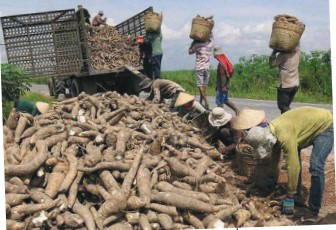
Cassava is unforgiving. Once mature, it must be harvested or it rots. Farmers cannot wait for better prices. That biological urgency turns a downturn into a crisis.
“This is not farmer stubbornness,” Ajisafe explains. “It is how agriculture works.”
He describes the familiar boom-and-bust pattern known as the Cobweb Theorem. High prices encourage expansion. By harvest time, supply overwhelms demand. Prices crash. Farmers retreat. Shortages follow. Prices rise again.
“You cannot change your mind halfway,” he says. “Once you plant, you are committed.”
Ajisafe insists only the government can stabilise the system. In Kogi, farmers scramble for buyers-ethanol factories, garri processors, animal feed producers – but growers do not control processing. They compete fiercely to sell raw tubers, and buyers dictate prices.
He recalls a time when Nigeria managed this better. The Produce Department acted as a first off-taker. Prices were not allowed to fall below production costs.
“There were systems,” he says. “We dismantled them.”
Ajisafe proposes unconventional ideas, like government-backed “production holidays” during glut years, where farmers are compensated for reducing hectares. He argues against handouts, calling instead for institutions: functional research, revived extension services, targeted funding and export facilitation.
“Value addition is everything,” he says. “Government should not buy cassava. It should help us sell it to the world.”
As he leaves his farm, the cassava remains in the ground, each tuber a reminder that policy failures are not abstract. They are buried in Nigerian soil.
Benue: When the food basket empties
In Benue State, the cassava glut has turned hardship into despair. Saaku Aondongu, immediate past chairman of the All Farmers Association of Nigeria, AFAN, in the state, says thousands of farmers have been pushed into poverty.
“Cassava farmers are lamenting everywhere,” he says, in Makurdi. “Many invested heavily last year. Now, everything has vanished.”
He points to garri prices as evidence. Last year, a paint bucket sold for N3,200. Today, it sells for N700 to N1,000.
“It is that bad,” he says.
Farmers had hoped cassava proceeds would sustain their families, settle debts and fund the next season. Instead, falling demand and market saturation have wiped out expectations. Input costs remain high. Tractorisation is expensive. Borders are open to food imports.
“Local farmers are paying the price,” Aondongu says.
Nasarawa: When harvesting makes no sense
In Lafia, Nasarawa State, Mrs. Susan Godwin no longer bothers to harvest some of her cassava. It is cheaper to leave it in the ground or let cattle eat it than to pay labourers and transporters.
“When you calculate everything, it is pure loss,” she says.
She recalls when a pickup load sold for N400,000. Then N150,000. Now N40,000.
Encouraged by government rhetoric on cassava farming, many farmers took loans to pay for labour, herbicides and transport. Fuel costs soared. Prices collapsed.
“Farmers cannot pay school fees,” Godwin says. “Banks are chasing people. Hunger is coming.”
A national crisis, lived locally
At the national level, Cassava Growers Association President, Mustapha Bakano, points to policy contradictions. While cassava itself is not imported, starch, derived from cassava, has been imported massively, weakening demand. Input subsidies have vanished. Processing capacity is limited. Logistics are poor.
Nigeria produces about 66 million tonnes of cassava, yet loses much of it before processing.
“We have farmers,” Bakano says. “But we don’t have a system.”
Beyond Statistics
The cassava glut is often discussed in tonnes and prices. But for farmers like Busari, Ajisafe, Godwin and thousands of others, it is measured in unpaid loans, abandoned farms, withdrawn children and quiet despair.
They all fear the same thing: that discouraged farmers will plant less next season, leading to shortages and higher prices. The cycle will repeat.
Unless, they say, the government intervenes, not with promises, but with structure.
The post When harvest hurts inside Nigeria’s cassava crisis through lives of its farmers appeared first on Vanguard News.