UNICEF hails Sokoto’s child welfare drive
 SKAiF NewsNG SNN
By Musa Ubandawaki
SOKOTO: The Executive Director of the United Nations Children’s Fund (UNICEF), Catherine Russell, has declared that Nigeria’s successful eradication of the wild polio virus demonstrates that even the most difficult public health challenges can be overcome through strong political leadership, community participation and sustained partnerships.
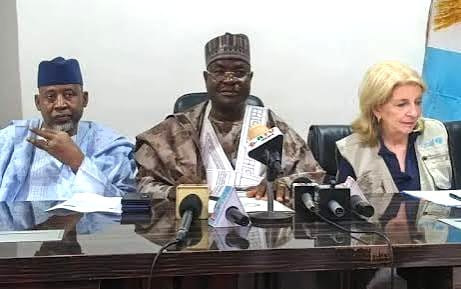
Russell made the remark on Friday during a courtesy visit to the Sokoto State Government as part of her mission to Nigeria. She was received on behalf of Governor Ahmed Aliyu by the Deputy Governor, Engr. Idris Muhammad Gobir.
The UNICEF chief noted that Nigeria’s certification as free of the wild polio virus in 2020 remains one of the country’s greatest public health achievements and a clear indication that coordinated action can deliver transformative results.
“Today, our task is to protect these gains by ensuring that every child receives routine immunisation, every missed child is reached, and disease surveillance remains strong,” she said.
Russell described Sokoto as a state with enormous potential, noting that its youthful population places it at the centre of Nigeria’s human capital development agenda. She commended the state government for its commitment to improving the welfare of children and vulnerable groups.
According to her, UNICEF remains encouraged by the progress being recorded in health, education and skills acquisition programmes across the state, particularly initiatives aimed at empowering children and young people.
She disclosed that during her visit, she toured a digital village where literacy, vocational training and life skills programmes are being implemented, as well as a primary healthcare centre providing routine immunisation and nutrition screening services.
“What I saw today was truly impressive. The digital village and the healthcare centre represent practical investments in the future of children. UNICEF is proud to work with the Sokoto State Government in supporting such impactful programmes,” Russell stated.
The UNICEF Executive Director expressed confidence that Sokoto could emerge as a national model for child-focused governance if ongoing reforms are sustained and expanded.
She said the agency was prepared to work closely with the state government to document and showcase successful interventions so that other states could learn from Sokoto’s experience in improving child survival and development
outcomes.
“Together, we believe Sokoto can eliminate the remaining immunisation gaps and become one of Nigeria’s strongest examples of political commitment to child survival. Every investment that helps a child learn contributes to human capital development and long-term economic growth,” she added.
Russell further assured the state government of UNICEF’s readiness to deepen its strategic partnership with Sokoto through stronger support for evidence based policies, improved service delivery and programmes capable of delivering measurable results for children.
Responding, Governor Ahmed Aliyu, represented by Deputy Governor Gobir, expressed appreciation to UNICEF for choosing Sokoto as one of the states visited during the Executive Director’s mission to Nigeria and for its longstanding interventions in health, education and child protection.
The governor said his administration had prioritised the health sector through free healthcare programmes for pregnant women and children, renovation of health facilities, and the recruitment of over 1,500 nurses and midwives, alongside 2,440 Community Health Extension Workers (CHEWs) to strengthen primary healthcare services, particularly in rural communities.
Aliyu also highlighted the state government’s collaboration with development partners, including UNICEF, Plan International, Save the Children and UNFPA, noting that the partnership had facilitated the establishment of 10 Integrated Qur’anic Schools, child-friendly centres and skills acquisition programmes for Almajiri and out-of-school children.
He disclosed that 2,720 beneficiaries had graduated from the state’s skills acquisition centres and received starter packs to support their livelihoods.
While acknowledging UNICEF’s technical and financial support, particularly under the European Union supported SARA programme, the governor appealed for additional assistance in rebuilding health and educational infrastructure damaged by insecurity.
He stressed that attacks on communities had destroyed schools and healthcare facilities in some parts of the state, posing a major challenge to efforts aimed at ensuring every child and mother has access to quality services.
He nevertheless reaffirmed Sokoto State’s commitment to strengthening collaboration with UNICEF and other partners to improve child welfare, reduce mortality rates and expand educational opportunities for vulnerable children across the state.
The post UNICEF hails Sokoto’s child welfare drive appeared first on Vanguard News.