Tinapa’s repossession as catalyst for Cross River’s economic rejuvenation
 SKAiF NewsNG SNN
ON April 2, 2007, former Nigerian President, Chief Olusegun Obasanjo, inaugurated the first phase of the Tinapa Business Resort & Free Zone in Calabar, one of the most ambitious developmental projects ever embarked upon by the Cross River State Government.
It was a vision birthed by then Governor, Donald Duke, to transform the state into the economic heartbeat of West Africa.
More importantly, it was designed as a fulcrum for job creation, revenue generation, tourism resuscitation, economic emancipation and development revolution. After the glitz and glam that heralded its inauguration, the project, in 2011, sailed into a man-made financial tempest that grounded it.
When all revival efforts failed, it was subsequently taken over by the Asset Management Corporation of Nigeria (AMCON). Nonetheless, Tinapa’s story, from its glittering conception to its paralysis, public debt and eventual repossession by the Cross River State Government in 2025, reads like an epic. It has been described in many quarters as a decisive victory that will rewrite the state’s story for future glory. It is a narrative of hope, missteps and remarkable resilience. And now, under Governor Bassey Otu, Tinapa is experiencing what many have described as its most promising rebirth.
The beginning Tinapa was conceived at a time when Cross River State sought to reinvent itself as a globally competitive investment destination. As the State transitioned away from oil dependency and aggressively promoted tourism, the government envisioned a complementary commercial nerve centre, one that would blend leisure, trade and business.
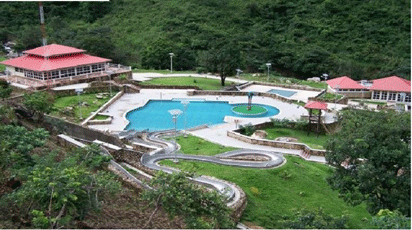
The resort was designed as a mixed-use development with world-class retail facilities, wholesale emporiums, a film studio (Studio Tinapa), hotels, entertainment complexes and Africa’s largest waterpark at the time.
The aspiration was not merely infrastructural, it was structural. Tinapa was intended to serve as what Governor Otu recently described as “an enabler of the socio-economic transformation of the State.” For years, the vision attracted international attention. Investors, tourists and development analysts touted the facility as a symbol of subnational ambition executed at an admirable scale.
At its opening, it was easily one of the most sophisticated business and leisure estates in Nigeria. It was hailed as a breakthrough. The combination of luxurious hotels, state-of-the-art retail spaces and seamless architectural design gave the State an economic beacon unlike anything in the region. Its location, strategically positioned near the Calabar Free Trade Zone, was intended to support duty-free shopping, large-scale trade, and international commercial traffic.
The early years saw a surge of interest from businesses and tourists. Conferences were held there. Families flocked to the waterpark. Retail shops buzzed with activity. For a while, it worked. Tinapa was alive. And Cross Riverians believed the promises that their State had finally found a non-oil revenue engine strong enough to rewrite the future.
Regulatory hurdles and operational strain But despite the glamour of its launch and the massive capital investment it attracted, Tinapa soon began drifting toward uncertainty. However, Tinapa’s decline did not occur overnight. It was gradual, layered and deeply tied to regulatory constraints.
The very engine that was supposed to power the resort, duty-free operations, ran into federal Customs restrictions that crippled the resort’s core business model. Goods meant to be traded freely were trapped in layers of bureaucracy.
Without free-flowing international commerce, Tinapa’s retail sector lost its competitive edge. Shops closed. Investors exited. Foot traffic dwindled. Financial pressure mounted and the State, unable to maintain the massive infrastructure without the projected revenue streams, found itself sinking into debt. The project that once symbolised progress became an emblem of stalled potential. It was during this period of financial distress that Tinapa fell under the management and supervision of the Asset Management Corporation of Nigeria (AMCON), which had stepped in to recover debt obligations. Legal shackles over true ownership of Tinapa Once AMCON took over the management of the resort’s liabilities, the question of ownership entered a grey zone. Though Cross River State remained the initiator and principal stakeholder, the facility functioned under different operational and legal encumbrances that undermined the State’s direct control. The ambiguity discouraged investors. Potential partners feared litigation. The general public viewed the once-glittering estate as a stranded asset. Tinapa, in effect, became a majestic structure trapped in limbo, unable to operate freely, yet too valuable to abandon. For years, successive governments attempted negotiations, renegotiations and legal reviews. But it was not until 2025 that a breakthrough finally came. Otu’s repossession as a turning point On November 7, 2025, the Government of Cross River State announced a historic breakthrough: Tinapa had been fully repossessed from AMCON, ending years of legal ambiguity. The repossession, which officials described as “decisive, strategic and economically necessary,” restored the resort as the bona fide property of the Cross River State Government. Governor Bassey Otu, in his remarks at the repossession celebration, delivered a set of statements that captured both the gravity of the moment and the optimism of the State moving forward. engines humming, ready to take off. Governor Otu’s final remark on the repossessed Tinapa amplifies the birth of a new dawn; “The Tinapa Business Resort Limited (TBRL) is indeed an investors’ haven where limitless opportunity beckons” Cross Riverians are excited. To them, the repossession is more than an invitation. It is a turning point, signalling the state’s economic rebirth.
The post Tinapa’s repossession as catalyst for Cross River’s economic rejuvenation appeared first on Vanguard News.