The strait that holds the world’s economy hostage, by Stephanie Shaakaa
 SKAiF NewsNG SNN
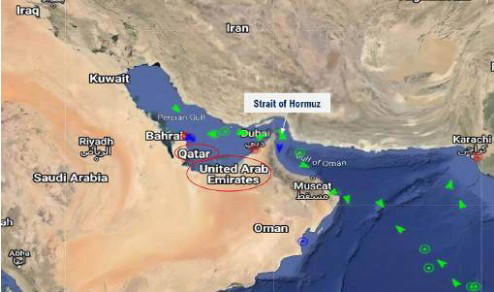
Imagine waking up tomorrow to news that twenty million barrels of oil, almost a fifth of the world’s daily supply might not reach refineries, power plants and trucks. A war in Iran has turned the Strait of Hormuz into a choke point so critical that one misstep could rattle every economy on Earth.

The modern global economy likes to imagine itself as sophisticated, diversified and resilient. Governments talk about strategic reserves. Economists talk about market flexibility. Politicians speak confidently about energy security. But history has a way of humiliating such confidence.
Right now the world is being reminded that the foundations of the global economy are still frighteningly fragile. A narrow stretch of water in the Middle East, barely wide enough to appear dramatic on a world map, suddenly holds the power to shake markets, rattle governments and push millions of people toward higher prices and economic anxiety.
The waterway is the Strait of Hormuz, and the war surrounding Iran is turning it into the most dangerous pressure point in the global economy.
Every single day, roughly twenty million barrels of oil pass through this narrow corridor between Iran and Oman. Tankers loaded with crude from Saudi Arabia, Kuwait, Iraq, the United Arab Emirates and Iran must all pass through this one maritime bottleneck before dispersing across the planet to power industries, move vehicles and keep electricity grids alive.
This is not just another shipping route. It is the main artery of the modern energy system.
And arteries are dangerous things to block. Energy analysts are now warning that the disruption surrounding the Strait of Hormuz could evolve into the largest oil supply shock the modern world has ever experienced. If tanker traffic collapses or is severely restricted, the global market could suddenly lose close to twenty percent of its daily oil flow. To understand how serious that is, it helps to remember the crises that shaped modern economic history.
The 1973 oil crisis triggered by an Arab oil embargo removed roughly four million barrels of oil per day from the global market and sent Western economies into recession. Fuel shortages became part of everyday life and inflation surged across the developed world.
The turmoil following the Iranian Revolution disrupted about five million barrels a day and pushed oil prices to levels that shook financial systems across continents.
Even the dramatic events surrounding the Gulf War, when Iraq invaded Kuwait and oil fields burned across the desert, removed roughly four million barrels per day from supply.
Those shocks changed global politics. What is now being discussed around the Strait of Hormuz is potentially several times larger.
Twenty million barrels of oil a day is not just a market disruption. It is the kind of shock capable of rattling currencies, reigniting global inflation and forcing central banks and governments back into crisis mode.
The first warning signs are already appearing. Shipping companies are becoming cautious. Insurance premiums for tankers entering the Gulf are climbing rapidly. Traders are scrambling to price risk into a market that had grown used to assuming stability.
Oil markets have always been sensitive to fear because energy is the invisible thread connecting every modern economy. When oil becomes expensive, transportation costs rise. When transportation costs rise, food prices follow. Fertiliser becomes more expensive. Airlines increase ticket prices. Manufacturing costs climb.
Yet there is another irony unfolding far from the war zone. In Europe and the United States there are, for now, no immediate shortages of oil or gas. Supply lines remain intact and markets continue to function. But in Nigeria, fuel prices are already rising despite the fact that global supply has not yet been physically disrupted. The tragedy of Nigeria is that abundance underground has never guaranteed affordability above it.
In other words, a war fought in one region begins quietly appearing in grocery stores thousands of kilometres away. The global economy has always tried to convince itself that it has outgrown these vulnerabilities. Supply chains have become more complex. Energy markets are supposedly more diversified. Technology has made the system smarter and faster. But none of that changes geography.
The uncomfortable truth is that global prosperity still depends on a handful of physical chokepoints. A canal here. A pipeline there. A narrow maritime corridor somewhere else. These thin lines on a map quietly determine whether factories run, whether food reaches cities and whether economies expand or contract.
The Strait of Hormuz is the most critical of them all. For oil producing countries like Nigeria the situation carries a bitter irony. Rising global oil prices should translate into higher national revenues. Yet because so many developing economies still depend heavily on imported refined fuel, citizens often feel the pain before they see the benefits.
Petrol becomes more expensive. Transport fares rise. Food prices climb.
The global energy system distributes risk unevenly, and the most vulnerable societies often feel the consequences first.
This is why the unfolding situation around Iran is more than a regional military story. It is a test of how stable the architecture of the global economy truly is.
The oil crises of the 1970s reshaped geopolitics, altered alliances and forced nations to rethink energy security. Entire strategic doctrines were rewritten as governments scrambled to avoid ever being so exposed again.
Yet decades later the world still depends heavily on a single narrow waterway.
For all the sophistication of modern finance, for all the talk of artificial intelligence and digital economies, the system still rests on ships carrying crude oil through a channel of water between two coastlines. And that fact should make everyone uneasy.
Because the lesson of history is brutally simple.
The global economy works beautifully until the moment it does not.
And sometimes the difference between stability and crisis is nothing more than a narrow strait and the decision of someone, somewhere, to close it.
History has proven one truth again and again: the world’s wealth, its comfort, its very stability, can hinge on a strip of water barely fifty kilometers wide. Today, the Strait of Hormuz reminds us that civilization is fragile, and the difference between order and chaos can be as narrow as the waves beneath a single tanker.
Empires have risen and fallen over control of trade routes, rivers, canals and straits. In our age of satellites and digital markets it is tempting to believe geography has lost its power. Yet the Strait of Hormuz tells a different story. For all our technology and wealth, the modern world is still vulnerable to the oldest force in history. The power of a narrow passage and the decision of someone, somewhere, to close it.
The post The strait that holds the world’s economy hostage, by Stephanie Shaakaa appeared first on Vanguard News.