Survivors share prostate cancer stories as TPC marks 1sr year with 100 robotic surgeries
 SKAiF NewsNG SNN
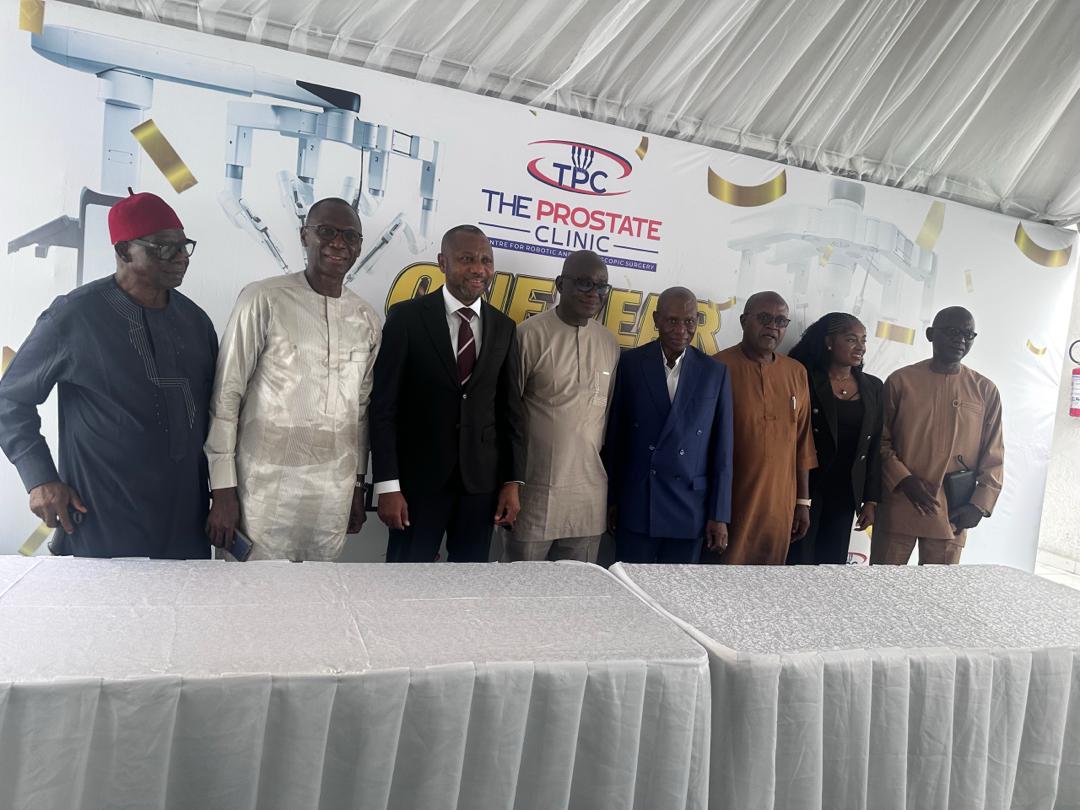

… I heard a voice; go check yourself — Rtd Maj Gen Enenche
…80% of Nigerian men present too late – Prof Kingsley Ekwueme
…Says no amount of sex will prevent prostate cancer
By Chioma Obinna
It was a testimony-laden Saturday as the first anniversary celebration of The Prostate Clinic, TPC, turned into a sobering national health warning, with survivors, including retired Major General Enenche John Enenche, and others recounting their encounters with prostate cancer and the life-saving interventions that followed.
Medical experts at the event also warned that fear, silence, and misinformation are driving over 80 per cent of Nigerian men to present with late-stage prostate cancer, often when treatment options are already limited.
At the heart of the gathering was Major General Enenche John Enenche (retd.), former spokesperson of the Nigerian Armed Forces, whose story captured both the danger, and hope, surrounding prostate cancer.
Others are Ichie Sylvester Osigwe, Mr. Adeshina Alabi, Mr. Ben Alozie, Mr. Innocent Ihebuzor, and Mr. Emmanuel who came all the way from Canada.
“My testimony is that of divine intervention,” Enenche said.
“I heard clearly: ‘Go and check yourself, check your prostate, check your kidneys. That instruction saved my life.”
Enenche admitted he had noticed subtle changes in his body years earlier but ignored them until that prompting pushed him to act. When he eventually went for a test, his PSA level came back at 14.2.
Further investigations confirmed a serious concern.
“They saw something that could be cancerous,” he said. Fear took over.
“I told the doctor, ‘Remove everything, both testicles and nerves. Let me just live so I can continue serving Nigeria,’” he recounted.
But the founder of TPC, Professor Kingsley Ekwueme, insisted on a more measured, evidence-based approach.
“He told me, ‘General, you will need those structures. Let us do what is best medically.’ That gave me confidence,” Enenche said.
According to Enenche, four hours of procedure changed everything. Enenche underwent robotic surgery, which he described as seamless.
“Prof told me the operation would take about four hours. When I woke up, it was done. I didn’t even realise what had happened,” he said.
Now fully recovered, he speaks with gratitude. “I walked into that hospital. I walked out. The money I spent became nothing compared to the life I gained.”
Enenche’s testimony was one of many at the event, which marked one year of TPC’s operations and brought together beneficiaries of its treatment.
For Enenche and others, the anniversary was more than a celebration, it was a call to action.
“Too many men are dying because they are afraid or unaware,” he said.
“If you are over 40, don’t wait. Don’t assume. Go and check yourself. That simple decision saved my life.”
Another survivor, Mr Innocent Ihebuzor described months of distress before his procedure.
“I was urinating up to 10 times a night. I couldn’t sleep,” he said.
“After the surgery, everything returned to normal. I urinate like a young boy again.”
Also, Mr. Emmanuel Okolie, who travelled from Canada, said his diagnosis came at a devastating moment.
Okoli, said he abandoned treatment delays in Canada to fly to Lagos. “I would rather die in the hands of a human being.
He expressed joy as his surgery was successful with a fast recovery.
Ichie Sylvester Osigwe explained how Prof Ekwueme reassured him at the blimey of his wife’s death and operated on him after.
“My PSA was 69, and my wife had just died of cancer. I asked, ‘Will I survive?’ The professor told me, ‘You will not die.’ Today, I am alive.”
On his part, Mr Adesina Alabi shared how his PSA level shot up to 7.9 last year. Frustrated by delays and poor service at another facility, he was referred to TPC.
He underwent robotic surgery on December 27 and recovered smoothly.
“This new place is excellent,” he said, praising the professionalism and care he received.
Also, Mr. Ben Alozie, a journalist survivor, reflecting years after his surgery, added: “Prostate cancer is not a death sentence. I am practically cancer-free.”
These beneficiaries are part of the 100 patients who have been treated at the hospital in the last year of its operation in Nigeria.
Other survivors who spoke aincluded patients from Ghana and Canada also sent video messages.
In his address, the Chairman of TPC, Mr. Francis Ogboro said patients are their mouthpiece.
Ogboro, described the anniversary as both symbolic and significant. “It is a monumental day for us,” he said. “
We have treated 99 patients, myself making it 100 patients. This is not just a vision realised for one man, but for the entire world.”
He emphasised that patient testimonies have become the clinic’s strongest voice.
“We don’t need to spend so much on advertising because our patients are our mouthpiece. When they share their experiences, others come running,” he said.
According to him, the clinic was established to deliver global best standards locally.
“When you come to TPC, you expect the best, not the best in Africa, but the best in the world. That is what we are committed to delivering.”
Addressing the gathering during the media briefing to mark the anniversary, the Founder of The Prostate Clinic, Prof Kingsley Ekwueme, described the disease as a silent killer among Nigerian men.
Ekwueme while fielding questions from journalists painted a troubling picture of prostate cancer in Nigeria.
“Prostate cancer kills more men in Nigeria than almost anywhere else,” he said. “Over 80 per cent of men present when the disease is already incurable.”
He contrasted this with developed countries. “In the UK, only about 12.5 per cent present with incurable disease. Here, it is the reverse. That is the tragedy.”
He warned that the difference between early and late detection is often the difference between life and death.
“If your cancer is incurable, even with money, you may live two to four years. But if it is found early, you will live your normal life expectancy,” he said.
Ekwueme stressed that misinformation remains a major problem. “There is no known cause of prostate cancer. What we have are established risk factors, age, being black, and family history. Every other claim is speculation.”
He dismissed widely held beliefs about prevention. “There is no diet that prevents prostate cancer. People take all sorts of mixtures and still present with advanced disease,” he said.
He added pointedly: “No amount of sex will prevent prostate cancer. These are myths.” According to him, risk increases with age, particularly after 50, while black men are more likely to develop aggressive forms. Those with a family history are at even greater risk.
“If you have a family history, you should begin PSA testing at 45,” he advised.
On the danger of fear, Ekwueme said fear continues to keep many men away from hospitals.
“Men are afraid of losing their erections, but they should be more afraid of losing their lives,” he said.
He cautioned against outdated and harmful practices.
“In some places, men still have their testicles removed unnecessarily. That is no longer standard practice. In over 20 years, I have not removed a testicle for prostate cancer in the UK.”
He stressed that treatment decisions must not be taken lightly.
“You cannot treat prostate cancer like going to the market. The first treatment you receive is your best chance. If it is done wrongly, it is very difficult to correct.”
Using a vivid analogy, he added: “Would you board a plane if the pilot told you it was his first time? That is how you should think about surgery.”
Reassuring patients, he said modern techniques have changed outcomes significantly.
“With the right technique, you will not be incontinent. You will not wear Pampers. Your dignity can be preserved, and you can live a normal life.”
He further emphasised that beyond the number of procedures performed, safety remains paramount.
“It is not just about how many surgeries we have done, but how safely they were done. Every patient should go home better than they came,” he said.
Highlighting another major concern, he added: “Many men worry about erection, but incontinence is actually worse. With the right expertise, both can be preserved, but the priority is to save life and dignity.”
Reaffirming his commitment, Ekwueme declared: “My mission is to reverse the prostate cancer statistics in Nigeria. I will not stop until we get there.”
Ekwueme said his vision goes beyond individual treatments to transforming access to care.
“I have treated patients from across the world, Ghana, Cameroon, Côte d’Ivoire, the United States, the UK, Canada, and they come to Nigeria for this care,” he said.
He explained that his decision to establish TPC locally was to bridge the gap.
“Nigerians should not have to travel abroad for world-class treatment. We must bring that care here,” he said, adding that plans are underway to expand services across the country.
The post Survivors share prostate cancer stories as TPC marks 1sr year with 100 robotic surgeries appeared first on Vanguard News.