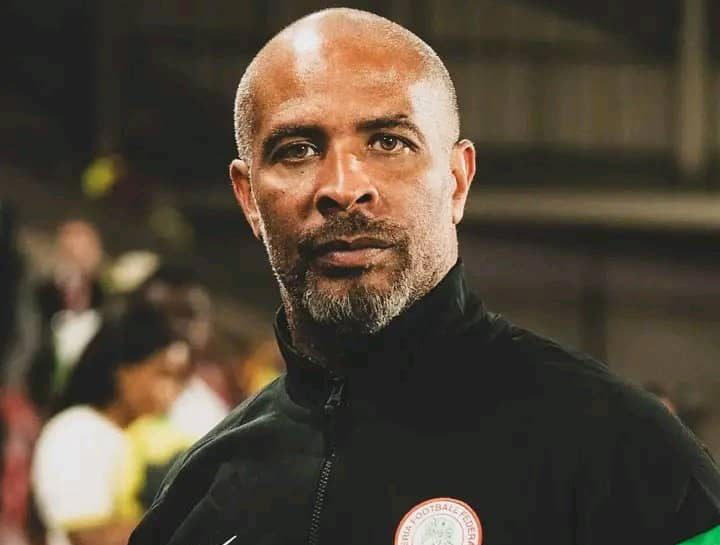
Super Eagles recruitment: Is Eric Chelle’s diaspora drive a lazy way out?
 SKAiF NewsNG SNN
By Douglas Baye-Osagie
The news that Eric Chelle is tracking Femi Azeez of Millwall, fresh off being rated the best right winger in the English Championship, and William Osula of Newcastle United for a potential Super Eagles debut, reignites a familiar debate: have we now fully committed to scouting Europe’s leagues rather than combing the NPFL and grassroots for homegrown talent?
This isn’t about questioning patriotism. Full respect to Ademola Lookman, Alex Iwobi, Semi Ajayi, and Calvin Bassey. They have been absolutely dedicated to the badge. They can also tell you about the immense pressure of wearing the green-white-green and what their journey on African turf has been so far.
But the pattern is clear. Our recruitment drive increasingly starts in London, Amsterdam, and Brussels before it starts in Lagos, Benin City, Kano, or Aba. The question is whether this dependency on foreign-born players has crippled the organic growth of our national teams.
Yes, these players are exposed to the best training facilities and elite coaches from a young age. They are tactically schooled and physically conditioned to modern standards. Yet exposure does not always equal execution when it matters most on the continent.
Have they shown the mental capacity and rawness to navigate the chaos of African World Cup qualifiers? The pitches in Ndola, the humidity in Conakry, hostile crowds in North Africa, and the dark arts of CAF football. Remember, we have missed back-to-back World Cups now.
This run of failure is coming on the heels of looking for shortcuts. In the past, when the Super Eagles had a problem, we looked home. The solution came from Shooting Stars, Rangers, Bendel Insurance, Enyimba, or the academies scattered across the country. Coach Stephen Keshi in the 2013 AFCON had the guts to play an unknown Sunday Mba from Warri Wolves against a midfield of Gervinho (Arsenal), Cheick Tiote (Newcastle), Yaya Toure (Manchester City) and Didier Zokora (Trabzonspor). Mba not only started the match, he also scored the winning goal. It wasn’t just about his talent; it was the belief the coach had in him that made him play well against a star-studded Ivorian team.
Since the retirement of Mikel Obi, we haven’t had a Number 10 with the confidence to manage a game and dictate the rhythm of the attack. We have creators, but not controllers. We have runners, but few conductors who understand the African tempo. Is it that we don’t have players in the local league or youth academies we can nurture into a playmaker*?*
Eric Chelle must not be lazy. He cannot limit his next phase of talent discovery to only foreign-born players. Scouting Europe is easier. The data is cleaner, the agents are louder, and the passports are ready. But easy does not mean right for Nigeria’s long-term health. If he must lead Nigeria to the next Olympics in 2028 or the World Cup in 2030*,* he needs to keep an eye on our local talents.
Even when the national U17 and U20 teams are falling short because of poor preparation and selections*,* our academy teams still prove what is possible at home. Nigerian academy sides like Sporting Lagos and Beyond Limit have won the Gothia Cup in Sweden in recent years, with clubs from all over the world participating. The same goes for other academies churning out bright stars to Europe from tattered playing surfaces in Nigeria. That tells you the raw material exists. What’s missing is the bridge from those U17 stars to the Super Eagles.
We should be intentional about building a base of young talents who have mastered the rhythm and temperament of the African game before involving our foreign-born players. Let the NPFL not be ridiculed for a lack of talent. Let scouts watch Remo Stars vs. Rivers United with the same urgency they watch Millwall vs. Sunderland.
The problem is not uniquely Nigerian. It is affecting our neighbours Cameroon too. The urge to cap foreign-born players hasn’t brought good fortune for the Indomitable Lions either. They’ve lost their fear factor and invincibility on the continent
Players haven’t integrated properly, and this has shown in World Cup qualifiers and the Africa Cup of Nations itself. Cameroon used to arrive every African Nations Cup as one of the favourites. Not anymore. The chemistry looks forced, the identity diluted, and the results have followed.
After Cameroon’s loss to Senegal at the 2023 AFCON, Samuel Eto’o made a statement of concern in the dressing room that cuts to the heart of this issue: “Dear brothers, I understand you. Many of you were not born in Cameroon and have never played for a club in Cameroon.”
Eto’o continued: “The advice of a Cameroonian coach is beneficial to a footballer from the start of his career until the end. You who were born there have too many rights over the leaders. Cameroon taught me that I am a soldier within the national team. I will die with this spirit.”
“Cameroon has just suffered humiliation just because love for the federation is not 100 percent. Excuse me for talking about myself. I could play two matches on the same day for the love of our beautiful country. I did it, Roger Milla did it and Francois Omam-Biyik did it.”
“You play with too many reserves, what are you afraid of? Dying for the homeland surpasses all the money on the earth.” Those were Eto’o’s words. The issues are the same in Nigeria and not very far off. It is about mentality, identity, and total buy-in.
In 2024, Mikel Obi also weighed in, encouraging foreign-born players not to treat Nigeria as a second choice. “Nigeria should not be your second choice. When you’re called upon to represent the country, you should take it with pride and dedication. We need committed players who will give their all to the team.”
Mikel’s words serve as a timely reminder of the importance of passion and dedication when the national team calls. The idea that the Super Eagles is a fallback option should not be entertained by players who have lost out on places with their European countries of birth.
This is not a call to shut the door on the diaspora. Femi Azeez and William Osula may well become great Eagles. The point is balance. We cannot outsource the soul of the team. We must blend the foreign-trained polish with the local-trained grit, and we must do it deliberately.
The Super Eagles’ identity was forged in the heat of Lagos, the mud of Enugu, and the cauldrons of African qualifiers. If we forget how to build from home, we’ll keep borrowing players but lose the spirit that made the world fear us. Chelle’s real test isn’t who he caps. It’s whether he can build a team that fights like Nigeria, not just one that plays like Europe.
The post Super Eagles recruitment: Is Eric Chelle’s diaspora drive a lazy way out? appeared first on Vanguard News.