Security is Tinubu’s priority in N58.18trn 2026 budget
 SKAiF NewsNG SNN
By Henry Umoru & Gift ChapiOdekina
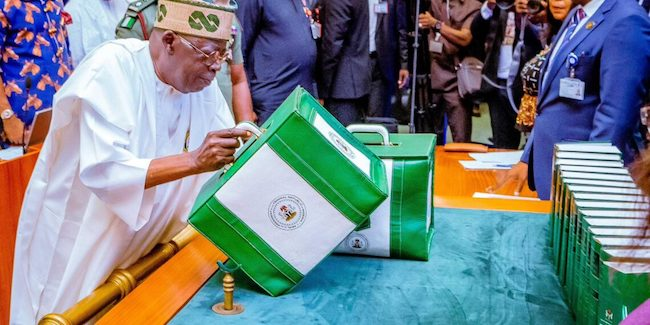
PRESIDENT Bola Tinubu yesterday presented the 2026 Appropriation Bill of the sum of ¦ 58.18 trillion to the joint session of the National Assembly.
Christened, “Budget of Consolidation, Renewed Resilience and Shared Prosperity”, Tinubu said the budget was a culmination of two and a half years of “painful but necessary” reforms aimed at steering Nigeria towards macroeconomic stability, job-rich growth, and inclusive prosperity.
The budget, is 3.87 per cent of the estimated Gross Domestic Product (GDP) with targeted revenue of N34.33trillion to fund the projected aggregate expenditure of N58.18 trillion. While presenting the budget, Tinubu assured members of the National Assembly that multiple budget implementations will end on the 31st of March 2026 when all contracts executed in the 2025 budgets must have been completed and contractors paid.
The President, in his address to the National Assembly, described the 2026 Appropriation Bill as “Budget of Consolidation, Renewed Resilience and Shared Prosperity”, stressing that the proposal seeks to lock in recent macroeconomic gains, restore investor confidence and translate recovery into jobs and improved living standards for Nigerians.
… at $64.88 per barrel; allocations
In the proposal, total revenue is projected at N34.33 trillion, while total expenditure stands at N58.18 trillion, including N15.52 trillion for debt servicing. Recurrent (non-debt) spending is put at N15.25 trillion, while capital expenditure totals N26.08 trillion.
The budget deficit of N23.85 trillion represents 4.28 per cent of GDP. The assumptions underpinning the budget include a crude oil benchmark of $64.85 per barrel, production of 1.84 million barrels per day, and an exchange rate of N1,400/$.
On sector allocation, the President said that Defence & Security got N5.41 trillion; Infrastructure N3.56 trillion; Education, N3.52 trillion; Health N2.48 trillion, Debt Servicing N15.52 trillion; Recurrent (NonDebt) N15.25 trillion; Capital Expenditure (Total) N26.08 trillion and total Budget N58.18 trillion “These numbers are not just accounting lines. They are a statement of national priorities,” Tinubu said, stressing commitments to fiscal sustainability, debt transparency and value-for-money spending.
The president also declared that all armed groups operating outside state authority would henceforth be treated as terrorists, as he vowed tougher security action, stricter budget discipline and deeper economic reforms.
President Tinubu, in his address acknowledged the pains of reforms over the last two and a half years but assured citizens that “their sacrifices are not in vain.”
On the stability of the nation’s economy, the President said that Nigeria’s economy was showing clear signs of stabilisation, citing 3.98 per cent GDP growth in Q3 2025, moderation in inflation for eight consecutive months to 14.45 per cent in November 2025, improved oil production, stronger non-oil revenues and rising investor confidence.
Tinubu disclosed that external reserves climbed to a seven-year high of about $47 billion as of mid-November 2025, providing over 10 months of import cover. “These outcomes are not accidental. They reflect difficult but deliberate policy choices,” Tinubu said, adding that the task ahead was to ensure that “stability becomes prosperity, and prosperity becomes shared prosperity.”
Security
On security, Tinubu said that Nigeria was resetting its national security architecture with a unified counter-terrorism approach. “Henceforth, any armed group or gunwielding non-state actors operating outside state authority will be regarded as terrorists,” he declared.
He said that bandits, militias, armed gangs, kidnappers, violent cult groups, forest-based armed collectives and foreign-linked mercenaries would be categorised as terrorists. He warned that financiers, ransom facilitators, arms suppliers, political protectors and even community or religious leaders who aid violence would also be designated terrorists.
On budget execution, Tinubu admitted that 2025 implementation faced transition challenges, noting that as of Q3 2025, N18.6 trillion in revenue (61% of target) and N24.66 trillion in expenditure (60% of target) had been recorded. Only N3.10 trillion, about 17.7 per cent of the 2025 capital budget, had been released by Q3.
He pledged stricter discipline in 2026, directing the finance and budget authorities to implement the budget “strictly in line with appropriated details and timelines.”
Revenue target
Heads of Government Owned Enterprises (GOEs) were ordered to meet revenue targets, backed by end-to-end digitisation to seal leakages.
“Nigeria can no longer afford inefficiencies or underperformance in strategic agencies. Every institution must play its part,” he warned. Tinubu said investments in human capital would be deepened, revealing that over 418,000 students have benefitted from the Nigerian Education Loan Fund in partnership with 229 tertiary institutions.
Health spending, he added, represents six per cent of the total budget, excluding liabilities, with over $500 million in prospective U.S. grant funding for targeted health interventions. On food security, he said agriculture would be prioritised through mechanisation, irrigation, climate-resilient farming, storage and agro-value chains to curb post-harvest losses and boost smallholder incomes.
A budget to deliver
“The greatest budget is not the one we announce. It is the one we deliver,” Tinubu said, outlining commitments to better revenue mobilisation, smarter spending and stronger accountability. “Our economy grew by 3.98% in Q3 2025, higher than the 3.86% recorded in Q3 2024.
Inflation has moderated for eight consecutive months, with headline inflation declining to 14.45% in November 2025, from 24.23% in March 2025.
“With stabilising food and energy prices, tighter monetary conditions, and improving supply responses, we expect the disinflationary trend to persist—so that inflation continues to decline further over the 2026 horizon, barring major supply shocks. Oil production has improved, supported by enhanced security, technology deployment, and sector reforms.
“Non oil revenues have expanded significantly through better tax administration —not excessive taxation. Investor confidence is returning, reflected in capital inflows, renewed project financing, and stronger private sector participation.
“Our external reserves rose to a 7 year high of about US$47 billion as at 14 November 2025, providing more than 10 months of import cover and a stronger buffer against shocks. The reform gains are not accidental but result from difficult and deliberate policy choices.
“Our task now is to consolidate these gains—so that stability becomes prosperity, and prosperity becomes shared prosperity”, he stressed.
President Tinubu assured Nigerians that their sacrifices would not be in vain saying that the nation has got out of the dark tunnel of uncertainty and economic volatility. Laying the bill before lawmakers, he said the 2026 Budget “belongs to all of us,” expressing confidence that cooperation between the Executive and Legislature would deliver the Renewed Hope Agenda.
“It is with great pleasure that I lay before this distinguished Joint Session of the National Assembly the 2026 Appropriation Bill of the Federal Republic of Nigeria,” Tinubu concluded.
“May God bless the Federal Republic of Nigeria. Earlier in his welcome address, the President of the Senate, Senator Godswill Akpabio, commended President Tinubu for all the courageous policies and decisions his government has taken since 2023.
He said that the National Assembly was fully behind him but begged him to review the policy of withdrawal of police orderlies from VIPs by restoring those attached to federal lawmakers at both chamber.
In his closing remarks, the Speaker of the House of Representatives on Friday commended President Bola Ahmed Tinubu for deepening fiscal discipline and restoring macroeconomic stability.
Speaker
The Speaker said Tinubu’s decision to personally present the 2026 budget underscored his “abiding faith in democratic institutions” and commitment to partnership between the executive and legislature in driving sustainable national renewal.
He described 2025 as a year of “regained stability, renewed confidence and steady progress,” noting that although the fiscal year was shaped by global economic headwinds and volatile crude oil prices, the challenges ultimately strengthened Nigeria’s reform agenda.
The post Security is Tinubu’s priority in N58.18trn 2026 budget appeared first on Vanguard News.