Sanusi II, Onaiyekan, and critiques of Tinubunomics, by Suleiman Suleiman
 SKAiF NewsNG SNN

By Suleiman A. Suleiman (suleimansuleiman@dailytrust.com; 07066451983 SMS)
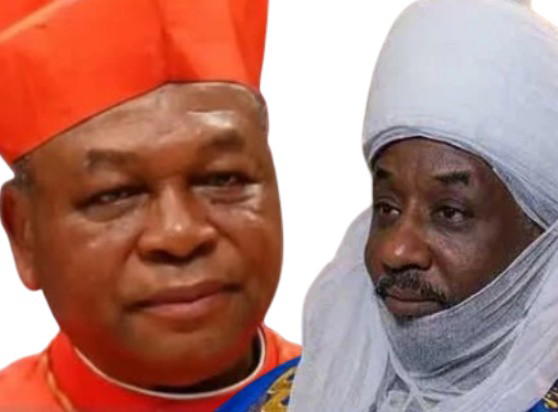
An otherwise routine meeting between President Bola Ahmed Tinubu and the Catholic Bishops of Nigeria Conference last week took a dramatic turn. In their memorandum to the President, the Catholic Bishops expressed serious concern about worsening economic hardship, insecurity, and the increasing danger of Nigeria drifting into a one-party state. The bishops said they were only passing on to the President the message they received from Nigerians.
President Tinubu would have none of it, however. In response, he not only rejected the bishops’ assessment, he insisted that his economic policies are working and that Nigerians should be thankful to him for rescuing the economy from the brink of collapse. A leading member of the delegation, Cardinal John Onaiyekan, Archbishop Emeritus of Abuja, subsequently doubled down on the bishops’ message in a television interview, saying that “when a nation is bleeding, you cannot expect a polite meeting with the Head of State. We had to let him know”.
At an event in Kano only a few days earlier, the Emir of Kano, Muhammadu Sanusi II said much the same. Now, Sanusi II is a former Governor of the Central Bank of Nigeria, a self-declared friend of President Tinubu, and a long-standing advocate of the policies of this government. Yet, in his speech, he clearly warned that “any economic policy that does not improve the welfare of the people is inherently ineffective”. He agreed that “the country has recorded notable achievements”, but was still categorical that Nigeria “continues to face political instability, ethnic and religious tensions, insecurity, poverty and economic hardship”.
For me, both assessments are not only correct, they represent the sort of interventions President Tinubu should actually value. The critical question, therefore, is why the government felt the need to reject the bishops’ assessment of its economic policies or dig in further in its position.
I can think of three answers. First, President Tinubu has become too detached from the realities of the people he leads, and is now intellectually insulated. The President and his government appear no longer able or willing to even assess the views of anyone else. Almost every criticism, from whoever, is interpreted either as political hostility or a failure to understand economics as much as the government does. The only outside voices the government pays attention to are those of the World Bank, IMF, foreign embassies or leaders. For President Tinubu and his government, domestic accountability is an irritation.
Moreover, because institutions of scrutiny like the legislature, opposition parties, labour unions, civil society organizations, universities, the media, etc, have been weakened, co-opted or otherwise silent, there has been less sustained critique of the government’s economic policies or political actions. Consequently, the government has come to believe that its own interpretation of reality is the only honest and valid one. This is nonsense, of course.
Intellectual insulation—the inability or unwillingness to entertain contrary opinion—cannot shield the government, since its economic policies do have direct impacts on the lives and livelihoods of millions of Nigerians. The very fact that both Emir Sanusi II and the Catholic Bishops arrive independently at similar concerns about the country should prompt reflection within the government, not intellectual insulation or closure.
Secondly, the Tinubu administration places excessive weight on macroeconomic indicator. At every opportunity, the government brandishes our GDP growth rate of nearly 4% this year. Or it reminds everyone that the Nigerian stock-market is among the “best-performing” in the world. Or it proclaims “stability” in the currency exchange market, or point to the increased federal allocations to the states, and so on. The government touts these indicators as the absolute measure of policy success, and does not bother much about the actual impacts of its policies on the lives and livelihoods of Nigerians. But macroeconomic indicators are neither the best nor the only measures of policy success, and even on their own terms, several of those cited repeatedly by this government are either misleading or unexceptional.
First of all, Nigeria’s current GDP growth rate stands at 3.8%, which is nothing exceptional and just barely within Nigeria’s historical average. GDP growth rates consistently did much better from 2003 to 2014 under Presidents Obasanjo, Yar’Adua, and Jonathan. More importantly, under the Buhari administration, an economy coming out of a massive COVID-induced recession in 2020-2021, rebounded to a respectable GDP growth rate of 4.3% by 2022. For all the magic of Tinubu’s reforms in the past three years, not once has Nigeria’s GDP growth rate reached Buhari’s 2022 figure. So, even the constant harping that this government inherited an economy on the brink of collapse is simply a dishonest ruse.
Yes, there have been significant increases in FAAC allocations to the states. But as a 2024 World Bank report indicates, this is due almost entirely to the devaluation of the naira, not increased productivity or higher revenue generation capacity. After all, every naira today is worth only about 30-35 kobo three years ago. Moreover, the government’s food importation policy has helped to keep food prices artificially low. Without this policy, the government would not need Catholic bishops to tell it that its policies are not working. But while food prices are low, local agriculture is being destroyed as many farmers have reduced production or downed tools all together as food importation continues to hurt local agriculture.
Most importantly, President Tinubu and his government tend to ignore or underestimate the practical and political effects of the recent rebasing of the inflation rate by the National Bureau of Statistics (NBS). Whatever the academic or policy arguments for it, the rebasing of the inflation rate from over 34% to less than 15% has had the practical and political effect of making the changes to the economy appear within reasonable limits, while in fact, for millions of Nigerians, things have already gone out of hand. An inflation rate of 36% would be screaming in the headlines daily, and the government have the clear impression that something is not right. Conversely, an inflation rate of 15% masks that sense of urgency, even if urgency is what most people feel. Without the rebasing of the inflation rate, the macro-economic indicators repeatedly cited would not appear so glowing even to the government itself. In this sense, the rebasing of the inflation rate by the NBS is political in effect, if not in intent.
Finally, the Tinubu government seems to have an ultra-orthodox approach to economic policy. The government appears to think that if you remove fuel subsidy, unify the exchange rate, increase electricity tariffs, then the economy will fly on auto-pilot all by itself. But this is either schoolboy naivety or ideological orthodoxy, but certainly not practical policymaking. Stabilization policies are not the same as development policies. Implementing subsidy removal, naira unification, etc, are only one half of the reform equation. You also need an industrial and agricultural policy to spur local production, create jobs, and expand the tax base. You need a social policy to protect the very vulnerable, who, in Nigeria, are over a third of the population. Above all, you need a certain level of state capacity to make all of this work.
Unfortunately, the Tinubu government has no answers to any of these. But rather than look for answers from all sources, it prefers intellectual insulation and epistemic closure. It prefers to dance only to its own tunes and sing its own praises. This is the inherent weakness of Tinubunomics, and it is strong enough to bring the whole edifice down.
The post Sanusi II, Onaiyekan, and critiques of Tinubunomics, by Suleiman Suleiman appeared first on Vanguard News.