Rent-seeking economy rigged against most Nigerians— Dele Oye, ex-OPS boss
 SKAiF NewsNG SNN
•WARNS: $74 billion livestock sector could become another Ajaokuta if…
•‘When government tries to operate businesses, disaster follows’
By Nnamdi Ojiego
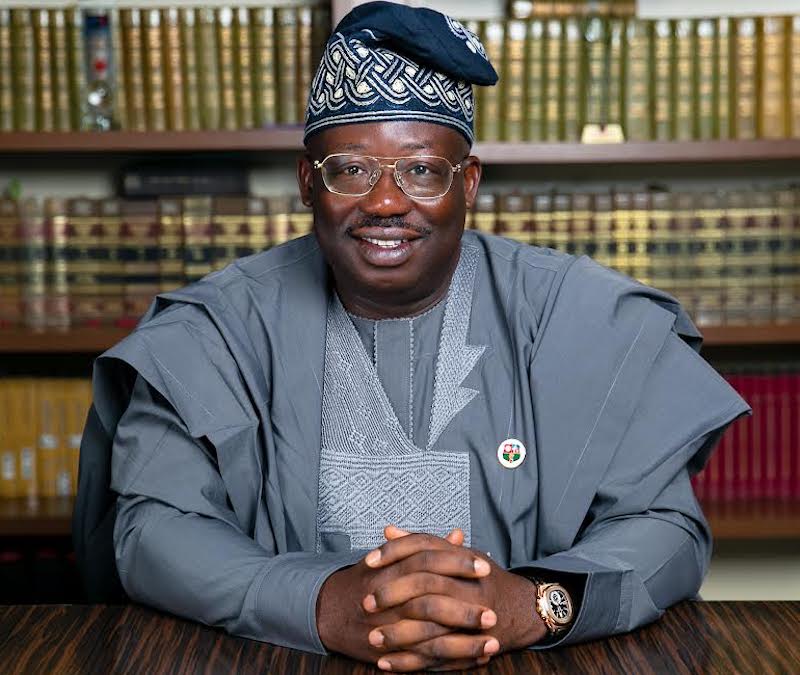
Hon. Dele Kelvin Oye, immediate past National President of Nigerian Association of Chambers of Commerce, Industry, Mines and Agriculture, is also a past Chairman of the Organised Private Sector of Nigeria. The current Chairman of Alliance for Economic Research and Ethics LTD/GTE and Chairman, Nigeria-Türkiye Business Council, in a paper delivered at the 2026 Edition of Vanguard Economic Discourse, said Nigeria’s rent-seeking economy is rigged against most Nigerians. In the paper
titled, ‘The government as facilitator, not operator: a new paradigm for Nigeria’s livestock industry’, Oye warned that the $74 billion livestock sector should not become another Ajaokuta. He emphasized that when government tries to operate businesses, disaster follows, citing the cases of Ajaokuta among other failed projects of the past.
The discourse held under the theme, ‘Food Security and Socioeconomic Stability: Options for Nigeria’s Agriculture Sector Rebound’. Excerpts from the Oye paper:
This conference, hosted by one of Nigeria’s most respected media institutions, is itself a symbol of what we must aspire to: rigorous inquiry, fearless analysis, and the courage to speak truth to power.
I. THE BRINK OF COLLAPSE: NIGERIA IN MAY 2023
In May 2023, Nigeria stood at the precipice of economic catastrophe. Our nation was, by every credible metric, on the verge of fiscal collapse. The statistics were not merely alarming—they were existential.
Nigeria’s debt servicing consumed between 65% and 124% of government revenue at various points during 2023, depending on the measurement period and methodology applied. Our foreign debt service alone reached $3.5 billion in 2023, ranking us as the third-largest debtor to the World Bank’s International Development Association (IDA).
The World Bank had projected, as early as December 2022, that debt servicing would gulp 123.4% of the Federal Government’s revenue in 2023.We were not merely borrowing to grow—we were borrowing to service existing borrowings.
Inflation was already elevated at approximately 22% when the new administration assumed office.
The official unemployment rate stood at 5.4% for 2023 according to the National Bureau of Statistics (NBS), though this figure masked the deeper crisis of underemployment and the millions engaged in subsistence activity that barely sustains life.
Fuel subsidies were draining the treasury at a rate of ¦ 4 trillion annually—a figure that was projected to rise to ¦ 5.4 trillion by 2024 had the subsidy not been removed.
The Naira was artificially propped up at approximately ¦ 460 to the dollar at the official window, while the parallel market quoted rates around ¦ 760, creating a premium of over 60% that fueled arbitrage, corruption, and capital flight.
Our fiscal trajectory was unsustainable. We were borrowing to pay interest on debt. We were subsidizing consumption while starving investment. We were, in the words of the World Bank, facing a “fiscal time bomb.”
II. THE TINUBU REFORMS: COURAGEOUS BUT PAINFUL MEDICINE
President Bola Ahmed Tinubu, upon assuming office on May 29, 2023, administered bitter but necessary medicine.
His administration undertook three foundational reforms that, whatever their short-term pain, were structurally indispensable.
First, the removal of the fuel subsidy eliminated the multi-trillion naira annual drain on the treasury.
Second, the floating of the Naira allowed market forces to determine exchange rates, closing the gap between the official and parallel markets and reducing the systemic corruption that the dual-rate regime had institutionalized. Third, the consolidation of monetary and fiscal policy restored coherence to economic management.
The short-term consequences were severe, as anticipated. Inflation surged from approximately 22% in May 2023 to a peak of 34.80% by December 2024—a shock that devastated household purchasing power.
Food inflation, the most politically sensitive indicator, reached an agonizing 40.53% by April 2024 before beginning a gradual descent.
The Naira depreciated significantly, and transportation costs tripled overnight, compounding the suffering of ordinary Nigerians.
Yet, these reforms have yielded measurable macroeconomic stabilization.
GDP growth recovered to 3.84% in Q4 2024, up from lower rates in the preceding quarters, driven by non-oil sector resilience.
External reserves stabilized and grew to approximately $48–49 billion by early 2026, a remarkable recovery from the depleted levels of 2023.
Investor confidence improved markedly, with capital importation jumping 88% to $23.21 billion in 2025—a testament to restored confidence in Nigeria’s macroeconomic framework.
The parallel market premium narrowed significantly, reducing arbitrage and the corruption it bred.
The World Bank now projects Nigeria’s economic growth at approximately 4.1–4.2% for 2026, reflecting the durability of the reform gains.
III. THE PARADOX: GDP GROWTH AMIDST POVERTY EXPANSION
But here lies the central paradox that should trouble every thinking Nigerian: Our GDP is growing, but our people are getting poorer.
According to the World Bank’s October 2025 Nigeria Development Update, poverty in
Nigeria rose to 63% in 2025, meaning over 139 million Nigerians now live below the poverty line.
To place this in historical context, poverty has rose steadily from 56% in 2023 to 61% in 2024, before reaching 63% in 2025—a trajectory that represents one of the most severe poverty expansions in our post-independence history.
This is not inclusive growth. This is growth that excludes the majority. This is growth that enriches the few while impoverishing the many.
The paradox is not accidental. It is structural. It is the predictable outcome of an economic architecture that rewards rent-seeking over production, financial engineering over real sector investment, and government dependency over private enterprise. Our GDP numbers reflect activity in the financial sector, telecommunications, and services—sectors that employ a small fraction of our population. Meanwhile, agriculture, livestock, and manufacturing—the sectors that employ the majority—are starved of credit, infrastructure, and policy support.
And let us be clear: This GDP growth is NOT primarily due to the Central Bank of Nigeria’s monetary policy. With the Monetary Policy Rate (MPR) currently at 27.00%—reduced from a peak of 27.50% after six consecutive hikes in 2024—the CBN’s policy has been restrictive, not expansionary.
High interest rates have choked borrowing, stifled investment, and pushed banks toward risk-free government securities rather than productive lending. No, our GDP growth has come despite the CBN, not because of it. Our growth is driven by Nigeria’s private sector ingenuity—the resilience of our entrepreneurs, the creativity of our SMEs, the adaptability of our informal sector.
IV. THE RENT-SEEKING ECONOMY: BANKS PROFITING FROM GOVERNMENT BONDS WHILE THE REAL ECONOMY STARVES
We must confront an uncomfortable truth: Nigeria has become a rent-seeking economy, rigged against the majority of our people.
Our banks are declaring record profits—not by funding agriculture, not by financing manufacturing, not by supporting the livestock sector—but by purchasing Treasury Bills and government bonds.
They are lending to the government, not to the people. They are extracting rent from the state, rather than creating value in the economy.
The evidence is damning. In 2024, Nigerian listed banks earned a combined ¦ 5.93 trillion from investment securities—primarily Treasury bills and government bonds—a sharp rise that highlights how lenders leaned into safe, high-yield government debt rather than riskier private sector loans.
In the first half of 2025 alone, Nigeria’s biggest banks realized ¦ 3.03 trillion in income from Treasury Bills, a 60.40% increase over the same period in 2024.
Consider the perverse incentive structure: When government bonds offer risk-free returns of 20–25%, why would any bank lend to a farmer at 27–30% interest, with all the attendant risks of weather, disease, and market volatility? The rational choice for the banker is to buy government paper. But the national consequence is devastating.
While agricultural credit rose to ¦ 3.24 trillion by mid-2024 and bank lending to the agricultural sector reached 5.33% of total credit by May 2025, this remains vastly inadequate for a sector that should be the backbone of our economy.
Manufacturing remains credit-starved. The livestock sector, which could employ millions, is virtually ignored by formal finance. Nigeria’s total food import bill skyrocketed to ¦ 7.65 trillion in 2025—a direct consequence of our failure to invest in domestic food production. This rent-seeking economy has produced the growth in our poverty index. It is an economy where the financial sector thrives while the real sector withers, where bankers get bonuses while farmers get bankruptcy.
V. THE FUNDAMENTAL ERROR: GOVERNMENT TRYING TO BE THE PRIVATE SECTOR
If Nigeria is to translate GDP growth into actual inclusive growth, we must address a fundamental structural flaw: Our government insists on being in business.
The private sector cannot be government. And government cannot be the private sector. This is not ideology—it is institutional logic. When government tries to operate businesses, disaster follows.
The evidence from our own history is overwhelming, and we must have the intellectual honesty to confront it.
Ajaokuta Steel Plant
Between 1979 and 2015, Nigeria wasted over $8 billion on the Ajaokuta steel complex—a project originally designed to cost a fraction of that sum. 46 years after construction began, the plant has never produced a single commercial steel ingot. It remains a monument to governmental hubris—a rusting colossus that employed political patronage rather than metallurgical expertise. In the nine years between 2016 and 2024 alone, the Federal
Government spent N42.03 billion on the Ajaokuta Steel Company, primarily on personnel costs for workers maintaining a plant that produces nothing.
As Aliko Dangote himself has declared, Ajaokuta cannot be revived—the money sunk into it was wasted.
Aluminium Smelting Plant, Ikot Abasi
Billions of naira was invested in a plant meant to process alumina into aluminum. It became
a white elephant, plagued by technical incompetence, political interference, and eventual abandonment. The money vanished; the plant stands idle. The story is so familiar it has become a national cliché—yet we have not learned from it.
Refinery Rehabilitation Disaster
This is perhaps the most painful example of governmental business failure in our history.
According to Reuters, Nigeria spent more than ¦ 11.35 trillion ($25 billion) on fixing the country’s three moribund refineries over the past decade, as stated by the outgoing National Assembly in 2023. In 2021 alone, the Federal Executive Council approved $1.5 billion for the rehabilitation of the Port Harcourt refinery, and additional hundreds of millions for the Warri and Kaduna refineries. Yet, as of 2026, these refineries remain largely comatose.
The House of Representatives has launched an investigation into the $18 billion spent on turnaround maintenance. As Dangote and former President Obasanjo have both stated, these refineries are unviable, and the billions sunk into them was wasted.
Nigeria Airways
Our national carrier, which once trained generations of aviation professionals, was deliberately killed through government interference. When Afrexim bank arranged a $20 billion syndicated loan facility for the aviation industry, Nigerian airlines failed to qualify—not because of market failure, but because of the absence of government guarantees. The airline died—not from market forces, but from governmental neglect and sabotage.
NITEL
The Nigerian Telecommunications Limited underwent at least four failed privatization attempts between 2001 and 2009. The first sale to Investors International London Limited for $1.3 billion collapsed when they failed to pay. A management contract with Pentascope failed. A sale to Orascom was rejected. Finally, a sale to Transcorp also failed. NITEL was eventually sold in 2015 for a paltry sum—a guided liquidation of a national asset that once represented our communications backbone. Over $4 billion in value was destroyed through governmental mismanagement. Today, MTN, Airtel, and Glo—all private sector entities—do what NITEL could never do.
The pattern is unmistakable. The lesson is clear. Yet we persist in the same error.
VI. THE LIVESTOCK SECTOR: A TEST CASE FOR GOVERNMENT AS FACILITATOR
Given this history of catastrophic failure, I come to the central message of this address: The government must NOT repeat the same mistake with the livestock industry.
Nigeria’s livestock sector holds enormous, largely untapped potential. We have an estimated 20.9 million cattle—the largest herd in West Africa. We have millions of sheep, goats, and poultry. We have a domestic market of over 220 million people. We have access to regional ECOWAS markets. And we have a potential annual red meat export market of extraordinary value.
The sector currently contributes approximately $32 billion to our GDP and supports millions of livelihoods. The National Livestock Growth Acceleration Strategy (NL-GAS) 2025–2035 targets growth from $32 billion to $74 billion by 2035—and some projections suggest the sector could contribute as much as $94 billion to GDP if properly structured.
On March 31st, 2026, the Federal Government and private sector aligned on a $50 billion livestock investment initiative to drive this growth target.
Yet the sector remains primitive—characterized by subsistence herding, seasonal migration, conflict between farmers and herders, disease outbreaks, and zero value addition. The paradox is staggering: despite having an estimated 58 million cattle when all livestock are counted, Nigeria spends over $1.5 billion annually importing dairy products. We import milk while our cows roam. We import beef while our herds migrate. We import what we should be exporting.
livestock sector within the broader imperative of structural economic transformation. The livestock sector is not merely an agricultural subsector—it is a microcosm of Nigeria’s development challenge.
Nigeria’s food import bill reached ¦ 7.65 trillion in 2025 50. We import what we should produce. We spend foreign exchange on food while our agricultural land lies underutilized.
The livestock sector alone could eliminate the $1.5 billion annual dairy import bill and generate billions in exports—but only if we get the institutional architecture right.
The farmer-herder conflict, which has cost thousands of lives and billions in economic losses, is fundamentally a resource governance problem. Concessioning grazing reserves to private operators with clear land tenure rights would not only transform the livestock sector—it would address one of the most destabilizing conflicts in our national life.
The World Bank projects Nigeria’s economy to grow at 4.1–4.2% in 2026. But growth without structural transformation is growth without destiny. We need growth that creates jobs, reduces poverty, and builds the productive capacity of our nation. The livestock sector, properly structured, can be a major driver of exactly this kind of transformative, inclusive growth.
XI. CONCLUSION: CHOOSING WISDOM OVER HUBRIS
All our problems are man-made, especially when government tries to be the private sector.
The disasters of Ajaokuta, Ikot Abasi, the refineries, Nigeria Airways, and NITEL are not accidents of fate. They are the predictable consequences of violating a fundamental law of institutional economics: Governments regulate; markets operate. When governments try to operate, they fail. When markets try to regulate, they exploit.
President Tinubu’s reforms have stabilized our macro economy. The CBN’s monetary policy, despite its punitive interest rates, has restored some predictability to our financial system. But
macroeconomic stability without inclusive growth is a hollow victory. With 139 million
Nigerians living in poverty, we cannot celebrate GDP growth figures as though they represent the lived reality of majority of our people.
To achieve inclusive growth, we must dismantle the rent-seeking economy by compelling banks to lend to the real sector, not just buy government bonds (by limiting the sectoral purchase of bonds to a maximum of 25%). We must embrace the facilitator model where government sets rules, builds infrastructure, and enforces standards—but private actors operate businesses. We must invest in the livestock sector not by government owning ranches, but by government guaranteeing loans, building roads, controlling diseases, and opening markets. And we must learn from Turkey, Uruguay, New Zealand, Ethiopia, and Kenya that success comes from public-private collaboration, not government monopoly.
Nigeria possesses the cattle, the land, the markets, and the private sector ingenuity. What we need is a government wise enough to know that it cannot be the private sector—and brave enough to let the private sector thrive.
The livestock industry can be our next economic frontier. It can create millions of jobs, generate billions in exports, eliminate our $1.5 billion annual dairy import bill, and transform rural livelihoods across the length and breadth of this nation, but only if we resist the temptation to repeat the mistakes of the past.
The post Rent-seeking economy rigged against most Nigerians— Dele Oye, ex-OPS boss appeared first on Vanguard News.