Raw materials export escalates amid clamour for value addition
 SKAiF NewsNG SNN
…Surges 159% to N1.87trn in H1’25
By Yinka Kolawole
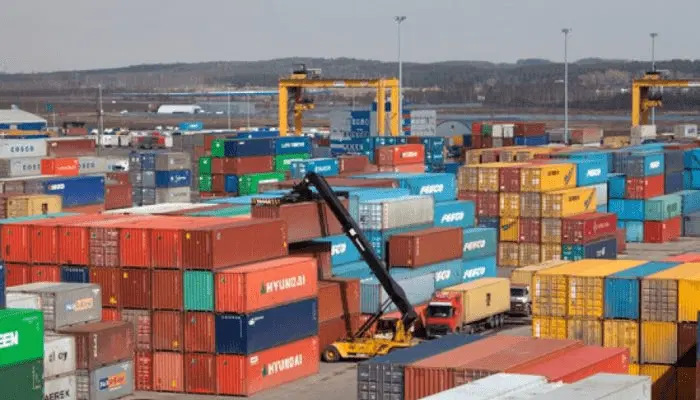
In spite of moves by the federal government mandating value addition before export, the value of raw materials exported from Nigeria rose drastically, year-on-year (y/y), by 159 percent to about N1.87 trillion in the first half of 2025 (H1’25) from N719.66 billion recorded in the corresponding period of last year (H1’24).
Data obtained from the National Bureau of Statistics (NBS) also revealed a 67.8 percent, quarter-on-quarter (q/q), increase in exports in the period under review compared to N1.11 trillion in the previous half-year (H2’24).
Analysis of the data over the past three years shows a rising trend in the raw materials exports, as the N719.66 billion recorded in H1’24 also represents a 108.3 percent increase over N345.51 billion recorded in H1’23.
The bulk of raw materials exported during the period are mainly ‘Urea whether or not in aqueous solution’ exported to Brazil. This was followed by ‘Nonmonetary Gold (including gold plated with platinum) in Powder form’ exported to Switzerland.
The surge runs contrary to the several moves by the federal government to discourage export of raw materials without value addition.
Last year, the Minister of Innovation, Science and Technology, Chief Uche Geoffrey Nnaji, announced a 10-year roadmap aimed at transforming Nigeria’s raw material sector, with a target of achieving 60 per cent value addition by 2034.
He emphasized the importance of improving the value of Nigeria’s raw materials before export, citing benefits such as job creation, domestic manufacturing growth, and a strengthened naira.
“The current 25% value addition is unacceptable. We must work together to unlock the immense potential of Nigeria’s raw material sector,” Nnaji said.
The minister added that the 10-year roadmap was developed in collaboration with the African Development Bank (AfDB).
In a related development, the Director General of the Raw Materials Research and Development Council (RMRDC), Prof. Martin Muonso, recently announced the passage of a bill by the Senate mandating that all raw materials must undergo a minimum of 30 percent local processing before they are exported from Nigeria.
The new legislation which seems to amend the Raw Materials Research and Development Council Act, 2022, stipulates that any exporter who fails to meet the 30 percent processing requirement will be subjected to a 15 percent levy on the export value of the raw materials and may face suspension or revocation of their raw material value addition certificate.
Under the new provisions, raw materials exported without meeting the processing threshold will be deemed as “smuggled goods” and penalised under existing Customs and trade regulations.
The bill also aims to encourage local industries by cutting down the importation of materials that can be sourced or processed domestically.
Commenting, Director General of the Manufacturers Association of Nigeria (MAN), Segun Ajayi-Kadir, emphasised the need to encourage local processing and value addition, rather than exporting raw materials, to foster industrial growth and job creation.
“The association believes that exporting raw materials contributes to job losses, limits technological innovation, and hinders economic diversification.
“MAN supports initiatives like the amendment to the Raw Materials Research and Development Council Act, which aims to end raw material export, unprocessed materials and develop local industries by mandating a minimum of 30% local processing,” he stated.
The post Raw materials export escalates amid clamour for value addition appeared first on Vanguard News.