‘Nigerianised’ Indian: How Chief Sanjay Jain is bridging two worlds through culture
 SKAiF NewsNG SNN
By Prisca Sam-Duru
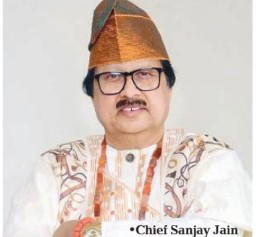
In the bustling heart of Lagos, a city known for its vibrant energy and melting pot of identities, lives a man who embodies the bridge between two of the world’s most resilient cultures.
Chief Sanjay Jain, a prominent figure in the Indian community and a double-titled chief in Mushin, Lagos, believes that the secret to a stronger India-Nigeria partnership isn’t found in just trade deals, but in the heart of their shared traditions.
The Charter Member of the Rotary Club of Palmgrove Estate, Lagos, who holds two traditional chieftaincy titles conferred by a Lagos monarch, told Consular Hub how much of a Nigerian he has become. “The first was bestowed on me by Oba Fatai Ayinla Aileru of Mushinland, Lagos State. We had several interactions during my business engagements in the area, and he found me worthy of the honour,” he stated.
For Jain, who has called Nigeria home for over three decades, the relationship between these two giants is personal. He sees culture not as a relic of the past but as a “strategic instrument” that can elevate the Federal Government’s Renew Hope Agenda to a global stage.
A Chief from Rajasthan
A native of Rajasthan but a Lagosian by residence, Jain’s story is one of deep integration. Holding two chieftaincy titles, Chief Jain is a man who speaks with the nuance of someone who understands the local geopolitical landscape as well as his Indian heritage.
“Several times, when my Nigerian friends hear me speak, they tell me, ‘You are very Nigerian,’ Jain says with a smile. “My accent and my understanding of the history here often surprise them. It has endeared me to the people; they see me as one of them, just of Indian extraction. I have been ‘Nigerianised,’ and I wear that with pride.”
Faith, food and friendship
As the immediate past president of the Indian Cultural Association (ICA) and current president of Rajasthani Samaj, Chief Jain has made it his mission to open the doors of Indian festivals to the Nigerian public. He believes that when a Nigerian sits down at an Indian feast, a barrier is broken. Interestingly, it is the similarities between the two nations that strike him most.
As a lifelong vegetarian, Jain has navigated Nigeria’s rich culinary landscape with ease. “Nigeria is rich in food. I have enjoyed Jollof rice, pounded yam and Amala with vegetable stew. My wife even serves me boiled yam with sauce, which is delicious,” he shares.
Beyond the plate, Jain sees a spiritual alignment in how both cultures treat their elders. “I love the Nigerian culture of caring for the elderly. In many Western societies, they are sent to homes. Here, like in India, we keep them close. It is a cultural lifestyle that has affected me deeply.”
The power of hospitality
While Jain speaks fondly of Indian values, he is quick to give credit to his hosts. He observes that while Indians are respectful, Nigerians take hospitality to an entirely different level.
“In Nigeria, people show respect to everyone—even strangers. This is beyond what we practice in India. I commend Nigerians for their culture of friendship and goodwill,” he notes, suggesting that this inherent warmth is the perfect foundation for stronger diplomatic ties.
On the influence of foreign cultures, Jain maintained that Indian culture has remained undiluted despite centuries of external influence. “Indian culture is ancient and has existed for thousands of years, surviving over a millennium of colonialisation. It remains rich, vibrant, and alive,” he said. “India is an emerging cultural centre with its diverse states showcasing their traditions regularly. These cultures have endured without being eroded by the growing influence of the internet”.
He stressed that culture alone was not sufficient for national progress. “It is not enough to have transparency, religious values, and good habits. Commitment to development is always part of the mix,” he said.
A vision for the future
Drawing a parallel to the governance of Indian Prime Minister Narendra Modi, Jain argues that culture must be paired with commitment. He believes that India’s recent growth is a result of transparent leadership and a “corruption-free approach,” a blueprint he feels can complement Nigeria’s developmental goals.
Despite the digital age, Jain remains an advocate for the “undiluted” nature of heritage. To him, culture is the soul of a nation that survives colonization and globalization alike. As he continues his work through the Rotary Club of Palmgrove Estate and the Jain International Trade Organisation (JITO), Chief Sanjay Jain stands as a living testament to the fact that when two cultures meet with respect and curiosity, the result is a partnership that feels less like diplomacy and more like family.
The post ‘Nigerianised’ Indian: How Chief Sanjay Jain is bridging two worlds through culture appeared first on Vanguard News.