NAF PLANE CRASH: How hero pilot died saving town
 SKAiF NewsNG SNN
•He took death to the swamp so we
could live — Igbokoda residents
•Black box, voice recorder, victims missing
seven days after tragedy
By Dayo Johnson, Akure
It was drizzling in Igbokoda on Monday morning, October 5, 2026.
It was the kind of quiet rain that makes fishermen stay indoors and mothers keep their children close.Then the sky screamed.
Residents did not first see the aircraft, with tail number NGR 931, carrying 32 people, comprising 25 passengers and seven crew members, on a routine flight from Benin to Lagos. They heard it. A tortured, rattling roar, like metal begging for mercy.
“It sounded like the engine was coughing blood,” one fisherman told me at the edge of the swamp. “We looked up and saw it wobbling. It was coming down on our heads.”
Where to die
Residents said the aircraft was already in trouble long before it crashed. They were unanimous in their belief that, had the pilot not struggled to control it, Igbokoda could have been counting hundreds of dead.
“Honestly, the pilot should be commended,” said Jomiloju, a resident. “Many lives would have been lost. It would have been a national tragedy if he had allowed the aircraft to go down in the middle of the community. He struggled with it and brought it down inside a deep swamp, 200 metres away from the town.”
Another resident corroborated the account, saying: “If the captain had attempted to bring it down inside the town, it would have caused a bigger disaster. He eventually went into the river and crashed over there.”
In Igbokoda, the pilot is no longer just a casualty. He is regarded as a hero.
“He is a big hero because he averted a tragedy,” another resident said. “The aircraft was heading towards the community, but he manoeuvred it into the swamp. He should be celebrated in death for saving us from catastrophe. Although we are not happy, 32 persons died. They are family members who paid the ultimate price.”
Engine
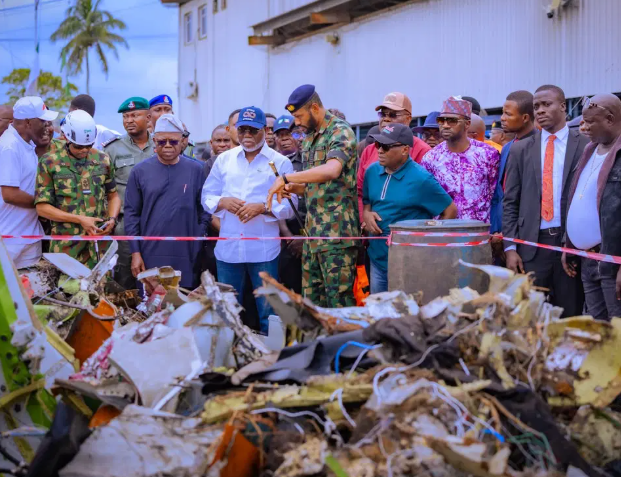
The residents’ account was echoed by Governor Lucky Aiyedatiwa when he visited the crash site. According to the governor, eyewitnesses told him that the aircraft came down with a loud sound suggesting engine failure and appeared to be heading towards the town.
“But the pilot managed to manoeuvre the aircraft away from the community before it landed about 200 metres away and went straight into the swamp,” Aiyedatiwa said. “Only the pilot, if he had survived, could have explained what happened in those final moments.”
What followed was a scene the governor described as “a very gory sight”.
When he arrived at the swamp, body parts, military jackets, clothes and fragments of the aircraft were floating on water blackened by aviation fuel. The main fuselage was nowhere to be found.
“The aircraft has sunk deep. The nature and depth of the swamp could have caused it to become deeply submerged in the mud,” he said.
To reach the wreckage, the state deployed two amphibious excavators, known as swamp buggies, machines designed to float and dig at the same time. Despite the deployment, the main wreckage had yet to be recovered seven days after the crash.
Fragments
Divers from the Navy and local communities had been searching the swamp, bringing out only fragments of the aircraft.
“I saw the divers struggling to locate the main fuselage,” said the Commissioner for Environment, Dr Tob Loko. “One of them said he was able to spot it, but the small boats were insufficient to pull it out. That is why we had to deploy heavier equipment.”
The Commissioner for Works, Ayorinde Olawoye, expressed optimism that progress would soon be made.
“You can see the swamp buggy is set to float on water and go to where it happened. Within five hours, reasonable progress will be made,” he said.
However, the Commissioner for Health, Dr Banji Ajaka, painted a grimmer picture.
“It is not something a vehicle or speedboat can just go to. It has gone down with weight and force,” he said.
At the site, the Ondo State Commissioner of Police, Felix Ohagwu, who accessed the scene in a canoe, said there were no survivors.
“From what we have seen, there are no survivors. What we see is just body parts and clothes littered everywhere, floating in the water,” he said. “It is a very difficult terrain, the creeks, mangroves. Accessing the site was not easy.”
Journalists were initially denied access to the site. A television crew was reportedly arrested by Navy personnel for entering without clearance but was later released.
Voices
For residents, the horror remained fresh.
“I was just trying to have my bath when I heard a loud noise. It was very frightening,” Jomiloju recounted. “We rushed towards the direction the sound came from. We had to sail to the location in canoes. All we saw was wreckage. The larger part of the plane was deep inside the swamp.”
Another resident, Lucky, added: “We have tried our best to rescue them, but the aircraft was deeply buried inside the swamp. Even the women and men took their canoes.”
Where is the black box?
Seven days after the crash, critical answers remained trapped in the swamp with the wreckage.
The Nigerian Air Force confirmed that the flight data recorder, commonly referred to as the black box, and the cockpit voice recorder had yet to be recovered.
“We hope to be able to find critical components of the aircraft that will speak to the investigators because the aircraft wreckage actually speaks to the investigators,”
Air Vice Marshal Ebimobo Ebiowe, NAF Superintendent of Standards and Evaluation, said at the site.
Investigation
The Chief of the Air Staff, Air Marshal Sunday Kelvin Aneke, who visited Igbokoda and inspected the site, ordered a high-level investigation involving military and civilian aviation safety experts, the Nigerian Safety Investigation Bureau and retired senior officers.
“I have flown on this aeroplane. My family has flown on this aeroplane. I know each of the crew personally. They are highly trained, professional and intelligent officers. The best we can do is to honour the sacrifice they have made,” Aneke said, appealing to Nigerians to avoid speculation.
Governor Aiyedatiwa described the incident as a national tragedy, commiserating with President Bola Tinubu, the Nigerian Air Force and the families of the personnel who died while in active service.
Scan sonar
As of Saturday, the Navy had deployed side-scan sonar equipment to map the swamp and locate the submerged fuselage. Aviation fuel was also reported to be leaking into the water, raising concerns about pollution.
In Igbokoda, two tragedies are being mourned: the 32 lives lost in the swamp and the potentially greater tragedy that residents believe was averted by a pilot who, in his final moments, steered the aircraft away from the town.
Whenever it drizzles on a Monday morning, they will remember the day the sky screamed and a man, in their eyes, chose where to die.
The post NAF PLANE CRASH: How hero pilot died saving town appeared first on Vanguard News.