Judiciary: Spotlight on cases that defined 2025
 SKAiF NewsNG SNN
By Henry Ojelu
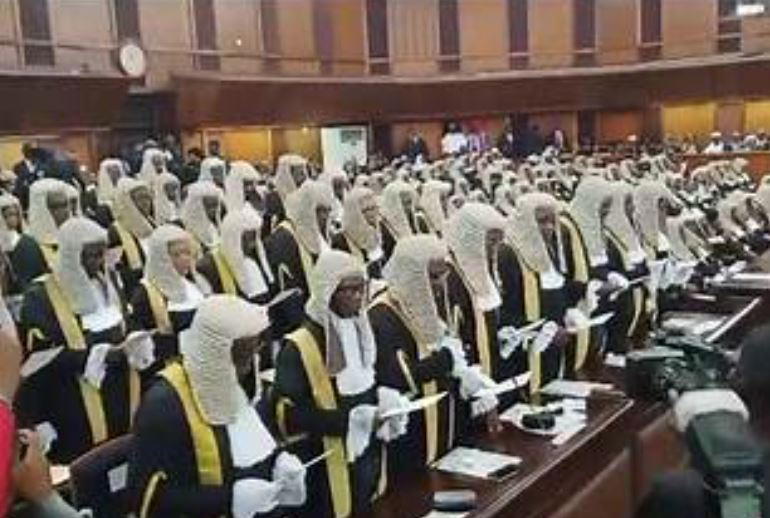
In a year marked by heightened public scrutiny, political tensions, constitutional contestations and renewed focus on justice delivery, the Nigerian judiciary found itself at the centre of national conversation. From the apex of the justice system, to the criminal justice trenches, the courts delivered judgments that did not just settle disputes — they stirred debates on fairness, constitutionalism, sovereignty and human rights.
2025 will be remembered not only for landmark decisions by the Supreme Court and Federal High Courts but also for the public discourse that followed. Across the federation — from the South-East to the South-West, from Abuja to Calabar — litigants and civil society challenged, applauded, condemned and interrogated judicial authority. In this edition, Vanguard Law & Human Rights examines some of the major court matters that defined Nigeria in 2025.
S-Court caseload surge
The year opened with a statistical signal that the Supreme Court was sharpening its jurisprudential reach. Chief Justice of Nigeria, CJN, Justice Kudirat Kekere-Ekun, announced that the apex court delivered 369 judgments from 2,280 matters in the 2024/2025 legal year — a 49% increase from the previous year
The output spanned civil, criminal, Sharia and political matters, suggesting judicial responsiveness to Nigeria’s complex legal landscape. The CJN attributed this to innovative case management, digitisation and centralised court records and highlighted new online tools for notary and filings that promised quicker access to justice. While the volume grew, so did public concern over the quality and impact of judicial decisions — a theme that would dominate national discourse throughout the year.
Sunday Jackson: Self-defence on trial
One of 2025’s most emotionally charged controversies stemmed from the case of Sunday Jackson, an Adamawa farmer convicted of murder for killing an armed intruder on his farm. Lower courts had held that he had the opportunity to flee and that the killing was not justified.
The Supreme Court affirmed his death sentence in March 2025, sparking nationwide outrage from human rights defenders, religious bodies, legal associations and ordinary Nigerians. Critics accused the judiciary of ignoring established principles of self-defence and failing to consider context and proportionality in the use of force.
Public pressure crescendoed into calls for executive intervention. In December 2025, Adamawa State Governor, Ahmadu Fintiri extended clemency, placing Jackson among inmates granted Christmas and New Year pardons. Though welcomed by rights activists, the pardon also reignited debate over judicial independence vs executive mercy, and whether clemency should override what some legal scholars viewed as a flawed judicial approach.
Nnamdi Kanu’s terrorism conviction
The trial and conviction of Mazi Nnamdi Kanu, leader of the proscribed Indigenous People of Biafra, IPOB, was arguably the most politically explosive judicial episode of the year. In November, the Federal High Court in Abuja convicted Kanu on multiple terrorism-related charges and sentenced him to life imprisonment, concluding a saga that began with his arrest, controversial extradition from Kenya in 2021, and years of public protest and diplomatic tension.
Judge James Omotosho emphasised the dangerous consequences of incitement and violence linked to IPOB’s activities in the South-East while reiterating the paramountcy of Nigeria’s territorial integrity.
The judgment drew praise from government spokesmen and security analysts but was sharply criticised by sympathisers and human rights activists who viewed the process as politically tinged. International observers underscored the need for strict adherence to fair trial standards despite the security context.
Withheld LG allocations
A constitutional tussle between federal authority and local government autonomy also dominated the legal calendar. In a controversial ruling, the Supreme Court struck out a suit by the Osun State Attorney-General seeking to compel the Federal Government to release withheld local government funds. The apex court held that the Attorney-General lacked competence and locus standi to sue on bhalf of Osun’s 30 Local Government Councils (LGCs). In a split 6-1 decision, the court emphasised that only elected local council chairpersons could institute such a suit.
While some legal experts welcomed the clarification on institutional roles, critics argued the ruling exemplified technical formalism over substantive justice. Civil society groups warned that the decision could undermine fiscal accountability and local governance if not balanced by political negotiation.
Presidential powers on emergency rule
Perhaps no judgment sparked as intense a constitutional debate as the Supreme Court’s decision on emergency rule and the suspension of democratic structures in Rivers State. In March, President Bola Tinubu declared a state of emergency in Rivers amidst political unrest, a move subsequently challenged in court by several states.
The apex court upheld the constitutional authority of the President to declare an emergency to avert law and order breakdown and to temporarily suspend elected officials’ functions for a specified period.
Detractors, however, charged that the ruling blurred democratic safeguards and granted the executive exceptional powers without sufficient checks.
The Rivers episode emerged as a constitutional flashpoint, raising questions about the scope of executive emergency powers, the integrity of federalism and the sanctity of electoral mandates.
Electoral fraud conviction
The Court of Appeal also played its part in shaping public discourse. In April, the appellate court sitting in Calabar upheld the conviction of Professor Peter Ogban, former returning officer for the 2019 Akwa Ibom North-West Senatorial election, for electoral fraud. Ogban’s conviction reignited debate over electoral integrity, accountability, and impartial adjudication in Nigeria’s democratic processes.
By affirming the lower court’s ruling, the Court of Appeal sent a potent message that the judiciary would not shy away from enforcing electoral malpractice sanctions, even as political actors criticised the verdict as partisan. The judgment sharpened calls for electoral reforms and stronger statutory safeguards.
VAT on ride-hailing services
Another significant, if more technical, court ruling involved taxation and the digital economy. The Federal High Court in Lagos upheld the Federal Inland Revenue Service’s authority to collect value-added tax (VAT) on transport and food delivery services via digital platforms such as Bolt.
By recognising ride-hailing platforms as VAT agents, the ruling expanded the fiscal base of the state and shed light on e-commerce regulation in the digital age.
Business groups criticised the imposition as burdensome and retrogressive, while tax authorities argued it was constitutionally sound and economically necessary. The ruling underscores how courts are called upon to arbitrate novel technology-law intersections.
Shadow Government
In another high-profile ruling, the Federal High Court in Abuja restrained political economist, Pat Utomi and associates from proceeding with plans to establish a “shadow government”. The court held that such an initiative was unconstitutional and incompatible with Nigeria’s presidential system, effectively dismissing what proponents described as a bold experiment in civic engagement.
Critics of the judgment claimed it stifled democratic innovation, while supporters emphasised the primacy of constitutional governance structures. The ruling triggered passionate debate on the boundaries of political expression and civic activism within Nigeria’s constitutional order.
S-Court enforcement, compliance issues
Beyond headline judgments, the judiciary grappled with compliance disputes that exposed tensions between judicial orders and executive agencies. In June, the Federal High Court took up a contempt (committal) suit against the Governor of the Central Bank of Nigeria (CBN) and others for alleged non-compliance with a Supreme Court judgment on forfeited funds in the Melrose General Services case.
The litigation highlighted a growing concern: the challenge of enforcing apex court rulings against powerful economic institutions. Legal experts warn that failure to enforce judicial decisions erodes the rule of law and emboldens institutional resistance to justice.
Quest for judicial integrity
Underlying these landmark cases was an ongoing public discourse about judiciary independence, integrity, and politicisation.
In March 2025, a coalition of civil society organisations staged a protest in Abuja, alleging politicisation of the judiciary. Demonstrators called for stronger action by the National Judicial Council (NJC) to address perceived abuses in controversial cases and demanded accountability for judges accused of political bias.
Such protests reflect a deeper public unease: while the judiciary remains a constitutional bulwark, trust in its impartiality and autonomy is increasingly questioned amid sensational cases and political litigation. Legal scholars argue that judicial accountability mechanisms must be reinforced to buttress public confidence and counter perceptions of partiality.
Judiciary at crossroads
The judiciary in 2025 confronted both legal complexity and societal expectations. Its rulings have shaped national policy, defined democratic boundaries, and influenced perceptions of justice administration in Nigeria.
The year’s most contentious verdicts — from self-defence jurisprudence, constitutional emergency powers, and electoral integrity cases, to local government fiscal autonomy and counter-terrorism trials — reveal a judiciary under public scrutiny yet central to Nigeria’s constitutional equilibrium.
As 2026 begin, calls for judiciary reform — greater transparency, institutional independence and adherence to constitutional ethos — are likely to resonate louder, driven by an informed populace and an evolving legal consciousness.
In the end, the judiciary remains more than a tribunal — it is the arena where national values, human rights and governance norms are tested and reaffirmed.
The post Judiciary: Spotlight on cases that defined 2025 appeared first on Vanguard News.