How 2026 budget compares with 2025’s
 SKAiF NewsNG SNN
Emma Ujah, Abuja Bureau Chief & Progress Godfrey
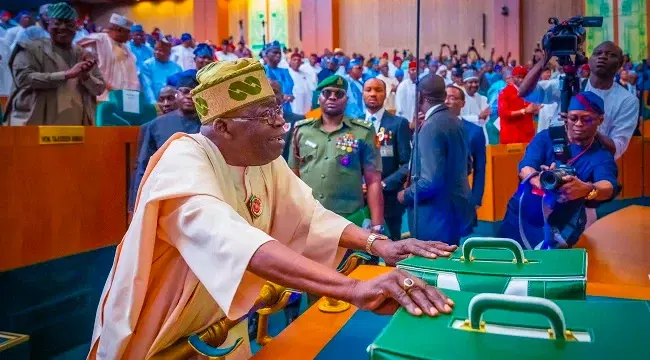
President Bola Ahmed Tinubu’s 2026 Appropriations Bill, themed, reflects a significant expansion in fiscal ambition compared with 2025, alongside a higher deficit financing and more conservative macroeconomic assumptions.
Total projected expenditure for 2026 is pegged at ₦58.18 trillion, a sharp increase from ₦49.7 trillion in 2025, underscoring the administration’s push to consolidate reforms and sustain economic recovery. However, expected revenue is projected at ₦34.33 trillion, slightly lower than the ₦34.82 trillion estimated in 2025, widening the fiscal gap.
As a result, the budget deficit is projected to rise to ₦23.85 trillion, representing 4.28 percent of GDP, compared with ₦13.08 trillion in 2025. This reflects a heavier reliance on borrowing to fund spending commitments amid revenue pressures.
On the spending side, capital expenditure rose to ₦26.08 trillion in 2026, signalling sustained infrastructure and productive-sector investment. In contrast, debt servicing climbed to ₦15.52 trillion, highlighting the growing burden of public debt, while recurrent non-debt expenditure stood at ₦15.25 trillion, broadly in line with fiscal restraint efforts.
Macroeconomic assumptions for 2026 are notably more cautious. The oil price benchmark was lowered to $64.85 per barrel from $75 in 2025, while oil production was reduced to 1.8 million barrels per day, down from 2.06 mbpd.
The exchange rate assumption improved marginally to ₦1,400/$1 from ₦1,500/$1, reflecting optimism around FX market stability. Meanwhile, GDP growth of 3.98 percent in Q3 2025 was cited as evidence of gradual recovery, supported by external reserves of $47 billion, a seven-year high.
Sectoral allocations reveal mixed movements. Defence and security rose to ₦5.41 trillion from ₦4.91 trillion in 2025, reinforcing internal security priorities. Infrastructure spending, however, declined to ₦3.56 trillion from ₦4.06 trillion, while education and health and social services allocations were retained at ₦3.52 trillion and ₦2.48 trillion, respectively, indicating continuity rather than expansion in human capital spending.
Beyond headline figures, the President disclosed targeted social and development interventions, including healthcare funding equivalent to 6 percent of the total budget, support for over 780,000 students under the education loan scheme, plans to cultivate one million hectares of land for food security, and $500 million in U.S.-backed health interventions, reinforcing the administration’s National Renewal agenda despite tighter fiscal conditions.
The post How 2026 budget compares with 2025’s appeared first on Vanguard News.