Gov. Okpebholo’s 3-Pronged Approach to Road Construction in Edo
 SKAiF NewsNG SNN
By Abdul-Kadir Abdullah
Infrastructure development remains one of the most critical responsibilities of government, particularly in a developing economy where road networks serve as the lifeline of commerce, mobility and social interaction.
In Edo State, Governor Monday Okpebholo has adopted a deliberate and multi-layered strategy to address road infrastructure challenges across the state. From Edo South to Edo Central and Edo North, the administration’s commitment to road construction and rehabilitation is becoming increasingly visible.
Rather than relying on a single approach, the governor has implemented what observers describe as a three-pronged model. This model focuses on empowering local government councils to address grassroots roads, establishing a rapid response mechanism for road maintenance and emergency repairs, and engaging reputable construction firms for major road and infrastructure projects.
Together, these pillars are designed to ensure that road construction, maintenance and rehabilitation take place simultaneously across different levels of Edo State’s transportation network.
Road infrastructure is widely recognized as the backbone of economic growth and development. Functional roads connect rural communities to urban centres, enable farmers to transport agricultural produce to markets and facilitate commercial and industrial activities.
In Edo State, years of neglect had left many roads in poor condition, limiting economic productivity and hindering mobility for residents.
Governor Okpebholo’s administration has therefore placed infrastructure development at the centre of its governance SHINE agenda. Within a relatively short period, the state government has initiated numerous road projects across the state, covering strategic urban roads, inter-community corridors and major transportation routes.
These projects are designed not only to improve mobility but also to stimulate economic activity, open up communities and attract investment into the state.
However, addressing the scale of road infrastructure challenges required a comprehensive strategy that goes beyond traditional government contracting.
One important component of the governor’s strategy is the empowerment of local government councils to play an active role in grassroots road development.
Many rural and community roads fall within the jurisdiction of local authorities. Historically, however, local governments have often lacked the equipment and resources required to maintain these roads effectively.
To address this challenge, the state government recently handed over 54 construction equipment to the 18 local government councils in Edo State. This initiative enables councils to undertake grading, rehabilitation and maintenance of roads within their communities.
With the availability of these machines, council administrations are now better positioned to respond to local infrastructure needs, open up rural areas and maintain community roads without waiting for state-level intervention.
The initiative also strengthens decentralization in infrastructure development. Residents can engage directly with their local councils on road issues affecting their communities.
Through bringing road maintenance closer to the grassroots, the state government is ensuring that smaller community roads receive timely attention.
Another critical pillar of the administration’s infrastructure strategy is the establishment of a Rapid Response Road Maintenance mechanism within the Ministry of Works.
Among the early administrative steps taken by Governor Okpebholo was the restructuring of ministries, departments and agencies in the state.
As part of that restructuring, the Ministry of Works was restored, reversing the previous administration’s decision to merge it into the Ministry of Roads and Bridges.
The restoration of the Ministry of Works strengthened the government’s capacity to focus on road construction and maintenance across the state.
To further enhance this capacity, the state government recently procured light and heavy-duty equipment for the ministry to support road maintenance and emergency repairs.
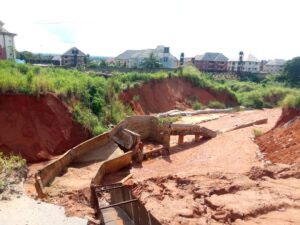
This equipment allows government maintenance teams to quickly intervene when roads develop potholes, erosion problems or drainage failures, particularly during the rainy season.
The approach reflects a proactive philosophy: roads should be maintained continuously rather than waiting until they deteriorate completely before intervention.
Through early response to road failures, the government is able to extend the lifespan of road infrastructure while minimizing disruptions to commuters and businesses.
The third pillar of the governor’s strategy involves engaging reputable construction companies to execute large-scale and technically complex road projects across the state.
Several strategic road projects are currently being handled by established engineering firms.
China Civil Engineering Construction Corporation (CCECC) is handling the Ikpoba Hill Flyover project as well as erosion control works around the Ramat Park axis in Benin City, one of the most significant infrastructure projects aimed at easing traffic congestion and addressing environmental challenges.
BRASS Engineering and Construction Nigeria Limited is responsible for the construction of Ogheghe Road off Sapele Road and the Sapele Road bypass in Benin City, projects expected to significantly improve connectivity within the metropolis.
Place of Peace Investment Limited is executing the 1.4-kilometre Charismatic Church Road off Ekenhuan Road in Benin City, improving accessibility for residents and businesses in the area.
Rawtech Nigeria Limited is handling the Old Sapele Road project linking the Agip, Ohogbohi and Ogheghe communities, a critical corridor within the expanding Benin urban area.
Meanwhile, Heartland Nigeria Limited is handling two major projects, the 12.6-kilometre Temboga–Ekiuwa–University of Benin Road (Temboga Road Extension) and Oba Irediauwa Road off Upper Mission Road in Benin City.
The Benin Technical Road Project is being executed by NAFRO Nigeria Limited, contributing to improved infrastructure around educational and residential districts.
Beyond Benin City, the administration has also initiated major road projects including the Ekpoma–Irrua–Udomi–Ubiaja dualisation, as well as the construction of UNEWA Road in Uromi and the Illeh–Uko Road.
In addition, the state government has maintained a cooperative relationship with the Federal Government, enabling Edo State to take over and reconstruct some federal roads within the state. One notable example is Sapele Road in Benin City, where reconstruction works are currently progressing and some sections are already nearing completion.
This collaborative approach ensures that critical roads serving Edo residents are not left unattended due to jurisdictional limitations.
A defining feature of Governor Okpebholo’s infrastructure policy is strict oversight and accountability.
The governor has repeatedly emphasized that contractors must deliver projects according to agreed timelines and quality standards.
Regular inspection visits to project sites ensure that contractors remain committed to their responsibilities.
The administration has made it clear that substandard work or unnecessary delays will not be tolerated.
This hands-on supervision helps ensure that infrastructure investments translate into durable and reliable roads for the people of Edo State.
The benefits of improved road infrastructure extend far beyond transportation.
Better roads improve access to markets for farmers, reduce travel time for commuters and support the growth of businesses across the state.
Students, healthcare providers and emergency services also benefit from improved mobility and connectivity.
Communities that were previously difficult to access are gradually being opened up, creating new economic opportunities and improving the quality of life for residents.
Governor Okpebholo’s three-pronged strategy represents a comprehensive approach to infrastructure development.
Through empowerment of local government councils, strengthening rapid response maintenance mechanisms and engaging reputable construction firms for major projects, the administration is addressing road infrastructure challenges at multiple levels.
Together, these initiatives are gradually transforming Edo State’s road network, improving connectivity and laying the foundation for sustainable economic growth.
If sustained and effectively implemented, this model could provide a useful framework for infrastructure development across other states in Nigeria.
The post Gov. Okpebholo’s 3-Pronged Approach to Road Construction in Edo appeared first on Vanguard News.