FG: We can’t gamble with energy security
 SKAiF NewsNG SNN
— Power Minister targets 200GW by 2060
By Shina Abubakar
OSOGBO — The Federal Government has said it cannot afford to gamble with Nigeria’s energy security, describing it as an integral part of the country’s national economic security.
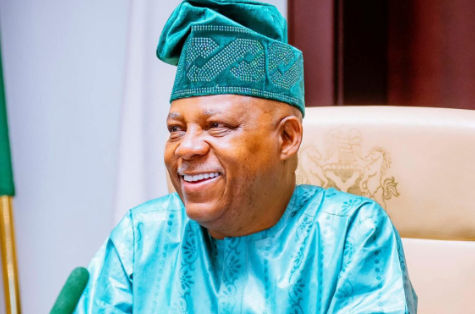
Vice President Kashim Shettima stated this on Wednesday at the groundbreaking ceremony of the new Ultra-Modern National Control Centre, NCC, building project in Osogbo, Osun State.
Shettima, who was represented by his Senior Special Assistant on Legal Matters, Bashir Maidugu, said Nigeria’s economic transformation was closely tied to the strength and reliability of its energy sector.
He said the Federal Government had consistently recognised the link between energy security and national economic security, stressing the need for data-driven decision-making, technology and stronger partnerships in transforming the power sector.
“The Federal Government has consistently recognised that energy security is inseparable from national economic security.
“In March 2026, I noted that Nigeria cannot afford to gamble with energy security and emphasised the importance of data-driven decision-making, intelligent use of technology and stronger partnerships in the transformation of the power sector,” he said.
According to him, the new NCC is strategic to the administration’s Renewed Hope Agenda, particularly its efforts to strengthen the security and reliability of the national electricity grid.
He said a modern economy required an electricity system capable of responding to changing demand, accommodating new generation sources, managing disturbances and supporting investment.
“As Nigeria expands its industrial and productive capacity, our electricity infrastructure must be capable of supporting that growth.
“The new National Control Centre is therefore part of a much larger national effort to strengthen the foundations upon which economic activity depends,” Shettima said.
The Vice President also said Nigeria’s electricity future would involve a more diverse generation mix, including renewable energy sources.
He noted that integrating solar and wind generation would require stronger system-management capabilities because of their operational characteristics.
“A modern System Operator must therefore possess the tools and expertise to integrate new sources of generation while maintaining system security. The new NCC will provide part of that capability. There is also a regional dimension to this project,” he said.
FG targets 200GW by 2060
Speaking after laying the foundation stone, the Minister of Power, Olasunkanmi Tegbe, said the new NCC had become necessary because the existing facility, built 64 years ago, could no longer adequately respond to the growing demands and changes in Nigeria’s power sector.
Tegbe said the Federal Government was targeting about 200 gigawatts of generation capacity by 2060, alongside an expansion of transmission infrastructure to meet rising electricity demand within Nigeria and the sub-region.
“As we are building our grids, in the next couple of years, by 2060 our target is to actually generate about 200 gigawatts.
“With that, we will be having more towers out there, more transmission lines out there, substations out there, and what we need is this kind of modern National Control Centre, upgraded to handle cybersecurity challenges, to handle all sorts of interferences and disturbances.
“That’s why this is required to stabilise our power sector,” he said.
Earlier, the Managing Director of the Nigerian Independent System Operator, NISO, Engr. Bello Mohammed, said the new NCC would provide an enhanced environment for real-time monitoring, system control, operational coordination, grid security and decision-making.
“It will strengthen our capacity to see the grid more clearly, understand its behaviour more accurately and respond to system events with greater speed and precision,” he said.
The post FG: We can’t gamble with energy security appeared first on Vanguard News.