Defection of Atiku’s son: Symbolic coup to APC, personal matter to family
 SKAiF NewsNG SNN
By Luminous Jannamike, Abuja
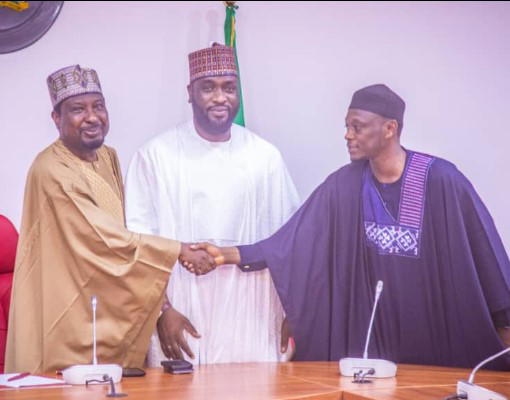
ABBA Abubakar did not look like a man making a routine political announcement. Standing inside the National Assembly complex in Abuja on Thursday, he spoke carefully, almost deliberately, as though aware that his words would echo far beyond party lines.
This was not merely a defection. It was a son publicly choosing a political path that diverged from his father’s, Nigeria’s former Vice President, Atiku Abubakar.
For Abba, the decision was framed as personal, ideological, and final. For the country watching, it felt intimate, unsettling, and deeply symbolic.
From Campaign Son to Political Actor
For years, Abba’s political identity had been inseparable from his father’s ambitions. In 2022, he founded the Haske Atiku Organisation to mobilise young supporters for Atiku Abubakar’s 2023 presidential run under the Peoples Democratic Party (PDP). The group became a visible extension of Atiku’s northern grassroots machinery, driven by youth energy and family loyalty.
On Thursday, that same structure was formally dismantled, and rebuilt in another image. Abba announced his resignation from the PDP and unveiled the Haske Bola Tinubu Organisation, repositioning the network to support President Bola Tinubu’s Renewed Hope Agenda and his expected 2027 re-election bid. What had once been a son’s political shield for his father became a weapon for his father’s rival.
Inside the Defection Ceremony
The venue was deliberate. The message was unmistakable. Hosted by Deputy Senate President Barau Jibrin at the National Assembly, the event was attended by senior APC figures who treated the moment as both a political win and a symbolic coup. Abba described his move as ‘historic and deeply personal,’ citing the ‘quality of leadership and political ideology’ under Tinubu and the APC.
More than words, he offered commitment. He pledged to work closely with Senator Barau to ‘actualise the second-term bid of President Bola Ahmed Tinubu come 2027.’ For the ruling party, it was a statement of intent. For the opposition, it was a wound that cut close to home.
A Father Responds, Carefully
Hours later, Atiku Abubakar broke his silence; not with anger, not with denial, but with restraint.
In a statement released on social media, the former vice president framed his son’s decision as an expression of democratic freedom rather than family disloyalty.
“The decision of my son, Abba Abubakar, to join the APC is entirely personal.
‘In a democracy, such choices are neither unusual nor alarming, even when family and politics intersect.
‘As a democrat, I do not coerce my own children in matters of conscience, and I certainly will not coerce Nigerians.
‘What truly concerns me is the poor governance of the APC and the severe economic and social hardships it has imposed on our people.
‘I remain resolute in working with like-minded patriots to restore good governance and offer Nigerians a credible alternative that brings relief, hope, and progress,” he said.
It was a statement designed to project control; over emotion, over narrative, and over political direction. Yet beneath its calm language lay an unavoidable truth: a political family had fractured in full public view.
The Weight of Symbolism
In Nigerian politics, defections are common. Sons defying fathers are not. Abba’s move lands at a delicate moment. Atiku Abubakar has formally joined the African Democratic Congress (ADC), alongside Peter Obi, as part of an emerging opposition coalition seeking to challenge Tinubu in 2027. The ADC has attracted heavyweights such as David Mark, Nasir El-Rufai, Rotimi Amaechi, Aminu Tambuwal, and Dele Momodu, positioning itself as the nucleus of a united opposition.
Against that backdrop, Abba’s defection does more than add numbers to the APC. It punctures a narrative. It raises questions about cohesion, loyalty, and the durability of Atiku’s political base, especially in the North, where Abba’s Haske organisation once operated.
To APC strategists, the symbolism is potent: if even Atiku’s son is backing Tinubu, what does that suggest about the opposition’s appeal?
Personal Ties, Political Calculations
Those close to the opposition insist the story is not betrayal but history. A source within the ADC recalled that Tinubu and Abba’s relationship predates current alignments, pointing to Tinubu’s presence at Abba’s wedding in Dubai in 2014.
The argument is simple: Abba did not suddenly discover Tinubu. The relationship has existed quietly, personally, and long before the current chessboard of 2027 was laid out.
Still, Nigerian politics is rarely judged on private context alone. Optics matter. Timing matters. And in an election cycle already defined by coalition-building and strategic defections, Abba’s choice becomes a data point: used, interpreted, and weaponised by all sides.
Public Reactions
Reactions across political and social spaces have been sharp, emotional, and deeply divided.
Hamma Hayatu, a political strategist, said: “Atiku is a democrat. His son Abba is an adult and has the right to do what he likes with his life.”
Everest Nwobi, an APC supporter, said: “Atiku the bridge builder couldn’t build a bridge between himself and his son. Atiku the unifier couldn’t unify his son. But I am a good man. Say amen.”
Abdul-Aziz Na’ib Abubakar, an Atiku loyalist, said: “H.E. Atiku Abubakar is a true Democrat, he didn’t even force his own children to join his party, unlike the other guy, who uses his power to force governors and senators to join his party! Atiku Is coming..”
Chikelue Ezeh, political affairs analyst, said: “Abba’s defection to APC objectively weakens Atiku’s political brand ahead of 2027 election. Losing a son who led a key support organisation, now reoriented to back Tinubu’s 2027 re-election, signals erosion in Atiku’s grassroots structure, especially in the North. Atiku failed.”
Daniel Regha, a social commentator, said: “Imagine running for office and your own son doesn’t believe in your vision, that he had to side with the opposition you jumped ship to oppose. Speaks volumes”
Fisayo Soyombo, publisher, said: “Atiku is in ADC but his son, formerly of PDP, has joined APC with a vow to work for Tinubu in 2027. Atiku has released a statement defending his son’s ‘entirely personal’ decision, saying he won’t coerce his son to act against his convictions. But you, an Ojuelegba-based civil servant earning N85,000 monthly, have begun sharpening your machete to inflict damage on a fellow victim of Nigeria who won’t vote for APC. Your tomfoolery is indescribable!”
More Than a Family Matter
Abba Abubakar’s defection is not just about party colours. It is about how power moves in Nigeria; through families, friendships, history, and opportunity. It reveals how ideology often competes with access, and how loyalty is rarely fixed.
For Tinubu, it strengthens momentum. For the ADC, it exposes vulnerabilities. For Atiku, it tests the democratic values he has long claimed as his political core.
And for Abba, it is a declaration of independence, one that ensures his political story will no longer be told as inheritance, but as choice.
The post Defection of Atiku’s son: Symbolic coup to APC, personal matter to family appeared first on Vanguard News.