Decline in varsity’s infrastructure caused by nations economic downturn – FUTA VC
 SKAiF NewsNG SNN
—-Wants varsity system repositioned for more relevance
—– Govt ineptitude responsible for decay in varsity system – Arogbofa
By Dayo Johnson Akure
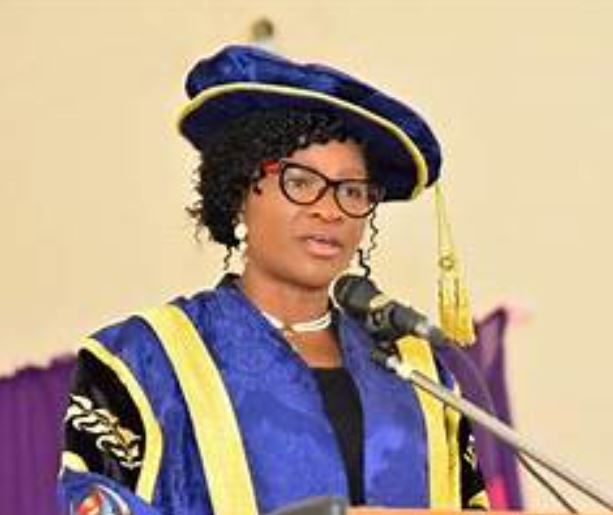
The Vice Chancellor of the Federal University of Technology Akure FUTA in Ondo state, Prof Adenike Oladiji has said that the downturn in Nigerian economy has affected “the university system “cruelly with marked decline in infrastructure and personnel.
Prof Oladiji said this during the Eight Elizade University Annual Registry Lecture, entitled ” The Nigerian University System, the Good, the Bad and the Ugly”held in Akure, the state capital.
She declared that “Since 1948 to date, the Nigerian university system, for 77 years, has coursed through different terrains – colonial, Independence, military, democratic regimes, robust economy and lean economy.
” In one way or the other, the system has been impacted. Most significantly, the downturn in Nigerian economy has affected the system rather cruelly with marked decline in infrastructure and personnel.
“Quite patently, the system has suffered and the quality of delivery inexorably dropped.
“However, since the system had once flourished, it is easy to cast our minds back to those things that were done in its halcyon days or to look at the nations that once looked up to us and see what they are doing right.
“With collective resolve to make things right, like the proverbial prodigal son, we can turn things right again.
The vice Chancellor, also, noted that the Nigerian University System has experienced many changes which are completely antithetical to the very essence of the universities – teaching, research, and community service.
According to her, the problem of examination malpractices, sex-for-grade or money exchanging hands for grades, ” are an offshoot of massification of university education.
” Some students are simply not cut for university education. It is not like these students are dumb. No. It is simply that they do not have the nerves for the rigour that university education demands.
” Some of them are technically gifted or would do well in sports and crafts but they would not make a success of the calm and quiet enquiries of scientific studies.
Speaking on sexual harassment and other social vices, the guest lecturer, who described these as ” then unthinkable to associate the university with anti-social behaviours, lamented that ” Unfortunately, there is hardly any social vice that cannot be found on our campuses today – cultism, sexual immorality, cyber-crimes, unlawful possession of arms, and even armed robbery. It is sad, but it is true.
“Due to inadequate funding and massification, too many students now live off-campus and get initiated into all manner of anti-social groups.
“As it is with students, so it is with the teaching and non-teaching staff.
” Universities used to be physically separated from the town, but now, due to grossly insufficient campus accommodation, most of the teaching and non-teaching staff make do with accommodation off-campus, either rented or owned, but the implication is that the interaction with non-scholars make them imbibe cultures that are strange to the university system.
She therefore advocated that universities should revert to their status as citadels of civility, and sustain the values for which they were established.
According to her “Universities serve as incubators of essential life skills: They are designed to be growth-oriented institutions, and because of their impact on society, they rightly command tremendous respect.
“The university, by design, is a world of its own—an ecosystem of ideas, innovation, and human capital development.
“If we collectively renew our commitment, work with sincerity, and uphold our shared values, we will not only restore dignity to our institutions but build the university of our dreams”.
She however decried the downsides of the university system stating that “even as we celebrate these strengths, we must confront the uncomfortable realities—the bad aspects and the ugly—those deeply troubling tendencies that threaten the very foundation of the universities and weaken our institutions.
“Such as inadequate funding, critical manpower shortages., misuse of , autonomy, politicizing of academic issues , Industrial disputes that disrupt academic calendars, the massification of university education, indiscriminate award of honorary degrees—particularly to individuals who do not meet the ethical and intellectual criteria.
“Fake admissions, declining institutional reputation, excessive localisation of universities, and the promotion or reward of loyalty over merit, abuse of unionism, examination malpractices, grade sorting, sexual harassment, the proliferation of degree mills, and in some cases, the mishandling or loss of sensitive student information. These practices not only tarnish the university but erode public trust”.
Speaking on the role of the Registry, Oladiji said that “The Registry remains the bridge between staff and students, the custodian of records, the engine of administrative order, and the stabilizing force that ensures continuity and coherence in the university system”
Oladiji said , despite these challenges, our institutions still retain a semblance of order, of sanity, of purpose. It is this residual strength that gives hope for renewal.
“The task before us is clear: we must return to a culture of excellence. We must reposition our universities to regain the respect they deserve. We must learn from one another, uphold merit, strengthen leadership, and recommit to the foundational values of scholarship and service .
” If we abandon the ideals that academic leaders are meant to uphold—integrity, accountability, excellence—we risk losing the essence of the university”.
Chairman of the occasion and former Pro Chancellor, Federal University, Lafia, Basorun Seinde Arogbofa, who lament the decadence and rot in the tertiary education system, called for an over haul to make the coming generation see education as valuable to their lives and future.
Arogbofa declared that ” the decay of the Nigerian university system is a direct result of government’s ineptitude.”
The Vice Chancellor of the University Professor Sunday Adeyemo, lauded the guest lecturer “for the cerebral delivery of the lecture describing her as an astute administrator whose imprimatur of excellence was visible all over the Federal University of Technology Akure.
Adeyemo said the lecture title was apt and an invitation to examine the achievements within the university system, identify persistent shortcomings that hinder growth and consider practical ways to address them.
According to him ” Each edition of the Annual Registry Lecture reinforces the indispensable role of the Registry in institutional development and effective university governance.
Earlier, the Registrar of Elizade University, Mr. Omololu Adegbenro said ” The University is a solution center. It is through scholarly exchanges like this that we reaffirm the potency of intellectual inquiry as a vehicle for reform , both within and beyond the academy.
Adegbenro said that ” The vibrancy of the university system depends on the quality of conversations we hold and the commitment with which we implement the ideas generated”.
The Registra described the university as a natural “solution Centre, where reason interrogates experience, where research informs policy, and where innovation shapes future possibilities.”
According to him” the theme of the lecture reflects the harsh realities confronting Nigerian universities which include unstable funding, governance conflicts, infrastructural decay, and the pressures of a rapidly evolving global knowledge economy.
The post Decline in varsity’s infrastructure caused by nations economic downturn – FUTA VC appeared first on Vanguard News.