Chinese envoy assures broader market access as China-Nigeria trade volume exceeds $28bn
 SKAiF NewsNG SNN
By Nkiruka Nnorom
The bilateral trade relations between China and Nigeria topped $28 billion in 2025, a 28 percent Year-on-Year growth, underscoring the deepening economic ties between both nations.
Also, Chinese direct investment in Nigeria rose by more than 100 percent within the same period, hitting a record $690 million.
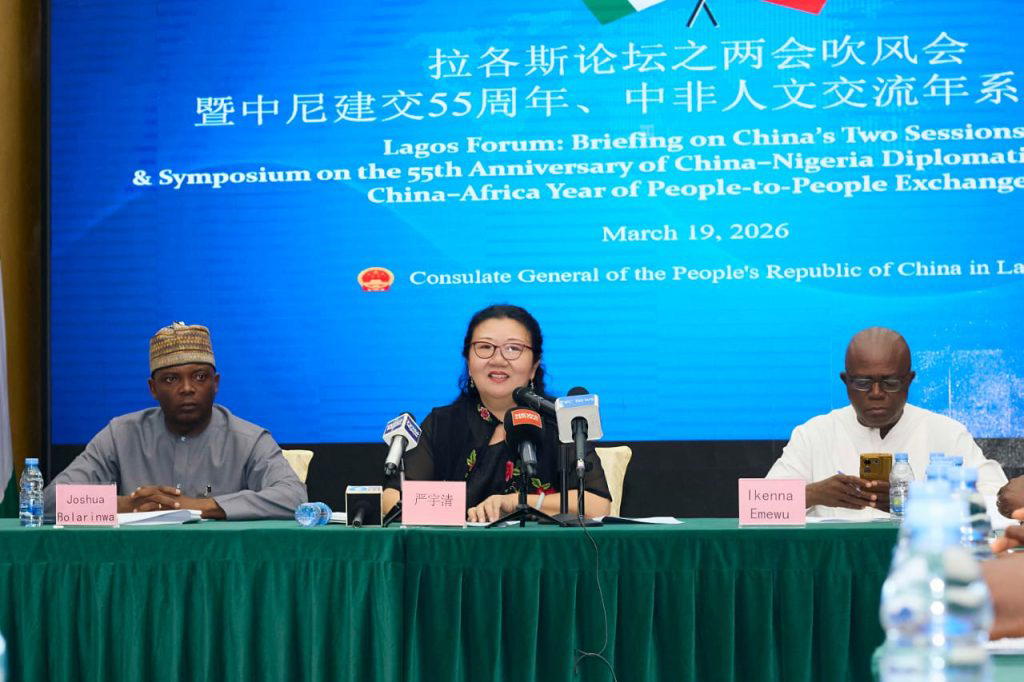
Consul General of the People’s Republic of China in Lagos, Ms. Yan Yuqing, made these revelations at the Symposium on the 55th anniversary of the establishment of China-Nigeria diplomatic relations and China-Africa people-to-people exchange year and the two sessions briefing in Lagos.
Yuqing assured that Beijing would further expand market access with Nigeria with focus on critical sectors such as telecommunications, healthcare and education as the country pursues its high standard opening-up in 2026.
From 1 May, she informed that China would grant zero-tariff treatment to 100 percent of African tariff lines, underscoring a push for more free trade deals and World Trade Organisation (WTO) reform amid global protectionism.
“China will further expand market access with a focus on the service sector, advancing opening-up in areas such as telecommunications, health care, and education. It will also continue to improve policies supporting foreign investment and strengthen service and protection systems for foreign enterprises.
“Companies from around the world, including those from Nigeria, will not only participate in China’s manufacturing sector, but also engage deeply in China’s service sector, sharing opportunities from the upgrading of industrial and value chains,” she said.
To drive the high level opening-up, she said that connectivity with Africa and indeed, Nigeria, would go beyond bricks-and-mortar, spanning hard infrastructure, soft policy links and people-to-people ties, with Belt and Road projects that pair flagship rail/port work in Nigeria with “small but beautiful” livelihood schemes and green/digital cooperation.
She said that China stands ready to work with African partners to deepen mutual learning and foster closer people-to-people ties, ensuring that China–Africa friendship endures for generations.
Dr. Adetoro Banwo, Head of Chinese Unit at University of Lagos, in his speech, made a case for the adoption of Artificial Intelligence (AI) in driving economic growth, arguing that AI was not only a tool for economic growth, but a strategic pillar for global competitiveness and technological self-reliance.
He stated that China had succeeded in these areas, integrating AI into manufacturing, and agriculture, as well as in creating business models, and urged Nigeria to plug into that push so that African firms could scale globally.
“In the area of artificial intelligence, China has made it very clear that AI is central to the future of economic industrialisation. The government is promoting what we call AI plus.
“This AI plus initiative seeks to integrate artificial intelligence in all areas of the economy, such as manufacturing and agriculture. Now, this also includes large scale application of AI into the creation of wealth and business models.
“Our ability to capture this policy would make us more global competitiveness,” he said.
“The integration of artificial intelligence into agriculture is transforming traditional farming into smart agriculture, improving efficiency, sustainability, and productivity.
“If we can tap into this AI, then we can talk about increasing our productivity and product,” Banwo added.
He further stated that data-driven policy culture was missing in Nigeria, stressing that mapping resources and gaps through data could cut waste and lift productivity.
Dr. Eric Ni, Chairman, HuaXing Arts Troupe Nigeria, said that Huaxing partnering with the Consulate General and Chinese Community had contributed to bridge-building mission, championing cultural education and grassroot empowerment programmes.
He stated that Huaxing’s past work had brought Chinese heritage into Nigerian neighbourhoods, while showcasing Nigerian culture back, creating two‑way cultural literacy.
According to him, scholarships funded by the troupe have given young Nigerians training, skills and exposure, tying people‑to‑people ties to concrete opportunity.
New plans for 2026, he noted, include scaling the Dragon Boat Festival and Children’s Drawing Competition into a national event for ages 6‑15, expanding reach beyond Lagos.
Dr. Efe Shuaibu, CEO\Director, Aifei Chinese School, and President of the Confucius Institute Alumni Association of Nigeria, said that education and cultural exchanges remained among the most powerful tools for building trust, adding that when people learn each other’s language, share experience and understand each other’s history, stereotypes disappear, they co-exist peacefully and genuine friendship grows.
He said though infrastructure development, trade cooperation, and investment have strengthened economic ties between China and Nigeria, “The true sustainability of this partnership lies in the human connection, in the friendship, knowledge exchange, and cultural understanding between our people.”
Referencing President Xi Jinping’s assertion that the lifeline of China-Africa relations lies with the people, Shuaibu said that “While government may build diplomatic relations, and institutions may build economic partnerships, it is people who build lasting bridges between nations.”
“The future of China-Africa cooperation will not only be defined by trade agreements or infrastructural projects. It will also be shaped by classrooms, research institutes, cultural centres and innovation hubs where young people from our region learn and collaborate,” he added.
He urged all the stakeholders, including the governments, educational institutions, cultural organisations and private sector to continue investing in education, and youth empowerment, arguing that they were the tools for strengthening the relationship between China and Africa and preparing a generation that would carry ‘this friendship forward for decades to come.”
The post Chinese envoy assures broader market access as China-Nigeria trade volume exceeds $28bn appeared first on Vanguard News.