APC Primaries: More hisses than cheers as fraud, fury taint process
 SKAiF NewsNG SNN
By Omeiza Ajayi
A week-long internal election exercise that was supposed to consolidate President Bola Tinubu’s grip on the party machinery ahead of 2027 has instead exposed the ruling All Progressives Congress APC’s deepest fault lines — with ghost elections, parallel results, inflated vote counts and protesters at the party’s own doorsteps.
Read Also: 12 contenders, dark horses eye Tinubu’s job
However, there are those who the system favoured and it’s all cheers from them. Some processes were peaceful and candidates emerged, singing the praises of the party and their leadership. It was a different story in many other places.
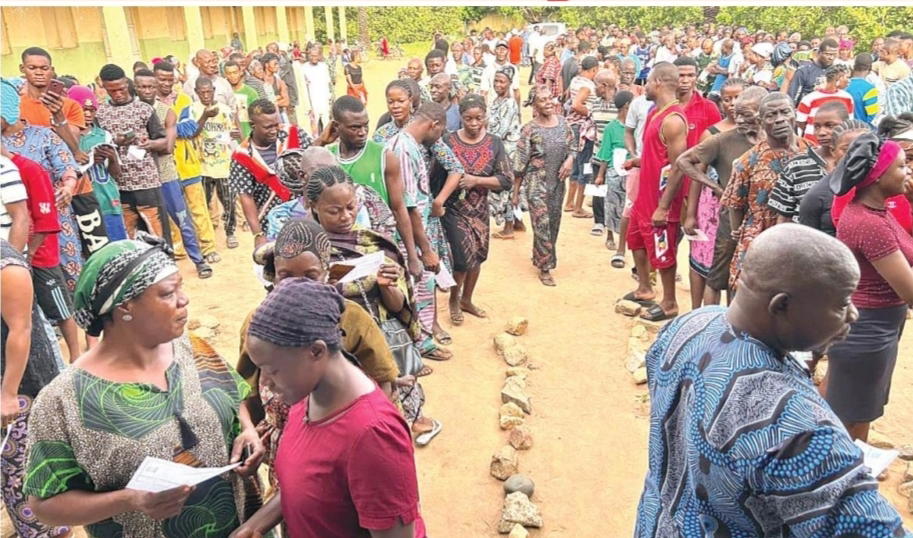
The scene in Balanga and Billiri local government areas of Gombe State on Saturday, May 16, 2026, told a damning story. Across the wards of the federal constituency, party members and delegates waited in vain. No accreditation officers came. No ballot papers were distributed. No counting took place. Yet, hours later, a returning officer — identified by aggrieved aspirant Alfred John Attajiri as former Gombe State commissioner — walked to a microphone and announced results.
In a statement issued the following day, Attajiri described what happened as an “invisible election,” insisting that no legitimate primary election was conducted in Balanga and Billiri before the declaration of results.
He said; “It is deeply disturbing that results were announced for a process that never held across our constituency”, pointing to video footage, photographs and eyewitness testimonies as his evidence.
The scene in Balanga/Billiri was not an isolated case. It was a preview of the kind of democracy the APC would conduct throughout its week-long primaries — an exercise the ruling party described as historic but which critics, aggrieved aspirants and even some of its top members have since described as a festival of manipulation.
In some places in Edo and Kogi states, votes were counted in geometric progression, in broad daylight. From the country of 1, 2, 3, etc the electoral official could suddenly jump to 100.
The Schedule and the Disorder
The APC’s primary exercise was spread across multiple days: the House of Representatives on May 15 — later shifted to May 16 — the Senate on May 18, the State Houses of Assembly on May 20, governorship primaries on May 21, and the presidential primary set for May 23, 2026.
Even before a single ballot was cast, the postponement of the House of Representatives primaries came against a backdrop of widening rebellion within the ruling party, as aspirants and grassroots members across multiple states pushed back hard against what they saw as a top-down imposition of consensus candidates. The party had championed consensus as a mechanism for preserving cohesion. What it produced was barely concealed fury.
President Tinubu himself felt the need to intervene publicly. Ahead of the exercise, Tinubu cautioned party members against infighting and “do-or-die” politics, urging aspirants, delegates and party leaders to conduct themselves peacefully while upholding the principles of internal democracy, fairness and sportsmanship. His words barely outlasted the week.
Violence, Imposition and Phantom Votes
Saturday’s exercise produced a mix of consensus candidates, high-profile victories and controversies ranging from violence to allegations of candidate imposition and unlawful detention.
In Lagos, the trouble was immediately visible. The APC House of Representatives primary election conducted across the 245 wards in Lagos State on Saturday was marred by allegations of irregularities, voter intimidation and disruptions in several polling centres.
Incidents of tension and disorder were reported in parts of Lagos Mainland, including Apapa Road, Makoko, Iwaya and Adekunle, where some party members and delegates were allegedly prevented from participating freely in the exercise.
One aggrieved party member captured the mood succinctly: “We reject whatever outcome emerges from today’s election because the process was flawed and manipulated.”
In Niger State, some constituencies witnessed protests over alleged attempts to impose candidates.
The Adamawa situation was more dramatic. Aggrieved aspirants from the Southern Senatorial Zone staged a peaceful protest against the alleged imposition of a House of Representatives candidate for Demsa, Numan and Lamurde Federal Constituency, Kwamoti Laori. The demonstration took place in Numan, where dozens of aspirants, party members and supporters gathered at the APC Zonal Secretariat carrying placards with inscriptions such as “No to Imposition,” “Allow Free Primaries,” and “Let the People Decide.”
In Adamawa’s Yola North, Yola South and Girei Federal Constituency, APC stalwart and aspirant Ahmadu Hamman Nasara delivered perhaps the most scathing verdict on the entire exercise. Nasara described it as “the end of democracy in Nigeria,” accusing the committee of reading someone’s script which does not represent the will of the electorate.
The Kaduna situation drew the attention of a coalition of former legislators and activists. Operating under the banner of APC Coalition of Kaduna Senatorial/House of Representatives Frontline Aspirants, the group addressed a protest letter dated May 17, 2026 to the National Chairman of the APC.
Signed by former Speaker of the Kaduna State House of Assembly, Yusuf Zailani; former senator Danjuma Laah; northern activist Yerima Shettima; and Sani Abdulkadir Dakace, the coalition urged the national leadership of the party to intervene in issues surrounding consensus arrangements and the conduct of some House of Representatives primaries in Kaduna State.
In Ondo State, aspirant Wale Omoniyi for the Okitipupa/Irele Federal Constituency seat rejected the exercise, insisting that no valid primary election took place across the 23 wards.
He described reports suggesting that a successful primary election was conducted in the constituency as “a sham.”
A separate group of APC members in the same constituency subsequently called for the release of the authentic results of the election, warning that any attempt to tamper with the results would undermine democratic processes in the federal constituency.
Back in Gombe, the Balanga/Billiri situation perfectly illustrated what one stakeholder called “democracy as a formality.”
Kingsley Musa, a party stakeholder, described the exercise as “a sham wrapped in the language of democracy,” insisting that what took place in several parts of the constituency fell far short of the expectations of party members.
“The consensus arrangement may have failed publicly, but in reality the consensus list was what was eventually executed. The voting exercise only became a formality to legitimise decisions already taken by powerful interests within the party,” he said.
Musa further alleged that some voting centres witnessed confusion over accreditation procedures and inconsistencies in vote collation. “In some wards, there were delays and uncertainty,” he said.
Landslides that defy logic
If the House of Representatives primaries were chaotic, the Senate exercise on May 18 produced results that stretched mathematical credulity.
In Imo West, Governor Hope Uzodimma polled a total of 230,464 votes to defeat former Governor Rochas Okorocha, who scored 1,098 votes.
In Delta Central, Senator Ede Dafinone scored 116,252 votes to defeat former Deputy Senate President Ovie Omo-Agege, who polled 3,643 votes.
In Delta North, former Governor Ifeanyi Okowa overwhelmingly defeated incumbent Senator Ned Nwoko, polling 113,309 votes against Nwoko’s 2,612 votes.
In Kogi Central, former Governor Yahaya Bello – who was allegedly not screened – polled 72,399 votes across the district, scoring 18,341 votes in Adavi LGA, 10,298 in Ajaokuta, 5,146 in Ogori/Magongo, 8,943 in Okehi, and 29,621 in Okene LGA.
And in Abia North, Senator Orji Uzor Kalu secured a landslide victory with 65,651 votes.
These were not elections. They were mathematical performances. The question that observers — and losing candidates — are asking is simple: when figures of 116,000, 113,000 and 230,000 are produced from party primaries of a single senatorial district, who exactly voted? On what register? With what accreditation?
The APC’s direct primary system, under which ward-level members are mobilized to vote, makes figures of this magnitude not just suspicious but also difficult to explain without a detailed accounting of the voter rolls — which the party has not publicly produced.
The defeated, unsurprisingly, rejected the outcomes. Omo-Agege declared himself victorious, citing a different set of results. In Edo South, two aspirants — Pastor Osagie Ize-Iyamu and Omoregie Ogbeide-Ihama — both claimed the candidacy of the party, with two separate officials announcing two completely different sets of results. One returning officer declared Ogbeide-Ihama the highest scorer with 27,154 votes, while another official declared Ize-Iyamu the winner with 33,399 votes. Two elections. Two winners. One party.
The incumbents swept aside were not minor figures. Reports indicate that at least 58 House of Representatives members and 12 senators may not return to the National Assembly. Former Ogun State governors, Gbenga Daniel and Ibikunle Amosun shunned the exercise entirely. Former Senator Danjuma Goje also fell by the wayside.
Kogi Central generated its own storm with the participation of Yahaya Bello — a man facing EFCC prosecution. Hundreds of protesters from Kogi Central stormed the national secretariat of the APC in Abuja, rejecting the participation of the former governor in the party’s senatorial primaries. They accused the former governor of allegedly violating the party’s constitutional processes and bringing the ruling party into disrepute.
Coordinator of the Kogi Central Movement, Usman Adabara, alleged that Bello had ignored the screening committee because he would have been disqualified over his ongoing cases with the EFCC and ICPC.
A formal petition submitted to the Chairman of the Kogi Central Primary Election Appeal Committee by APC senatorial aspirant Momoh Yusuf Obaro alleged widespread irregularities, violence, intimidation and manipulation of results during the exercise, and claimed that the election committee abandoned due process by isolating itself inside the Kogi Government House and refusing to engage other aspirants or stakeholders.
The State Houses of Assembly primaries on May 20 carried the scars of what had preceded them. In Kwara State, the APC cleared all 159 aspirants contesting for tickets to the State House of Assembly after reversing an earlier screening outcome that had disqualified more than half of the contenders. The revised list included Speaker Yakubu Danladi-Salihu, who had not initially appeared among the cleared aspirants. The reversal did little to restore confidence.
In Benue, former Speaker of the Benue State House of Assembly, Hyacinth Dajoh, withdrew from the APC primary election for Gboko West State Constituency over alleged irregularities and lack of transparency, and later defected to the Peoples Democratic Party.
By Thursday, May 21, when the governorship primaries were scheduled across states, the cumulative weight of the week’s controversies was already bending the exercise out of shape.
In Kwara, the exercise was halted mid-process. Fresh confusion engulfed the APC as the party in Kwara State halted the governorship primary election after the exercise had already commenced, with voting activities and mobilisation efforts already underway in several parts of the state. The abrupt announcement created uncertainty among party members already gathered at several wards across the state.
The new date given was Friday, May 22, 2026, with no official reason given for the postponement. It was the same fate that befell Bauchi and Zamfara states
In Gombe, the damage had been done before the governorship exercise even began. Former Minister of Communications and Digital Economy, Professor Isa Ali Ibrahim Pantami, withdrew from the APC governorship primary in Gombe State, citing alleged violations of the Electoral Act 2026 and failure by party officials to provide conditions necessary for a credible primary process.
His camp alleged that no actual election took place during the National Assembly direct primaries conducted in Gombe State on May 16 and 18, 2026, claiming that many aspirants were not informed about voting venues or accreditation. Senator Alkali, another major governorship aspirant, boycotted the exercise altogether.
A Party at war with Its own rules
Many of the lawmakers who lost are now crying foul, complaining about irregularities and manipulation. Some claim they were unfairly excluded and would have tested their popularity elsewhere if not for the law they helped pass. That law— the Electoral Act 2026 — closed the door to party-switching after primaries, trapping aggrieved aspirants inside a process they believe was rigged against them.
What is unfolding, especially after the APC primaries, exemplifies one of those moments when a law enacted for selfish political reasons backfires.
The numbers themselves are the most revealing indictment. A sitting senator getting three votes in his own senatorial district. A governor polling over 230,000 votes in a party primary. Election results announced in constituencies where no voting took place. Two separate winners declared in the same contest. These are not aberrations — they are the product of a system in which the outcome is decided before the exercise begins, and the voting is the theatre.
As the APC governorship primaries continued on Thursday and the party prepares to stage the presidential primary on Saturday — where President Tinubu is widely expected to be returned unopposed or by acclamation — the accumulation of grievances from the week gone by will hang over the voting centres. The party’s appeal committees are already bracing for a deluge of petitions. Some aspirants have gone further, threatening to take their cases to court.
Whether the APC can absorb all of this before the 2027 campaign season truly begins is the question its national chairman, Prof. Nentawe Goshwe Yilwatda and the presidency must now answer.
For now, the party’s internal democracy has delivered one unmistakable result: a ruling party at war with its own members, held together not by conviction but by the arithmetic of power.
The post APC Primaries: More hisses than cheers as fraud, fury taint process appeared first on Vanguard News.