Abuja one chance menace: How criminals exploit a transportation gap to kill, steal, destroy
 SKAiF NewsNG SNN
By Kingsley Omonobi
Of the myriad unpleasant things that occur daily in the Federal Capital Territory (FCT), Abuja, none unsettles residents as much as a negative phenomenon that has come to define the town’s ecosystem.
Like a bad omen, the tragedy foisted on the city is ingeniously captured as ‘One Chance’ by evil merchants who use privately owned vehicles to cause havoc.
Under this well-organised crime ring, the daredevils typically pose as genuine commercial vehicle operators, lining up the sprawling roads as innocent and hardworking commercial drivers seeking passengers to ferry safely to their destinations for an agreed fee. But that is only a facade that has often taken many commuters into their early graves. They are fake drivers on the prowl seeking to deceive and lure victims into their dens for either ransom or other pecuniary reasons. Many female victims have not been lucky to return safely from the grip of the villains to tell their stories of torture, rape and organ-harvesting.
‘One Chance’ implies that the vehicle will proceed to the desired location once the last passenger boards. Commuters, often desperate to find vehicles—especially during rush hours when vehicles are thinning due to the high cost of fuel, purchase, and maintenance—are lured to board these vehicles in large numbers. It is a simple demonic trick that has worked perfectly for the perpetrators and terminated the lives and future of many of those who fall victim to the merchants of deaths.
The truth is that once the victim boards the dangerous vehicle, which serves more as a caravan of death, the occupants and the driver who belong to the same gang, suddenly brandish guns, charms and other dangerous items to scare the ‘lone’ stranger in their midst and threaten them with death unless they meet whatever demands are placed on them. Usually, if the long passenger is a female, they either rape her and demand a huge ransom to be paid within a tight deadline or be killed, or they brutally kill her and harvest her vital sex organs for rituals.
This pattern has become commonplace in Abuja in recent months and weeks, sending shockwaves across the city and causing horror and heartbreak to families whose members’ lives have been brutally cut short by these gangs of evildoers.
This onslaught on the unsuspecting commuters has resulted in frequent deaths and the recovery of bodies on roadsides.
In recent weeks, the situation has grown from bad to worse even though the police and security agencies continue to dispute the clear evidence that the menace is taking a worrisome dimension in the city as one attack follows another in quick succession.
Incidents mount
One of the two most recent and worrisome incidents that shook the FCT to its foundations, occurred on January 3, 2026, when Chinemerem Chukwumeziem, a nurse with the Federal Medical Centre, Jabi, was lured and killed by ‘one chance’ vehicle operators after she closed from work and innocently boarded the doomed vehicle at night. Her lifeless body was recovered the following day by the roadside after information filtered into town that she never reached home 24 hours after closing from work.
The criminals were said to have used a screw-driver, hammer and scissors to inflict pain on the victim while demanding ransom before murdering her and dumping her body along the highway.
As if that was not gruesome enough, the harbingers of death also snuffed the life of another woman, identified as Princess Mediatrix Chigbo, whose body was also found on the roadside after the ‘one-chance’ operators had killed her after taking all the valuables they found on her.
The practice of deploying what is supposed to serve as commercial vehicles to rob, steal and kill has become routine in the FCT.
A survivor, Umar, recounted his harrowing experience with ‘one-chance’ criminals, highlighting the need for constant vigilance among commuters.
He said “sometime in 2025, I boarded a vehicle from a place where cars usually pick up passengers. There was a driver and one man in the front seat. Then another man sitting at the back, which I joined. Everything looked normal until we moved. A few minutes into the ride, I became uneasy, seeing how these people were staring at me and at each other. So, I told the driver I wanted to alight at the next bus stop. All of them got infuriated by this request.
“At that moment, I sensed that something was wrong. I questioned the driver because I felt I had the right to ask what was happening. The man sitting at the back started attacking me. I was slapped and beaten”.
Umar said that as he struggled to regain balance, the one with him pulled out a gun and pointed it at his head. He said they tied him up and forced him to transfer money into an account they provided.
“They made me transfer N500,000 from my account. They searched my pockets, found my ATM card, forced me to reveal my PIN and immediately withdrew the money with the POS in their possession.
“Afterwards, the criminals threatened to kill me, but eventually changed their mind, slowed down and pushed me out of the moving vehicle.”
Umar said, “People should be extremely careful, even in places that look like regular loading points. Just because many people gather there does not mean it is safe.”
Another one-chance incident involving a lady, simply identified as Precious, was reported in February 2026 at about 6 pm in Gwarimpa. That evening, Precious said she was waiting for a roadside taxi in Gwarimpa, popularly called ‘along’, after receiving a call from a customer to come to her shop in Garki.
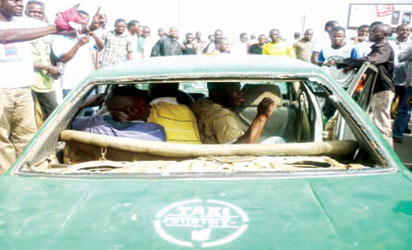
A green-colour Golf taxi which is the official colour of taxis in the FCT, stopped for her. A lady sat in the front, and two men occupied the rear seats. Not suspecting anything, she entered the vehicle after negotiating the fare. As they approached the Oando Filling Station along the Gwarimpa highway, she became suspicious that something was wrong.
“The lady in the front started winding up her window; then the driver and the guy next to me did the same. Mine was the only window still down, so the man beside me reached over to wind it up. I refused. At that point, he slapped me.”
The driver confirmed her worst fears when he said, “You think say we be normal human beings?” From that moment, she knew she was in the hands of a criminal driver and notorious one chance robbers.
“I told them to take whatever they wanted,” she recounted. But the driver told her they had received up to N5million in ransom from some of their victims in the past.
At that point they demanded her phone and bag and, in the process, found her credit card and started extorting her bank account after inflicting physical harm on her.
A thankful testimonial
Commuters in Abuja routinely return to their churches to thank God once they undertake trips with such drivers and return safely to their destinations on each day. Travelling by commercial vehicles in Abuja has become a probability: one can die or live, depending on which driver and what route they use. The God factor and luck also play a crucial role in securing a safe journey to and from any part of the capital city, especially at night when the demons of death unleash their fangs with fury and force, aiming to devour, steal and rape their victims with more tenacity and angst.
One young woman, who gave her name as Iniobong Festus, from Uruan Local Government of Akwa Ibom State, and lives with an aunty in the Gwarinpa area of the FCT, narrated a story of how she accidentally boarded a ‘one-chance’ taxi from the Dawaki Underbridge on her way to church in Asokoro via the AYA-Kubwa Highway, and ended up being beaten and thrown out of the vehicle by the robbers when they did not find anything to steal from her.
“On that fateful Saturday, my madam had gone to the market and gave me money to take public transport to the church in Asokoro,” Iniobong said.
“They stopped under the Dawaki Bridge and explained to me that there was only one passenger remaining for them before they’d leave for Asokoro. But as soon as I boarded, they blindfolded me and asked me to bring out everything I had on me,” the woman recalled.
“But after I explained to them that I am only a housemaid and that I did not have any money on me, they became very upset and asked if I had a mobile phone or an account with any bank, to which I replied in the negative. That further infuriated them and they instantly stopped the vehicle around Mpape area and threw me out with force,” Iniobong told Vanguard. She is still thanking her stars that she was not killed. Hannah was not so lucky.
Hannah was not so lucky
But Hannah, a computer operator, who lives in Dutse Alhaji, opposite Gwarinpa Housing Estate, but works in the Maitama District of Abuja, was not lucky enough to escape the atrocity of the hoodlums, when she mistakenly walked into the trap of the evil men under the Galadima Bridge. There, Hannah a Makurdi-born girl, who has been living in Abuja since 2013 when she came to do her HND programme in Abuja, fell into the hands of the criminals and they made a mincemeat of her in the process. “As soon as I boarded the rickety vehicle, one of the men, who sat with me at the back seat, brandished a short gun at me and asked me not to shout. He said I should bring out my phone and every other valuable I had with me. Before I could say anything, one other man brought out a sharp sword and threatened to cut off my hand if I wasted time in surrendering all valuable items on me. While I was trying to beg them that I had nothing, they snatched my phone and checked and saw my account balance of about N550,000. They forced me to give them the password or they would cut off my head. I had no option but to give them,” the woman revealed.
“As soon as I boarded the rickety vehicle, one of the men, who sat with me at the back seat, brandished a short gun at me and asked me not to shout. He said I should bring out my phone and every other valuable I had with me. Before I could say anything, one other man brought out a sharp sword and threatened to cut off my hand if I wasted time in surrendering all valuable items on me. While I was trying to beg them that I had nothing, they snatched my phone and checked and saw my account balance of about N550,000. They forced me to give them the password or they would cut off my head. I had no option but to give them,” the woman revealed.
They forcefully drove me to a place inside Mpape and after emptying my account, they gave me N500 to pay my way to where I was going and threw me out of their car and drove away,” she recalled with tears, while talking to Vanguard.
Freda Arnong, RIP
Another notable incident was that of a young lady known as Freda Arnong, who was killed in one chance robbery in Abuja on July 2, 2025. Reports indicated that Freda left a house fellowship near the CBN Institute in Maitama, Abuja, boarded a commuter vehicle with the robbers on her way home, but never to returned alive.
Dangerous spots
One-Chance robberies are also prevalent in satellite towns such as Zuba and along the Gwagwalada–Lokoja highway, raising concerns about the ease with which these crimes are committed without immediate intervention from security agencies.
Ride-sharing as an option
Some survivors recall being threatened with guns, cutlasses, axes and knives during these terrifying ordeals while others point to the fact that fear of falling victim has forced them into patronizing ride-sharing alternatives when commuting within the capital city.
The authorities are concerned, but…
The tragedy and havoc orchestrated by one-chance drivers in Abuja remain a source of distress and pain to many and leave the security authorities frustrated as the perpetrators are hardly ever caught and dealt with while the crime intensifies and escalates in style and dimensions. Often, security agents come out and threaten fire and brimstone after every attack has ended and the victims are buried and forgotten. As a new attack takes place, the police return with a threat to deal with the perpetrators.
Decades of neglect of transportation system
All the violent deaths, robberies and abductions occasioned by one-chance robbers in the city have been seamlessly accomplished due to the inexplicable failure by successive administrations in Nigeria to put in place a functional transportation system for FCT residents.
For decades, there was no safe, affordable and workable government bus, taxi or mass transit service to ferry the over 1.4 million residents of the FCT from one point to the other despite the avalanche of many government agencies saddled with the task of ensuring safe transportation in the FCT. Neither the FCT, which used to display mass transit buses under the Abuja Urban Mass Transit Service nor any of the six area councils – AMAC, Abaji, Bwari, Gwagwadala, Kwali and Kuje – could boast of any public transportation scheme for public use to ensure their safety.
It was that helplessness over the decades that snatched the life of Princess Chigbo, a prominent legal practitioner and rights advocate, who was abducted in the FCT while in transit, killed and dumped at the Dawaki axis of the Kubwa Expressway.
Wike’s approach
Mercifully, the incumbent Minister of the FCT, Nyesom Wike, is trying to ensure that his Transportation Masterplan works. Wike’s transportation overhaul continues to focus on enforcing the original Abuja Master Plan by replacing informal transport with a centralized, regulated terminal network. The strategy builds structured central bus hubs in the city center and satellite towns like Bwari and Gwagwalada to improve commuter security and curb “one-chance” criminal activities.
Rage of the NDA/FIDA and Nurses
Infuriated by both incidents, the National Association of Nigerian Nurses and Midwives (NANNM), FCT Council and the Nigerian Bar Association/FIDA condemned Chukwumeziem’s and Princess Chigbo’s killing by the hoodlums, expressing outrage over their brutal murder and describing it as an assault on healthcare workers and humanity.
The immediate past president of NBA, Mazi Afam Osigwe, SAN, in a statement at that time said the one-chance incidents had plunged Abuja into grief and fear, warning that insecurity was once again tightening its grip on the nation’s capital.
“These were not faceless victims. They were professionals, contributors to society, and ordinary citizens whose only intention was to return safely from their daily engagements. Their deaths underscore a frightening reality that insecurity is once again tightening its grip on the nation’s capital,” the association said.
Osigwe described the death of Mediatrix as deeply personal for the legal profession, adding that she served the NBA Abuja Branch with dedication and integrity and that her murder was both a professional and personal loss.
“The Nigerian Bar Association condemns in the strongest terms these senseless and horrifying killings. The pattern is no longer deniable. Criminal gangs, masquerading as commercial transport operators, now operate with alarming confidence on our roads,” the statement read.
CP, FCT Responds
Consequent upon the outcry over the one-chance menace, the FCT Police Commissioner, CP Ahmed Mohammed Sanusi, who was formerly the Commander of the Intelligence Response Team (IRT), was asked what strategies he intended to deploy to curtail the menace of one-chance robbery and attacks.
He declared a zero-tolerance stance on crime in Abuja, vowing to dismantle the notorious ‘one-chance’ criminal syndicates operating across the Federal Capital Territory.
Sanusi said, “FCT will no longer serve as a refuge for criminal elements including one-chance robbers. Decisive measures will be taken to restore safety and public confidence.”
He also made it clear that indiscipline and unprofessional conduct within the Command would not be tolerated under his leadership.
The post Abuja one chance menace: How criminals exploit a transportation gap to kill, steal, destroy appeared first on Vanguard News.