A Nation, a Whistle, and a Yellow Card Too Far: How do I explain this to my son?, by Stephanie Shaakaa
 SKAiF NewsNG SNN
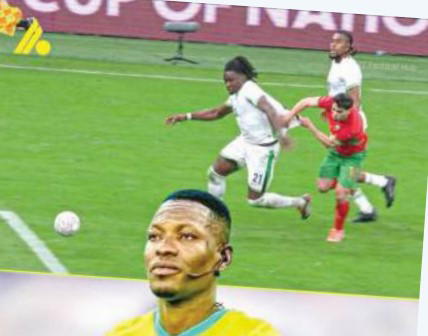
How does the Confederation of African Football think it is neutral to bring a biased referee to officiate Nigeria’s most important match at AFCON 2025, a semi-final against Morocco, and expect everyone to simply accept it? This was not just another fixture. It was the final before the final. It was a match defined by History, Pride and Destiny.

This was our chance to lift Africa’s crown again. Yet from the moment Daniel Nii Ayi Laryea of Ghana was announced as centre referee, the tone was set for controversy. A referee from a country with a long, competitive history with Nigeria was suddenly entrusted with determining whether we reached the final of the continent’s biggest tournament and the Nigeria Football Federation raised no objection. No protest. No caution. Just silence.
Some CAF apologists will hide behind phrases like experience and neutral panel, but neutrality is not defined by a name on paper. Neutrality is how justice is seen to be done on the pitch. Many Nigerians warned, loudly and early on social media, that this appointment was a red flag. What followed on match night confirmed our worst fears.
When Calvin Bassey received a baffling yellow card after being clearly, unmistakably fouled the mood changed instantly. Excitement gave way to dread. Confusion spread from the pitch to the commentary box to living rooms across Nigeria. How does the fouled player become the offender? By the simple magic of a whistle controlled by one man.
When a referee begins dishing out cards against your team for legitimate challenges, while rewarding the opposing side with advantage and leniency after fouls, you don’t just feel robbed. You feel belittled. Even commentators hesitated. Referee assistants looked unsure. Players were visibly confused. At moments, even Moroccan players appeared surprised by the generosity they were receiving. Viewers at home kept asking the same question.What exactly is going on here?
This wasn’t just bad officiating. It was patterned. It was consistent. And consistency is what makes bias visible.
I had to turn off my television and go to sleep. Not because Nigeria was losing, but because I could not continue watching what felt like a slow, public humiliation under the watchful eyes of CAF. My chest was tight. My head was pounding. I am not exaggerating when I say I felt physically unwell. Football has never done this to me before. Many Nigerians shared that same feeling that our chances were being quietly taken away, decision by decision, whistle by whistle.
Wednesday night, football stopped being a game to me. It became a lesson in how injustice feels when it is dressed up as procedure.
And then there is the question I cannot escape. How do I explain this to my children?
How do I explain that Calvin Bassey was fouled and still booked? How do I explain that the victim became the culprit? How do you teach children fairness when the referee punishes the person who was hurt?
From the first half, something felt wrong. Nigerian players were fouled hard and instead of protection, they were cautioned. Yellow cards came quickly, casually, almost eagerly. Meanwhile, similar or worse infractions from the opposition were met with play-ons, warnings, or sudden generosity. Football cannot breathe under that kind of pressure.
In trying too hard not to be accused of African solidarity, did CAF decide that Nigeria must pay the price? Is neutrality now defined as punishing one team excessively so no one can accuse you of favour? Is football defined by punishing the skin with the same tone as you so no one can call you racial?How about being fairly professional? Because neutrality is not cruelty. Neutrality is balance. Neutrality is fairness. Neutrality does not mean weaponising authority against one side to prove a point.
And let us talk honestly about Ghana. Nigeria has done nothing to Ghana to deserve this treatment, not on the pitch, not in culture, not in history. Nigeria has been a big brother in ways that are too easily forgotten. We opened our leagues to Ghanaian players, giving them platforms to grow and gain global relevance. During Ghana’s economic downturn, countless Ghanaians lived and worked in Nigeria not as beggars, but as contributors.
In my own primary school, most of my teachers were Ghanaians. My extra-lesson teacher was Ghanaian. These were educated professionals trusted with Nigerian children, paid from Nigerian pockets. We did not see them as foreigners. We saw them as neighbours.
Nigeria has always absorbed Ghanaian talent effortlessly into our schools, our industries, our culture. Long before hashtags and “collabs,” Nigerian soil gave Ghanaian creatives room to thrive. Nollywood helped launch Ghanaian actors into continental relevance without asking for passports. Our music industry did the same. Nigerian airplay is not local,it is global. When Nigerian audiences accept you, the world listens. That is not arrogance. It is fact.
Yet Ghana has fought Nigeria over almost everything football, music, comedy, influence, even something as laughable yet telling as jollof rice. A trivial rivalry, yes, but also symbolic. Competition sustained not just by sport, but by resentment.
So when a Ghanaian referee is placed in charge of Nigeria’s biggest match of the tournament, perception alone demands caution. Football administration is not naive. CAF knows this. Which makes the silence of the NFF unforgivable.
Why was there no protest? Why was there no official objection? Why did we walk quietly into a situation that screamed conflict of interest? When it is time to talk on Television our former FA boss would talk endlessly but when it is time to make that Oratory useful he zips his mouth. This is not an attack on Ghanaian people. It is a demand for institutional wisdom. You do not set matches on fire and then act surprised when flames appear.
And it wasn’t only Nigerians who noticed. At some point, the confusion became so glaring that even Algeria’s official football Twitter handle reacted publicly, posting in disbelief and asking how anyone could explain Calvin Bassey receiving a yellow card for being fouled. When another African football federation pauses its own business to question a refereeing decision in real time, you know something has gone terribly wrong.
On the pitch, the disbelief was just as visible. Ademola Lookman stood frozen, hands spread, face twisted in confusion, struggling to understand how the referee arrived at some of those verdicts. These were not players acting for cameras,these were professionals who knew the rules and could no longer reconcile them with what they were witnessing.
When players stop arguing and start looking genuinely lost, when opponents appear surprised by decisions in their favour, and when neutral observers across the continent begin asking the same questions Nigerians are asking, the issue is no longer emotion. It is credibility.
How do you explain to a child that an entire stadium, commentators, players, and even another country’s official football account could see the injustice but the man with the whistle could not?
Wednesday night, Nigerian players were not just playing against Morocco. They were fighting the whistle, the cards, the narrative. Every tackle became a risk. Every challenge came with fear. When a referee controls the emotional temperature of a match unfairly, the game is already lost no matter the scoreline.
And then there is the part that truly breaks me. I cannot remember how many times my little boy has looked up at me and asked, with genuine confusion, Mummy, why does the whole world hate Nigeria?
Each time, my heart shatters quietly. Not because I lack answers, but because I fear what those answers say about the world and about us. How do you explain to a child that sometimes people don’t hate you because you are wrong, but because you are present? Because you are loud. Because you are many. Because you refuse to disappear quietly? Because you are in their faces.
Wednesday night, watching that match unravel, I realised children are watching. They are learning what fairness looks like. And when the whistle punishes the fouled and excuses the offender, what lesson are we teaching them?
Do I tell my son to accept it and move on? Do I tell him it is just football? Or do I admit that sometimes the world is unfair, and that this pain has a long memory?
It breaks my heart that a child even has to ask that question. And it breaks it even more that football the place meant to teach fairness and joy seemed to answer him so cruelly.
CAF must do better. The NFF must grow a spine. And Nigerians must stop accepting silence as strategy. Neutrality is not geography. It is justice. And Wednesday night, justice was nowhere to be found.
When a child watches football and learns that fairness is optional, something sacred is lost. Wednesday night, it wasn’t just a match that failed Nigeria it was an institution. And until African football learns that justice must not only be done but be seen to be done, the whistle will remain louder than the truth.
Because no game survives when the whistle becomes louder than the truth.
Long Live the Federal Republic of Nigeria
Long Live Our Super Eagles.
The post A Nation, a Whistle, and a Yellow Card Too Far: How do I explain this to my son?, by Stephanie Shaakaa appeared first on Vanguard News.