2027: Why we want Tinubu’s job— Atiku, Obi, Olawepo-Hashim, others
 SKAiF NewsNG SNN
•2 women, Anita Zugwai-Chukw, Esther Okereke raise ante
By Clifford Ndujihe, Henry Umoru, John Alechenu, Gabriel Ewepu & Luminous Jannamike
LAGOS – WITH the conclusion of primaries, Nigeria’s 2027 presidential election is shaping up to be one of the most consequential and unpredictable contests since the return to civilian rule in 1999. Economic hardship, persistent insecurity, rising public frustration and growing disillusionment with the political class have combined to create an unusually fluid political environment as opposition presidential standard bearers outline reasons they want to takeover from President Bola Tinubu, next year.
Currently, long-standing loyalties are under strain; and traditional assumptions about region, religion and party identity are being tested.
Unlike previous elections dominated by a clear two-party contest, the race towards Aso Rock is unfolding against a backdrop of opposition fragmentation, shifting alliances and competing claims to political legitimacy. The PDP, once Africa’s largest political party, is now split between two rival blocs – one led by former Minister, Mr Kabiru Turaki backing ex-President Goodluck Jonathan, and another aligned with FCT Minister, Nyesom Wike, backing Senator Sandy Onor. Both claim to be the authentic PDP. Neither will budge.
Crowded field
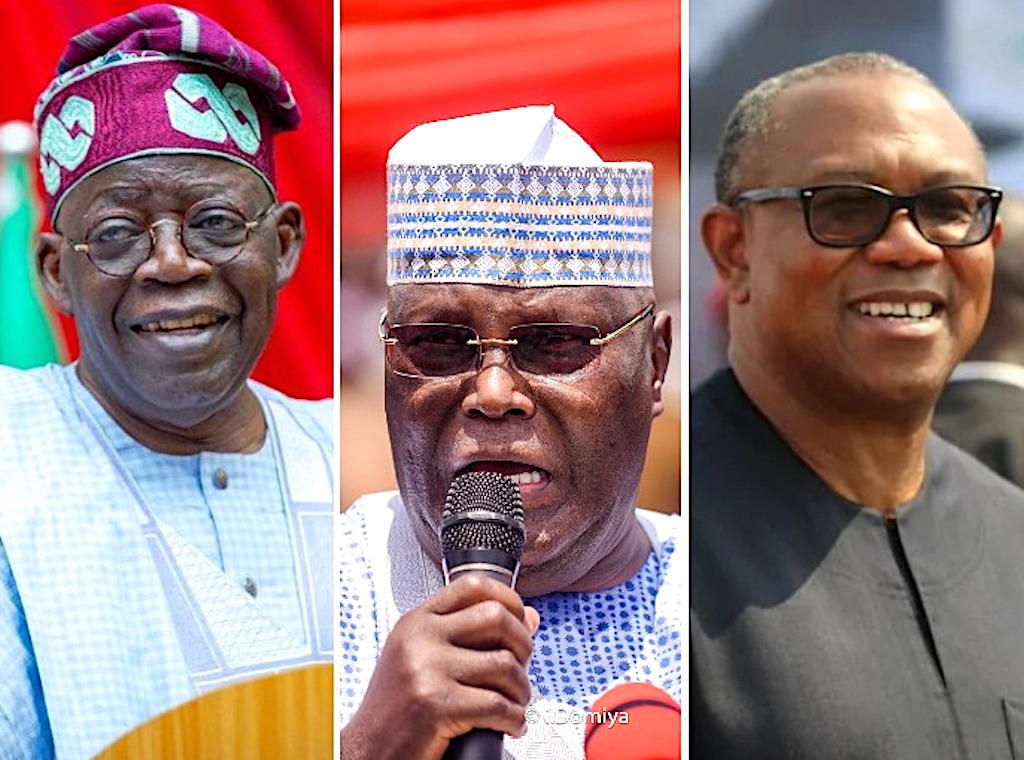
Beyond the PDP crisis, the field is crowded: Former Vice President Atiku Abubakar is running on the platform of the African Democratic Congress, ADC, which has a factíonal candidate in Mr. Dumebi Kachikwu. Former Anambra State Governor and 2023 Labour Party, LP, Presidential Candidate, Mr. Peter Obi is standing on the plank of the Nigeria Democratic Congress, NDC: former Cross River State Governor, Mr Donald Duke of the Peoples Redemption Party, PRP; and former Presidential Candidate, Dr Gbenga Olawepo-Hashim of Accord.
Also running are Prince
Adewole Adebayo of the Social Democratic Party, SDP, which also has factíonal flag bearer, Atanda Abimbola; Omoyele Sowore of the AAC, Anita Zugwai-Chukwu of the Young Progressive Party, YPP; Dr Esther Nkem Okeke of the National Rescue Movement, NRM; Dr. Chibuzo Okereke of LP; Ambassador Aliyu Bin Abbas of the ADP, and Sonny Adenuga of the Because of Our Tomorrow, BOOT Party among others.
Together, they offer Nigerians competing visions – and sharply different answers to the same urgent question: who can govern Nigeria better?
Veteran contender: Atiku Abubakar
For more than three decades, Atiku has remained a permanent feature of Nigeria’s presidential politics – surviving party splits, electoral defeats and changing eras. Born in Jada, Adamawa State, in 1946, he rose from the Nigeria Customs Service to establish a substantial business empire before serving as vice president under Olusegun Obasanjo from 1999 to 2007. In 2026, he secured the ADC presidential ticket.
Supporters credit his advocacy for restructuring, fiscal federalism and economic liberalisation. His nationwide network and resources remain unmatched in the opposition field.
Restructuring Nigeria
Atiku, who has consistently criticized President Tínubu’s handling of security, economy and good governance, anchored his push on restructuring Nigeria’s federal architecture, devolving more fiscal and political power to the states, liberalising the economy, privatising key sectors and attracting foreign direct investment. On security, he advocates stronger intelligence capacity and addressing the root economic causes of insurgency. His path to victory requires consolidating his northern base while expanding meaningfully in the South. His obstacle is a familiar one: voter fatigue after multiple runs and a fragmented opposition that will split anti-incumbent votes across several candidates.
Governance Governor: Donald Duke (PRP).
Donald Duke’s reputation precedes him – but so does the gap between admiration and actual electoral support. Born in Calabar in 1961, he served as governor of Cross River State from 1999 to 2007, repositioning the state as a tourism and cultural destination. The Calabar Carnival became a national brand. The Tinapa Business Resort was a bolder, more contested gamble – praised for imagination, criticised for underdelivering.
What does Duke plan to do? His campaign is built on the argument that Nigeria’s problem is not a lack of resources but a failure of governance imagination.
Creative economy
He advocates creative economic development, investment-led growth, tourism as a serious economic driver and merit-based public administration. His target constituency is the professional class and younger voters disillusioned with the old political machinery. His obstacle is organisational – the PRP lacks the national structure to match his personal credibility. His candidacy’s real value may lie in keeping governance quality at the centre of the national debate.
Sandy Onor, PDP
Sandy Onor did not spend decades building a national brand. His path has been quieter – shaped by academia, public administration and legislative politics in Cross River State, where he served as a Senator representing Cross River Central. Supporters describe him as thoughtful and methodical; critics say those qualities may not be enough in an era of personality-driven politics.
The Wike-aligned PDP faction adopted him as their consensus presidential candidate precisely because he carries less baggage than more prominent personalities. His emergence reflects the PDP’s internal battles more than any groundswell of grassroots support.
My plans for Nigeria
Onor has framed his campaign around organisational discipline, consensus governance and competence as alternatives to spectacle. His challenge – and it is formidable – is introducing himself to millions of Nigerians who barely know his name, while competing against household names like Jonathan and Atiku. His candidacy will matter beyond his vote tally: it may determine whether the PDP survives as a single structure or formally fractures ahead of 2027.
However, he has boasted that with him as flag bearer, the PDP stands a better chance of returning to Aso Rock.
The Ideas Candidate: Gbenga Olawepo-Hashim (Accord Party)
Born in 1965, Olawepo-Hashim was shaped by pro-democracy activism during the military era, then built a successful business career alongside sustained public advocacy. He studied at the University of Lagos and the University of Buckingham and was among the founders of the PDP during Nigeria’s 1998-1999 transition – before growing increasingly critical of where that party went.
What does Olawepo-Hashim plan to do? His agenda centres on constitutional reform, economic diversification, institutional strengthening and national unity. He insists democratic institutions, not powerful individuals, must drive national development. He advocates restructuring governance to reduce waste, empowering citizens through institutional reform and building a diversified economy less dependent on oil revenue. Critics question whether intellectual sophistication can overcome the dominance of party machinery and financial firepower in Nigerian elections. Supporters say his long-game approach is building something more durable than any single election result.
The fiscal disciplinarian Peter Obi, born in Onitsha, Anambra State, in July 1961, he served two terms as governor, earning a reputation for fiscal prudence and infrastructure delivery before entering federal politics. His 2023 Labour Party presidential campaign generated the “Obidient” movement – one of the most energetic grassroots mobilisations in Nigerian electoral history. He joined the NDC in 2026.
His 2027 agenda
He outlined his detailed and data-driven agenda after his emergence as NDC candidate. On security, he said Nigeria has deteriorated from 8th to 4th on the Global Terrorism Index since 2022 and pledges an intelligence-driven, technology-enhanced strategy targeting both symptoms and root causes – poverty, unemployment, marginalisation. On healthcare, he proposes doubling health insurance coverage within four years, ensuring all 8,809 wards have functional primary healthcare centres and raising the health budget to at least 10% of GDP. On agriculture, he argues Nigeria has no justification for ranking 115th on the Global Hunger Index given its vast land mass, and calls for massive investment in food production – particularly in the uncultivated north. On energy, he pledges a minimum 10,000 MW increase in power generation and distribution within four years. On employment, he targets support for MSMEs across agriculture, manufacturing, entertainment and distribution. His fundamental argument: Nigeria must shift from consumption to production.
The technocrat: Sonny Adenuga
Sonny Adenuga is a project management professional with over two decades of international experience across the UK, Europe and Africa, including work with Ford Motor Company. He holds a Master’s in Project Management from Northumbria University and certifications in risk and information systems control.
What does Adenuga plan to do? His platform is technology-led: digital government services, transparent public finance management, technology-enabled anti-corruption systems and data-driven policy. He specifically promises to deploy an “Intelligence Champions Security Framework” to address insecurity within 24 months of taking office. His campaign is built around merit-based leadership and zero tolerance for both corruption and political violence.
Lawyer statesman, Adewole
Born on January 8, 1972, Adewole Adebayo is a lawyer called to the Nigerian bars and that of New York and California, with practice spanning the UK, Europe and Australia. He founded KAFTAN TV, a multi-language broadcaster reaching over six million homes across 20 African countries. The
SDP, at its May 2026 National Convention held in Bauchi state unanimously re-adopted him as its presidential candidate.
His campaign centres on constitutional governance, rule of law, economic diversification and strengthening democratic institutions. He brings an international legal and business perspective and has invested heavily in youth development through KAFTAN TV’s training programme, which has graduated over 1,000 corps members and scores of Ondo youths.
Policy Scholar, Chibuzo Okereke
Dr. Okereke holds a PhD in Legislative Governance Studies and serves as President of the ERGAF-AFRICA Legislative Governance Innovation and Policy Hub and as a consultant to the National Assembly. His candidacy represents Labour Party’s bid to reposition itself around institutional reform and policy expertise rather than personality-driven campaigns.
Zugwai-Chukwu, NRM
Zukwai-Chukwu, the first Nollywood actress to become a presidential candidate is running on the platform of the NRM.
Proactive leadership
If elected, she said she is committed to providing the leadership needed to address Nigeria’s economic and security challenges, and described her nomination as a sacred assignment.
She painted a grim picture of the country’s current realities, citing widespread poverty, unemployment, insecurity and economic hardship.
Saying Nigeria could overcome its difficulties through responsible leadership, she said her vision is to build a nation driven by unity, innovation, economic growth and inclusive development.
Abbas, ADP
Action Democratic Party, ADP on May, 31 elected Ambassador Aliyu Bin Abbas as its presidential Candidate.
Abbas, a forner close aide Atiku Abubakar, is the founder of the vibrant National Youth Alliance, NYA, a movement poised to ensuring youth and women are accorded their rightful place in Nigeria’s affairs.
Aliyu Bin Abbas is a prominent Nigerian political strategist, humanitarian, and diplomat from Borno State.
As a 2027 presidential candidate, Ambassador Abbas focuses on national unity, increased youth and women’s participation in governance, and economic empowerment.
Speaking after his declaration, the ADP flagbearer who declared that a new dawn was set in Nigeria with his emergence, assured that he would harness artificial intelligence to fix the country.
Abbas said, “This milestone represents more than a political victory; it signifies the emergence of a new generation of leadership committed to national renewal, inclusive governance, economic transformation, and the empowerment of Nigerian youths.
The post 2027: Why we want Tinubu’s job— Atiku, Obi, Olawepo-Hashim, others appeared first on Vanguard News.