2027: Inside Makinde’s closed-door succession talks that produced Adekanmbi
 SKAiF NewsNG SNN
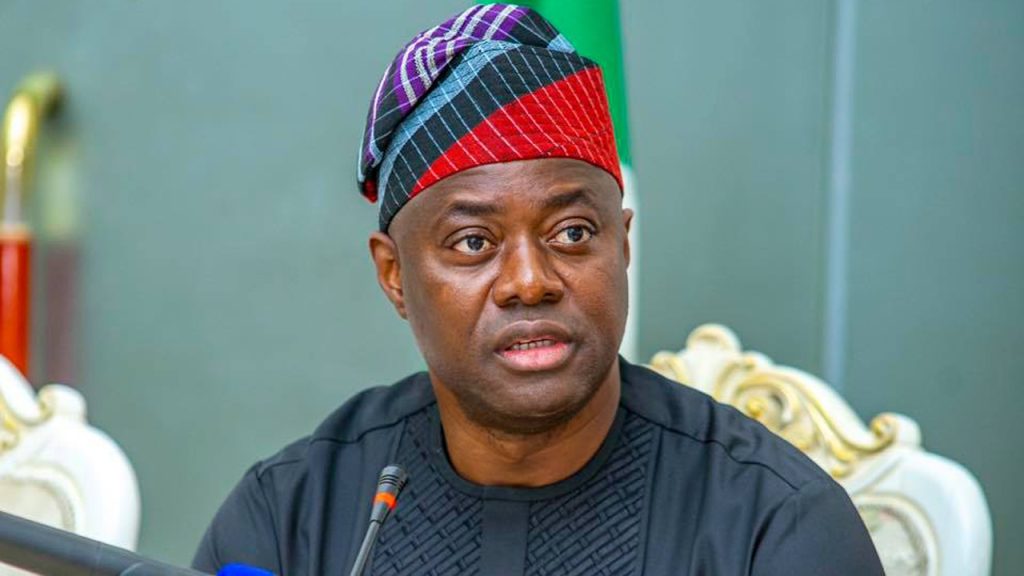
By Adeola Badru
For nearly 92 hours, the political heartbeat of Oyo State reportedly shifted from the corridors of government to the private residence of Governor Seyi Makinde, where a series of tense and strategic consultations unfolded behind closed doors.
By the time the deliberations ended on Thursday, insiders said, the direction of the 2027 governorship race had already begun to take shape.
Driving much of the political tension is one overriding question: who succeeds Governor Seyi Makinde?
The answer that eventually emerged, Abimbola Adekanmbi, has since stirred political conversations across Oyo State and beyond, particularly because his emergence reportedly came after the rejection of other influential contenders and after intense bargaining among stakeholders drawn from different political, religious and regional interests.
Sources familiar with the deliberations disclosed that what initially appeared to be a routine consultation among political leaders soon evolved into a carefully managed succession exercise, one in which Governor Makinde played a decisive and uncompromising role.
By the end of the marathon meetings, Adekanmbi, a Christian and relatively less controversial figure within the state’s political establishment, had reportedly secured the endorsement of the stakeholders present, edging out Saheed Fijabi, a Muslim politician many observers had initially considered one of the strongest contenders.
The development has not only exposed the deep calculations shaping the build-up to 2027, but has also revealed the complex web of loyalty, religion, regional identity, legal uncertainty and political survival now defining the politics of succession in Oyo State.
A Succession Battle Playing Out Amid PDP Crisis
Beyond the intrigue surrounding the choice of a preferred successor lies a deeper crisis threatening the political foundation upon which Governor Makinde hopes to build his succession plan.
The Peoples Democratic Party (PDP) in Oyo State has, in recent months, become entangled in a prolonged internal legal and political battle linked to the wider national struggle for control of the party.
At the centre of that crisis are two powerful blocs, one aligned with the Minister of the Federal Capital Territory, Nyesom Wike, and the other loyal to Governor Makinde, one of the leading voices within the anti-Wike coalition inside the PDP.
The rivalry has sharply divided the party at both national and state levels, with Oyo emerging as one of the key battlegrounds in the struggle for influence ahead of 2027.
The tension escalated significantly after the Supreme Court reportedly nullified the Oyo State elective congress conducted by the Makinde-led faction of the party, ruling that the executives produced through the exercise lacked legal standing.
The judgment effectively threw the party structure in the state into uncertainty and raised serious questions about the legitimacy of the PDP machinery currently loyal to the governor.
For many politicians eyeing elective offices in 2027, the development created a dangerous atmosphere of political unpredictability.
Without a legally secure party structure, several aspirants aligned with Makinde began quietly reconsidering their future within the PDP.
Some have reportedly initiated contacts with alternative political platforms, while others are said to be exploring strategic alliances that could protect their political aspirations should the PDP crisis worsen before the next electoral cycle.
Political analysts said the defections and behind-the-scenes negotiations are largely driven by a desire for political survival.
“The fear among many aspirants is simple. Nobody wants to invest years building structures under a platform whose legitimacy could still be challenged before the elections,” a senior political observer in Ibadan explained.
That anxiety has transformed the succession calculations around Makinde’s preferred candidate into something far more complicated than an ordinary governorship endorsement.
Makinde at a Political Crossroads
The legal crisis within the PDP has now placed Governor Makinde in one of the most delicate political situations of his career.
While he remained one of the most influential governors within the opposition party nationally, insiders maintained the uncertainty surrounding the PDP structure in Oyo has forced fresh strategic calculations within his camp.
There is growing speculation in political circles that the governor may eventually be compelled to decide whether his preferred successor will contest the 2027 election on the PDP platform or under another political party entirely.
Although no official decision has been announced, sources disclosed that quiet consultations are already taking place regarding alternative political options should the PDP’s internal crisis remain unresolved.
The possibility of a major political realignment has become one of the most discussed issues within Oyo political circles.
Some observers believed Makinde may attempt to retain control of the PDP structure through prolonged legal and political negotiations.
Others, however, argued that the governor could eventually support a broader coalition or even align with another platform capable of guaranteeing electoral stability for his camp.
Such a move, if it occurs, would dramatically reshape the political landscape not only in Oyo State but across the South-West.
The uncertainty also explained why loyalty has become such a central factor in the governor’s succession calculations.
Sources close to the consultations insisted Makinde is less interested in choosing merely a popular candidate and more focused on selecting someone capable of remaining politically dependable regardless of future party realignments.
In that context, the choice of Adekanmbi is increasingly being interpreted not simply as a succession endorsement but as part of a larger political survival strategy.
The Meeting That Changed the Conversation
According to multiple insiders, the consultations began quietly on Tuesday night at Makinde’s private residence in Ibadan.
Unlike previous political gatherings marked by fanfare and media attention, this meeting was conducted with unusual secrecy. Invitations were reportedly selective. Discussions were discreet. Phones were said to have been restricted during some sessions, underscoring the sensitivity of the talks.
Those invited included influential political stakeholders, party loyalists, strategists, senior government figures and trusted political associates with deep roots across the state’s power blocs.
Sources said the gathering was initially expected to review possible succession options and test the political temperature ahead of the 2027 elections.
Yet, from the outset, it became evident that Makinde was not prepared to leave the succession debate entirely in the hands of party stakeholders.
The first names reportedly presented for consideration by the stakeholders were Hon. Adedeji Olajide, popularly known as Odidiomo, and former Commissioner of Police, Fatai Owoseni.
Both men were believed to possess formidable credentials.
Olajide, a federal lawmaker with growing political influence, has built a reputation as a grassroots politician with substantial support among younger political actors and sections of the PDP structure.
Owoseni, on the other hand, entered the succession conversation with the profile of a technocrat and retired security expert whose experience in law enforcement had earned him admiration in certain elite circles.
However, insiders said Governor Makinde was unmoved.
Rather than endorse either recommendation, the governor reportedly introduced two fresh names into the conversation, Abimbola Adekanmbi and Saheed Fijabi.
That moment, sources maintained, the tone of the deliberations was altered entirely.
Why Makinde Rejected the Early Nominees
Political observers familiar with Oyo State politics stated the governor’s rejection of the initial nominees was neither impulsive nor unexpected.
For months, there had been subtle indications that Makinde was searching for a successor whose loyalty to him and to the state’s internal political structure would be unquestionable.
One source who attended the consultations said the governor repeatedly stressed the need for “someone loyal to Oyo State”.
That phrase, according to insiders, became the defining philosophy guiding the selection process.
In the case of Fatai Owoseni, sources claimed concerns were raised about his long years of professional service outside Oyo State, particularly in Lagos and Benue States.
Although his policing career was widely respected, some stakeholders reportedly argued that his political and institutional relationships outside Oyo could become a liability.
More significantly, insiders alleged that some within Makinde’s inner circle viewed Owoseni as being too close to powerful political interests in Lagos.
In the often suspicious world of South-West politics, where alliances and godfatherism remain potent forces, such perceptions may have proved damaging.
“There was anxiety about external influence The governor was looking beyond popularity. He wanted someone whose political loyalty would remain rooted in Oyo,” one source familiar with the meeting disclosed.
Similar concerns reportedly affected the chances of Adedeji Olajide.
Though regarded as politically astute and increasingly influential, Olajide was said to have been viewed by some within the governor’s camp as too closely aligned with figures in the ruling All Progressives Congress (APC) at the federal level.
Sources specifically pointed to his perceived relationship with the Chief of Staff to the President and some APC lawmakers.
In the eyes of Makinde’s loyalists, such relationships reportedly triggered fears that an Olajide governorship could eventually weaken the governor’s hold on the PDP structure in the state after leaving office.
For a governor nearing the end of his constitutionally permitted tenure, succession politics is rarely only about continuity. It is also about legacy, influence and political survival after office.
Makinde, insiders insisted, is acutely aware of this reality.
The Adekanmbi Calculation
The emergence of Abimbola Adekanmbi carried strategic political significance beyond the immediate succession debate.
Adekanmbi is not entirely new to the power dynamics of Oyo State politics. A former Commissioner for Finance under the late former Governor Abiola Ajimobi of the APC and the immediate predecessor of Governor Makinde, he is widely regarded as a technocrat with experience in governance and fiscal administration.
His role in the Ajimobi administration is particularly noteworthy given the historical rivalry between the APC and the PDP in Oyo State. Political observers stated Adekanmbi’s background potentially gave him an advantage among moderate political actors who value administrative competence over rigid partisan identity.
Insiders familiar with the succession talks said some stakeholders viewed him as a bridge between different political tendencies in the state, a figure capable of attracting support beyond the PDP while still remaining acceptable to Makinde’s inner political structure.
For Governor Makinde, whose administration has consistently projected itself as reform-oriented and performance-driven, Adekanmbi’s technocratic profile may have strengthened his appeal during the consultations.
One source close to the discussions described him as “a familiar face in governance but without the heavy political baggage that usually divides stakeholders”.
His emergence also reflected the increasingly fluid nature of Oyo politics, where political relevance is often shaped less by old party affiliations and more by strategic alliances, personal loyalty and perceived competence.
Though some critics may question the optics of a former APC commissioner emerging as the preferred choice within a PDP-led political structure, supporters argued that Makinde appeared more interested in administrative continuity and political stability than rigid party orthodoxy.
Fijabi’s Rising Influence
Saheed Fijabi’s inclusion among the final names considered during the consultations was equally significant.
A former member of the House of Representatives, where he served two terms, Fijabi had built substantial political visibility long before his recent association with the Makinde administration.
Like Adekanmbi, he also previously belonged to the APC before gradually developing closer ties with the PDP-led government in Oyo State.
His political profile rose considerably after Governor Makinde appointed him Chairman of the Oyo State @50 celebration committee, a major assignment that placed him at the centre of one of the state’s most prominent commemorative events.
The successful execution of the anniversary celebrations reportedly enhanced Fijabi’s standing within government circles and introduced him more prominently into the political calculations of the PDP administration.
Several observers believed the assignment served as a political test of competence and loyalty, both of which Fijabi was said to have demonstrated effectively.
Indeed, some insiders disclosed that his handling of the Oyo @50 activities significantly improved his acceptability among influential stakeholders who previously viewed him primarily through the lens of his APC background.
That growing influence partly explained why many political observers considered him a serious contender in the succession consultations before the momentum eventually shifted toward Adekanmbi.
For many within political circles, Fijabi’s emergence among the final two names was itself evidence of how far he had travelled politically within the Makinde administration.
How Consensus Formed Around Adekanmbi
Sources said that after prolonged consultations, the momentum gradually shifted toward Adekanmbi.
Interestingly, some Muslim stakeholders reportedly became among the earliest supporters of his candidacy despite the religious balancing considerations surrounding the succession debate.
Their support, insiders claimed, was driven less by religion and more by calculations around continuity, accessibility and trust within the existing political structure.
One insider described the consensus around Adekanmbi as “gradual but firm”.
“At some point, it became clear that the meeting was no longer about testing names. The momentum had shifted toward building agreement around one candidate,” the source said.
The consensus model itself is politically significant.
By encouraging stakeholders to rally around a preferred figure rather than allowing an open and potentially divisive contest to develop immediately, Makinde appeared determined to minimise internal fractures within whichever political structure eventually carries his succession project into 2027.
Whether that strategy succeeds remains uncertain.
The Owoseni Fallout
Perhaps the most immediate consequence of the consultations was the reported resignation of former police commissioner Fatai Owoseni from his appointment within the Makinde administration.
Sources described Owoseni as deeply dissatisfied with the outcome.
While no official statement directly linked his resignation to the succession talks, political insiders insist the timing was hardly coincidental.
His exit has intensified speculation that the consultations left behind bruised ambitions and unresolved grievances.
For some observers, the development also illustrates the risks inherent in succession politics.
Governors seeking to shape who succeeds them often attempt to balance competing ambitions while preserving party unity.
Yet the process can easily create resentment among allies who feel excluded after years of loyalty and service.
Owoseni’s supporters are believed to be particularly upset by suggestions that his ties outside Oyo counted against him.
Some see such arguments as unfair and politically convenient.
Others insist the governor’s camp was justified in prioritising local political rootedness over broader elite connections.
Whatever the interpretation, the episode has added another layer of tension to the evolving political landscape.
The APC Watching Closely
The opposition APC is unlikely to ignore these developments.
Although the PDP currently controls Oyo State, the APC remains deeply entrenched and politically experienced.
Indeed, some APC strategists may view the emerging tensions within the PDP as an opportunity.
Should discontent among excluded aspirants deepen, opposition forces could attempt to exploit divisions through defections, alliances or tactical partnerships ahead of 2027.
There is already growing speculation in political circles that some aggrieved figures may eventually reconsider their political future if they conclude that the succession process has been effectively predetermined.
That possibility could reshape the electoral equation significantly.
Oyo has historically demonstrated an unpredictable voting culture. Political dominance in the state has rarely been permanent, and voter sentiment can shift dramatically when internal party crises emerge.
For the APC, therefore, Makinde’s succession strategy presentef both a challenge and an opening.
Power, Legacy and the Battle Ahead
Ultimately, the unfolding succession drama in Oyo State reflected a deeper struggle over power, continuity and political inheritance.
For Governor Makinde, the challenge is not merely selecting a successor but preserving influence in a political environment where former governors often fade rapidly once out of office.
For aspirants such as Fijabi and Owoseni, the consultations illustrate the harsh realities of elite politics, where ambition can be stalled not necessarily by public rejection but by calculations made behind closed doors.
For the PDP, the challenge is even more profound, surviving an internal legitimacy crisis while simultaneously preparing for one of the most consequential governorship elections in the state’s recent history.
And hanging over everything is the unanswered question now dominating political conversations across Ibadan and beyond: under which platform will Makinde’s anointed candidate eventually contest?
Until that question is resolved, every alliance, endorsement and political consultation within Oyo State will continue to be viewed through the lens of uncertainty.
The coming months are likely to witness increased underground negotiations, strategic positioning, quiet defections and subtle coalition-building aimed at shaping the next political order in the state.
Publicly, many actors may continue to preach unity and loyalty.
Privately, however, the contest for 2027 has already begun in earnest.
The meetings at Makinde’s residence may never be fully documented in official records. Yet within Oyo’s political circles, they are already being spoken of as a defining moment, the point at which succession moved from speculation to active political engineering.
Whether the strategy ultimately secures Makinde’s desired legacy or triggers deeper political fractures remains to be seen.
But one thing appears increasingly certain: the road to the Oyo State governorship election of 2027 will not merely be a contest between parties.
It will be a battle over influence, identity, loyalty, legal legitimacy and the future direction of power in one of Nigeria’s most politically significant states.
The post 2027: Inside Makinde’s closed-door succession talks that produced Adekanmbi appeared first on Vanguard News.