Ebola: A virus that refuses to disappear
 SKAiF NewsNG SNN
By Chioma Obinna
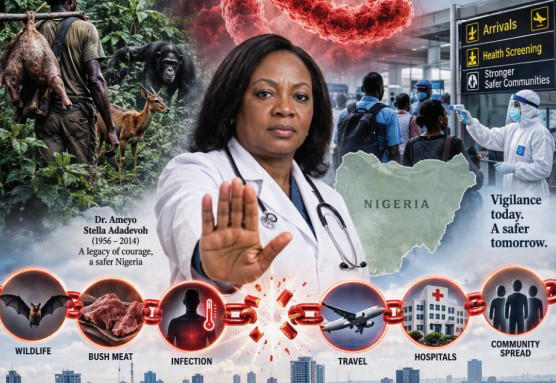
WHEN late Dr Ameyo Stella Adadevoh insisted that Patrick Sawyer be isolated at a Lagos hospital in July 2014, she was confronting a disease Nigeria had never experienced on that scale. Her decision to trust her clinical judgement, despite the pressure surrounding the patient, became a defining moment in the country’s fight against Ebola.
Adadevoh recognised the danger, alerted the authorities and helped trigger the response that eventually contained the outbreak.
She contracted the virus and died on August 19, 2014. Nigeria recorded 20 Ebola cases and eight deaths during the outbreak. The country was declared free of Ebola transmission by the World Health Organisation on October 20, 2014.
More than a decade later, Ebola continues to challenge public health systems. The reported confirmation on October 20, 2026, of an imported case of Bundibugyo virus disease in a woman who travelled from Uganda and was admitted to a private hospital in Abuja has brought the disease back into focus.
A threat that remains
Why does Ebola remain such a formidable threat despite advances in medicine, surveillance and outbreak response? The answer lies in the virus’s biology, limited treatment options for some species, exposure to infected wildlife, international travel and weaknesses in health systems. Fear, misinformation and distrust can further undermine efforts to control outbreaks.
Adadevoh’s story remains relevant because Ebola’s first encounter with a health system may not appear extraordinary. It may begin with a patient whose symptoms resemble those of a familiar illness and a doctor who must decide whether to look beyond the obvious.
The danger behind familiar symptoms
For Dr Rotimi Adesanya, a family physician and public health expert, Ebola is dangerous because it can rapidly overwhelm the body.
“Ebola Virus Disease is one of the most dangerous infectious diseases known to mankind because of its ability to overwhelm the body’s immune system and cause severe damage to multiple vital organs within a relatively short period,” he said.
Early symptoms include fever, headache, weakness, muscle and joint pain, sore throat and fatigue. More severe symptoms, including vomiting, diarrhoea and abdominal pain, may follow. These symptoms can resemble malaria, typhoid and other common infections, making a patient’s travel history and possible exposure important parts of clinical assessment.
Symptoms generally appear between two and 21 days after exposure.
According to the Nigeria Centre for Disease Control and Prevention (NCDC), Ebola spreads through direct contact with the blood or other bodily fluids of infected people or deceased patients, infected animals, or contaminated materials. Early identification, laboratory confirmation, isolation, contact tracing and strict infection prevention and control measures are essential to containing outbreaks.
Adesanya cautioned against the belief that every infected person must bleed visibly. “Contrary to popular belief, not every Ebola patient experiences bleeding. In fact, severe dehydration, shock and multiple organ failure are among the major causes of death.”
“Vomiting and diarrhoea can cause substantial fluid and electrolyte loss, resulting in dehydration, falling blood pressure and shock. The disease can also damage the liver, kidneys and other organs.”
Waiting for bleeding before suspecting
“Ebola can therefore be dangerous. Patients may need urgent medical intervention before advanced symptoms appear, while exposed individuals may need to be identified and monitored.
“Early diagnosis saves two lives. The life of the infected patient and potentially the lives of others who might otherwise become infected,” Adesanya said.
The lesson from Adadevoh’s experience is not that every fever should be treated as Ebola, but that clinicians must consider relevant exposure risks and promptly assess suspected cases through appropriate medical and public health channels.
Why Ebola outbreaks keep returning
Containing an outbreak does not mean the virus has been eradicated. Ebola is a zoonotic disease, meaning it can pass from animals to humans. As long as Ebola viruses continue circulating in their natural environment, further spillover into human populations remains possible.
According to Adesanya, certain fruit bats are considered likely natural reservoirs for some Ebola viruses, although their ecology and the precise pathways of transmission are not fully understood. Human infection may occur through contact with infected wildlife or their bodily fluids.
Once the virus enters the human population, it can spread through direct contact with the blood or other bodily fluids of infected people, including deceased patients, or through contaminated materials. In an interview with Vanguard, Adesanya identified several factors that make outbreaks difficult to prevent.
Surveillance systems may be weak in remote communities where healthcare and laboratory services are limited. Conflict and population displacement can disrupt health services, while poverty can prevent people from accessing treatment centres. Distrust of authorities may also discourage communities from reporting suspected cases or cooperating with public health teams.
Adesanya said Ebola viruses may persist in certain body fluids of survivors after recovery, occasionally resulting in renewed transmission. International travel and migration add another challenge because an infected person may cross national borders before the infection is detected.
“Therefore, Ebola cannot be controlled through hospital treatment alone. It requires a comprehensive One Health approach, integrating human health, animal health and environmental surveillance.
“The approach recognises that human health is connected to animal health and the environment. It requires public health officials to work with veterinary services, wildlife specialists and environmental agencies to identify risks before they become outbreaks.”
These factors explain why decades of research have not eliminated Ebola. Scientific advances have improved diagnosis, treatment and outbreak response, but they cannot prevent every opportunity for a virus circulating in wildlife to infect a human being.
Treatment remains a challenge
Ebola is not automatically a death sentence. Survival depends on the virus species, the patient’s condition and how quickly appropriate care begins. However, treatments developed for one Ebola virus species cannot automatically be assumed to work against another.
According to Adesanya, no approved virus-specific treatment or vaccine is currently available for Bundibugyo virus disease. Care therefore centres on supportive measures, including intravenous fluids, correction of electrolyte imbalances, oxygen therapy when indicated, blood pressure support, nutritional care and close monitoring of organ function.
For disease caused by the Zaire ebolavirus species, monoclonal antibody treatments such as Inmazeb and Ebanga, as well as the Ervebo vaccine for prevention, are available. These treatments and vaccines should not be assumed to be approved for Bundibugyo virus disease.
In one of its public health advisories on Bundibugyo virus disease, the NCDC also stated that no approved specific treatments or licensed vaccines were available for the disease, noting that existing Ebola vaccines and monoclonal antibody treatments were primarily directed against the Zaire ebolavirus species.
Beyond medicines: The challenge of delivering care
The challenge extends beyond medicines. Effective care requires functional treatment and isolation facilities, diagnostic laboratories, reliable supplies and trained healthcare workers. Healthcare workers must also have the protective equipment and safe working conditions needed to prevent infection.
Adadevoh’s death illustrates the consequences of an infection not being recognised promptly and the risks faced by frontline personnel. For Nigeria, scientific advances must go hand in hand with investment in treatment centres, laboratory capacity and emergency response personnel.
Medicines alone cannot defeat Ebola if patients cannot access appropriate care early enough.
The mystery before the first human infection
Even with improved diagnostic and treatment capabilities, Ebola can reach humans from wildlife before authorities know an outbreak has begun. Scientists suspect thatfruit bats in the Pteropodidae family are natural hosts of some Ebola viruses, although a natural reservoir has not been conclusively established for every species.
Chimpanzees, gorillas, monkeys and forest antelopes such as duikers can also become infected. Great apes and monkeys are particularly vulnerable and may die from the disease.
However, these animals should not all be described as natural reservoirs. Some are susceptible hosts that can become infected and expose people who handle their bodies.
Environmental changes can increase contact between people and wildlife. Deforestation, agricultural expansion and human encroachment into forest habitats may create more opportunities for pathogens to cross species barriers.
Preventing Ebola therefore requires more than responding after the first human infection. Authorities must also investigate the ecological conditions that bring people into contact with potentially infected animals.
The risks lurking in bush meat
Across parts of Africa, bush meat remains part of local diets and trading networks, while hunting and selling wild animals support some livelihoods. Public health responses must recognise these realities rather than portray affected communities as careless or uninformed. The danger is not limited to eating bush meat.
Exposure can occur while hunting, killing, transporting, skinning or butchering an infected animal. Blood, organs and other potentially infectious material may come into contact with broken skin or the eyes, nose or mouth. Eating raw or inadequately cooked meat from an infected animal may also pose a risk, while thorough cooking inactivates Ebola virus in food.
However, cooking cannot reverse exposure that has already occurred during hunting or butchering. Contaminated hands, tools and surfaces can also expose people to infectious material.
For communities that depend on wildlife for food and income, warnings alone may not be enough. Public health education must explain where risks arise and offer practical ways to reduce exposure without disregarding people’s livelihoods. Preventing spillover requires cooperation among public health authorities, veterinary services, wildlife experts, environmental agencies and communities living near wildlife habitats.
Wildlife surveillance, investigation of unusual animal deaths, stronger laboratory capacity and rapid information sharing could help authorities identify warning signs. Hunters, wildlife rangers, veterinarians and community health workers can also contribute by reporting unusual animal deaths through established channels.
The aim is to reduce exposure while giving communities realistic ways to protect their health and livelihoods.
How travel can carry
Ebola across borders Once Ebola enters the human population, preventing further transmission becomes the priority. “Transmission can occur through direct contact with the blood or other bodily fluids of an infected person who is ill or has died, or through contaminated materials. It does not spread through the air in the same way as measles,” Adesanya said.
International travel adds another layer of complexity because infected people may cross borders before their illness is recognised.
For Dr Ope Osunyomi, a public health expert and financial secretary of the Medical Guild, Nigeria must remain vigilant because infections can be imported from countries experiencing outbreaks.
The post Ebola: A virus that refuses to disappear appeared first on Vanguard News.